{"title":"混合蜂窝结构的增强策略:通过细胞比例和泡沫集成的几何修改来改善弯曲性能","authors":"Houssem Eddine Fiala, Khaled Teffah, Yazid Aitferhat, Nassim Aguechari, Tarek Bouakba","doi":"10.1007/s00339-025-08496-w","DOIUrl":null,"url":null,"abstract":"<div><p>This study investigates the mechanical performance of additively manufactured hybrid honeycomb structures, incorporating hexagonal and re-entrant geometries, fabricated from acrylonitrile butadiene styrene (ABS), widely employed thermoplastic material, under bending conditions. Through three-point bending experiments and finite element analysis (FEA), the energy absorption capacity and flexural modulus of these cellular architectures are evaluated. A comparative assessment is conducted between hollow hybrid structures and those reinforced with polyurethane (PU) foam to elucidate the effects of its integration on mechanical properties. The findings indicate that re-entrant hybrid honeycombs exhibit superior reinforcement characteristics compared to hexagonal honeycombs, attributable to their variable cell ratios and dimensions, which allow control over mechanical properties without altering cell geometry. This adaptability facilitates the manufacturing process by enabling the selection of the most straightforward geometry while varying only cell ratios. Additionally, parametric FEA studies explore the influence of structural parameters and bending load configurations on honeycomb performance, revealing that hybrid structures exhibit improved stiffness and energy absorption under three-point bending. Notably, the experimental results closely align with the FEA results, thereby enhancing the reliability of the computational models employed. This research underscores the potential of hybrid designs in the development of advanced lightweight, high-performance materials for diverse engineering applications.</p></div>","PeriodicalId":473,"journal":{"name":"Applied Physics A","volume":"131 5","pages":""},"PeriodicalIF":2.8000,"publicationDate":"2025-04-16","publicationTypes":"Journal Article","fieldsOfStudy":null,"isOpenAccess":false,"openAccessPdf":"","citationCount":"0","resultStr":"{\"title\":\"Enhanced strategies for hybrid honeycomb structures: improving bending properties through geometric modifications of cell ratios and foam integration\",\"authors\":\"Houssem Eddine Fiala, Khaled Teffah, Yazid Aitferhat, Nassim Aguechari, Tarek Bouakba\",\"doi\":\"10.1007/s00339-025-08496-w\",\"DOIUrl\":null,\"url\":null,\"abstract\":\"<div><p>This study investigates the mechanical performance of additively manufactured hybrid honeycomb structures, incorporating hexagonal and re-entrant geometries, fabricated from acrylonitrile butadiene styrene (ABS), widely employed thermoplastic material, under bending conditions. Through three-point bending experiments and finite element analysis (FEA), the energy absorption capacity and flexural modulus of these cellular architectures are evaluated. A comparative assessment is conducted between hollow hybrid structures and those reinforced with polyurethane (PU) foam to elucidate the effects of its integration on mechanical properties. The findings indicate that re-entrant hybrid honeycombs exhibit superior reinforcement characteristics compared to hexagonal honeycombs, attributable to their variable cell ratios and dimensions, which allow control over mechanical properties without altering cell geometry. This adaptability facilitates the manufacturing process by enabling the selection of the most straightforward geometry while varying only cell ratios. Additionally, parametric FEA studies explore the influence of structural parameters and bending load configurations on honeycomb performance, revealing that hybrid structures exhibit improved stiffness and energy absorption under three-point bending. Notably, the experimental results closely align with the FEA results, thereby enhancing the reliability of the computational models employed. This research underscores the potential of hybrid designs in the development of advanced lightweight, high-performance materials for diverse engineering applications.</p></div>\",\"PeriodicalId\":473,\"journal\":{\"name\":\"Applied Physics A\",\"volume\":\"131 5\",\"pages\":\"\"},\"PeriodicalIF\":2.8000,\"publicationDate\":\"2025-04-16\",\"publicationTypes\":\"Journal Article\",\"fieldsOfStudy\":null,\"isOpenAccess\":false,\"openAccessPdf\":\"\",\"citationCount\":\"0\",\"resultStr\":null,\"platform\":\"Semanticscholar\",\"paperid\":null,\"PeriodicalName\":\"Applied Physics A\",\"FirstCategoryId\":\"4\",\"ListUrlMain\":\"https://link.springer.com/article/10.1007/s00339-025-08496-w\",\"RegionNum\":4,\"RegionCategory\":\"材料科学\",\"ArticlePicture\":[],\"TitleCN\":null,\"AbstractTextCN\":null,\"PMCID\":null,\"EPubDate\":\"\",\"PubModel\":\"\",\"JCR\":\"Q3\",\"JCRName\":\"MATERIALS SCIENCE, MULTIDISCIPLINARY\",\"Score\":null,\"Total\":0}","platform":"Semanticscholar","paperid":null,"PeriodicalName":"Applied Physics A","FirstCategoryId":"4","ListUrlMain":"https://link.springer.com/article/10.1007/s00339-025-08496-w","RegionNum":4,"RegionCategory":"材料科学","ArticlePicture":[],"TitleCN":null,"AbstractTextCN":null,"PMCID":null,"EPubDate":"","PubModel":"","JCR":"Q3","JCRName":"MATERIALS SCIENCE, MULTIDISCIPLINARY","Score":null,"Total":0}
Enhanced strategies for hybrid honeycomb structures: improving bending properties through geometric modifications of cell ratios and foam integration
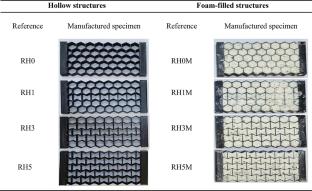
This study investigates the mechanical performance of additively manufactured hybrid honeycomb structures, incorporating hexagonal and re-entrant geometries, fabricated from acrylonitrile butadiene styrene (ABS), widely employed thermoplastic material, under bending conditions. Through three-point bending experiments and finite element analysis (FEA), the energy absorption capacity and flexural modulus of these cellular architectures are evaluated. A comparative assessment is conducted between hollow hybrid structures and those reinforced with polyurethane (PU) foam to elucidate the effects of its integration on mechanical properties. The findings indicate that re-entrant hybrid honeycombs exhibit superior reinforcement characteristics compared to hexagonal honeycombs, attributable to their variable cell ratios and dimensions, which allow control over mechanical properties without altering cell geometry. This adaptability facilitates the manufacturing process by enabling the selection of the most straightforward geometry while varying only cell ratios. Additionally, parametric FEA studies explore the influence of structural parameters and bending load configurations on honeycomb performance, revealing that hybrid structures exhibit improved stiffness and energy absorption under three-point bending. Notably, the experimental results closely align with the FEA results, thereby enhancing the reliability of the computational models employed. This research underscores the potential of hybrid designs in the development of advanced lightweight, high-performance materials for diverse engineering applications.
期刊介绍:
Applied Physics A publishes experimental and theoretical investigations in applied physics as regular articles, rapid communications, and invited papers. The distinguished 30-member Board of Editors reflects the interdisciplinary approach of the journal and ensures the highest quality of peer review.




 京公网安备 11010802042870号
京ICP备2023020795号-1
京公网安备 11010802042870号
京ICP备2023020795号-1

 分享
分享
 求助内容:
求助内容: 应助结果提醒方式:
 扫码关注我们
