{"title":"所有利用金剥离的干燥转移工艺用于预定形状的过渡金属二硫化物","authors":"Daiki Murase, Keisuke Shinokita, Yusai Wakafuji, Momoko Onodera, Tomoki Machida, Kenji Watanabe, Takashi Taniguchi, Jianfeng Bi, Zhou Zhou, Sihan Zhao, Kazunari Matsuda","doi":"10.1021/acs.langmuir.4c04629","DOIUrl":null,"url":null,"abstract":"Two-dimensional (2D) materials have attracted significant attention owing to their exceptional electrical and optical properties. The high-quality monolayer 2D materials are usually fabricated by mechanical exfoliation from bulk single crystals using a scotch tape method, limiting the flake size and production yield. Extensive efforts have been made to increase the production yield and size by using an Au-assisted process, such as the modified mechanical exfoliation method. However, the wet-etching processes are inevitable in the scalable Au-assisted mechanical exfoliation method, which causes defect formation and unintentional contamination, leading to a quality decrease in the monolayer 2D material flakes. Here, we developed a Au-assisted all dry transfer method without any wet process for fabricating 2D materials and their van der Waals (vdW) heterostructures. The developed dry transfer technique using patterned Au substrates and <i>h</i>-BN on polymer stamps gives us a large area and designed shape of monolayer 2D materials and their vdW heterostructures with clean interfaces. It will be beneficial for building high-quality vdW heterostructures, allowing us to explore and develop more potential applications in electrical and optical devices based on monolayer 2D materials.","PeriodicalId":50,"journal":{"name":"Langmuir","volume":"7 1","pages":""},"PeriodicalIF":3.9000,"publicationDate":"2025-04-15","publicationTypes":"Journal Article","fieldsOfStudy":null,"isOpenAccess":false,"openAccessPdf":"","citationCount":"0","resultStr":"{\"title\":\"All Dry Transfer Processes Utilizing Au Exfoliation for Predetermined Shapes of Transition Metal Dichalcogenide\",\"authors\":\"Daiki Murase, Keisuke Shinokita, Yusai Wakafuji, Momoko Onodera, Tomoki Machida, Kenji Watanabe, Takashi Taniguchi, Jianfeng Bi, Zhou Zhou, Sihan Zhao, Kazunari Matsuda\",\"doi\":\"10.1021/acs.langmuir.4c04629\",\"DOIUrl\":null,\"url\":null,\"abstract\":\"Two-dimensional (2D) materials have attracted significant attention owing to their exceptional electrical and optical properties. The high-quality monolayer 2D materials are usually fabricated by mechanical exfoliation from bulk single crystals using a scotch tape method, limiting the flake size and production yield. Extensive efforts have been made to increase the production yield and size by using an Au-assisted process, such as the modified mechanical exfoliation method. However, the wet-etching processes are inevitable in the scalable Au-assisted mechanical exfoliation method, which causes defect formation and unintentional contamination, leading to a quality decrease in the monolayer 2D material flakes. Here, we developed a Au-assisted all dry transfer method without any wet process for fabricating 2D materials and their van der Waals (vdW) heterostructures. The developed dry transfer technique using patterned Au substrates and <i>h</i>-BN on polymer stamps gives us a large area and designed shape of monolayer 2D materials and their vdW heterostructures with clean interfaces. It will be beneficial for building high-quality vdW heterostructures, allowing us to explore and develop more potential applications in electrical and optical devices based on monolayer 2D materials.\",\"PeriodicalId\":50,\"journal\":{\"name\":\"Langmuir\",\"volume\":\"7 1\",\"pages\":\"\"},\"PeriodicalIF\":3.9000,\"publicationDate\":\"2025-04-15\",\"publicationTypes\":\"Journal Article\",\"fieldsOfStudy\":null,\"isOpenAccess\":false,\"openAccessPdf\":\"\",\"citationCount\":\"0\",\"resultStr\":null,\"platform\":\"Semanticscholar\",\"paperid\":null,\"PeriodicalName\":\"Langmuir\",\"FirstCategoryId\":\"92\",\"ListUrlMain\":\"https://doi.org/10.1021/acs.langmuir.4c04629\",\"RegionNum\":2,\"RegionCategory\":\"化学\",\"ArticlePicture\":[],\"TitleCN\":null,\"AbstractTextCN\":null,\"PMCID\":null,\"EPubDate\":\"\",\"PubModel\":\"\",\"JCR\":\"Q2\",\"JCRName\":\"CHEMISTRY, MULTIDISCIPLINARY\",\"Score\":null,\"Total\":0}","platform":"Semanticscholar","paperid":null,"PeriodicalName":"Langmuir","FirstCategoryId":"92","ListUrlMain":"https://doi.org/10.1021/acs.langmuir.4c04629","RegionNum":2,"RegionCategory":"化学","ArticlePicture":[],"TitleCN":null,"AbstractTextCN":null,"PMCID":null,"EPubDate":"","PubModel":"","JCR":"Q2","JCRName":"CHEMISTRY, MULTIDISCIPLINARY","Score":null,"Total":0}
All Dry Transfer Processes Utilizing Au Exfoliation for Predetermined Shapes of Transition Metal Dichalcogenide
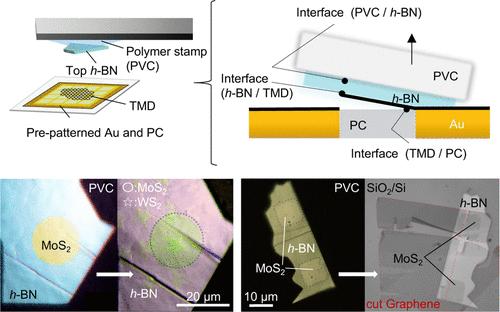
Two-dimensional (2D) materials have attracted significant attention owing to their exceptional electrical and optical properties. The high-quality monolayer 2D materials are usually fabricated by mechanical exfoliation from bulk single crystals using a scotch tape method, limiting the flake size and production yield. Extensive efforts have been made to increase the production yield and size by using an Au-assisted process, such as the modified mechanical exfoliation method. However, the wet-etching processes are inevitable in the scalable Au-assisted mechanical exfoliation method, which causes defect formation and unintentional contamination, leading to a quality decrease in the monolayer 2D material flakes. Here, we developed a Au-assisted all dry transfer method without any wet process for fabricating 2D materials and their van der Waals (vdW) heterostructures. The developed dry transfer technique using patterned Au substrates and h-BN on polymer stamps gives us a large area and designed shape of monolayer 2D materials and their vdW heterostructures with clean interfaces. It will be beneficial for building high-quality vdW heterostructures, allowing us to explore and develop more potential applications in electrical and optical devices based on monolayer 2D materials.
期刊介绍:
Langmuir is an interdisciplinary journal publishing articles in the following subject categories:
Colloids: surfactants and self-assembly, dispersions, emulsions, foams
Interfaces: adsorption, reactions, films, forces
Biological Interfaces: biocolloids, biomolecular and biomimetic materials
Materials: nano- and mesostructured materials, polymers, gels, liquid crystals
Electrochemistry: interfacial charge transfer, charge transport, electrocatalysis, electrokinetic phenomena, bioelectrochemistry
Devices and Applications: sensors, fluidics, patterning, catalysis, photonic crystals
However, when high-impact, original work is submitted that does not fit within the above categories, decisions to accept or decline such papers will be based on one criteria: What Would Irving Do?
Langmuir ranks #2 in citations out of 136 journals in the category of Physical Chemistry with 113,157 total citations. The journal received an Impact Factor of 4.384*.
This journal is also indexed in the categories of Materials Science (ranked #1) and Multidisciplinary Chemistry (ranked #5).




 京公网安备 11010802042870号
京ICP备2023020795号-1
京公网安备 11010802042870号
京ICP备2023020795号-1

 分享
分享
 求助内容:
求助内容: 应助结果提醒方式:
 扫码关注我们
