Xiao-Jun Wu, Hong-Yao Guo, Wei-Quan Lin, Yan Meng and Ji-Dong Leng
{"title":"基于双齿氧化膦配体的六配位镧系配合物:合成、结构和磁性能","authors":"Xiao-Jun Wu, Hong-Yao Guo, Wei-Quan Lin, Yan Meng and Ji-Dong Leng","doi":"10.1039/D5DT00422E","DOIUrl":null,"url":null,"abstract":"<p >Three six-coordinate mononuclear lanthanide complexes of the formula [Ln{(O = PPh<small><sub>2</sub></small>)<small><sub>2</sub></small>CH<small><sub>2</sub></small>}<small><sub>2</sub></small>Cl<small><sub>2</sub></small>]Cl·THF based on the Kramers ions Dy<small><sup>3+</sup></small> (<strong>1</strong>), Er<small><sup>3+</sup></small> (<strong>2</strong>) and Yb<small><sup>3+</sup></small> (<strong>3</strong>) have been synthesized and structurally characterized. Single-crystal X-ray diffraction reveals that these complexes adopt an octahedral geometry with <em>cis</em>-arranged chloride ligands and four oxygen atoms from two bidentate phosphine oxide ligands. The octahedral coordination sphere generates a crystal field environment conducive to field-induced slow magnetic relaxation for lanthanide ions with both oblate (Dy<small><sup>3+</sup></small>) and prolate (Er<small><sup>3+</sup></small>, Yb<small><sup>3+</sup></small>) electron density distributions. Under optimized direct-current fields, complexes <strong>1Dy</strong> and <strong>2Er</strong> show Orbach relaxation processes with effective energy barriers of 28.0(5) and 16.2(5) cm<small><sup>−1</sup></small>, respectively. In contrast, complex <strong>3Yb</strong> exhibits more complex relaxation dynamics involving a combination of quantum tunnelling, direct, and Raman processes. <em>Ab initio</em> calculations demonstrate that complexes <strong>1Dy</strong> and <strong>2Er</strong> undergo magnetic relaxation through their first excited Kramers doublets, while the higher-lying first excited state in complex <strong>3Yb</strong> (177 cm<small><sup>−1</sup></small>) prevents thermal relaxation <em>via</em> this pathway.</p>","PeriodicalId":71,"journal":{"name":"Dalton Transactions","volume":" 19","pages":" 7819-7827"},"PeriodicalIF":3.3000,"publicationDate":"2025-04-16","publicationTypes":"Journal Article","fieldsOfStudy":null,"isOpenAccess":false,"openAccessPdf":"","citationCount":"0","resultStr":"{\"title\":\"Six-coordinate lanthanide complexes based on bidentate phosphine oxide ligands: synthesis, structure and magnetic properties†\",\"authors\":\"Xiao-Jun Wu, Hong-Yao Guo, Wei-Quan Lin, Yan Meng and Ji-Dong Leng\",\"doi\":\"10.1039/D5DT00422E\",\"DOIUrl\":null,\"url\":null,\"abstract\":\"<p >Three six-coordinate mononuclear lanthanide complexes of the formula [Ln{(O = PPh<small><sub>2</sub></small>)<small><sub>2</sub></small>CH<small><sub>2</sub></small>}<small><sub>2</sub></small>Cl<small><sub>2</sub></small>]Cl·THF based on the Kramers ions Dy<small><sup>3+</sup></small> (<strong>1</strong>), Er<small><sup>3+</sup></small> (<strong>2</strong>) and Yb<small><sup>3+</sup></small> (<strong>3</strong>) have been synthesized and structurally characterized. Single-crystal X-ray diffraction reveals that these complexes adopt an octahedral geometry with <em>cis</em>-arranged chloride ligands and four oxygen atoms from two bidentate phosphine oxide ligands. The octahedral coordination sphere generates a crystal field environment conducive to field-induced slow magnetic relaxation for lanthanide ions with both oblate (Dy<small><sup>3+</sup></small>) and prolate (Er<small><sup>3+</sup></small>, Yb<small><sup>3+</sup></small>) electron density distributions. Under optimized direct-current fields, complexes <strong>1Dy</strong> and <strong>2Er</strong> show Orbach relaxation processes with effective energy barriers of 28.0(5) and 16.2(5) cm<small><sup>−1</sup></small>, respectively. In contrast, complex <strong>3Yb</strong> exhibits more complex relaxation dynamics involving a combination of quantum tunnelling, direct, and Raman processes. <em>Ab initio</em> calculations demonstrate that complexes <strong>1Dy</strong> and <strong>2Er</strong> undergo magnetic relaxation through their first excited Kramers doublets, while the higher-lying first excited state in complex <strong>3Yb</strong> (177 cm<small><sup>−1</sup></small>) prevents thermal relaxation <em>via</em> this pathway.</p>\",\"PeriodicalId\":71,\"journal\":{\"name\":\"Dalton Transactions\",\"volume\":\" 19\",\"pages\":\" 7819-7827\"},\"PeriodicalIF\":3.3000,\"publicationDate\":\"2025-04-16\",\"publicationTypes\":\"Journal Article\",\"fieldsOfStudy\":null,\"isOpenAccess\":false,\"openAccessPdf\":\"\",\"citationCount\":\"0\",\"resultStr\":null,\"platform\":\"Semanticscholar\",\"paperid\":null,\"PeriodicalName\":\"Dalton Transactions\",\"FirstCategoryId\":\"92\",\"ListUrlMain\":\"https://pubs.rsc.org/en/content/articlelanding/2025/dt/d5dt00422e\",\"RegionNum\":3,\"RegionCategory\":\"化学\",\"ArticlePicture\":[],\"TitleCN\":null,\"AbstractTextCN\":null,\"PMCID\":null,\"EPubDate\":\"\",\"PubModel\":\"\",\"JCR\":\"Q2\",\"JCRName\":\"CHEMISTRY, INORGANIC & NUCLEAR\",\"Score\":null,\"Total\":0}","platform":"Semanticscholar","paperid":null,"PeriodicalName":"Dalton Transactions","FirstCategoryId":"92","ListUrlMain":"https://pubs.rsc.org/en/content/articlelanding/2025/dt/d5dt00422e","RegionNum":3,"RegionCategory":"化学","ArticlePicture":[],"TitleCN":null,"AbstractTextCN":null,"PMCID":null,"EPubDate":"","PubModel":"","JCR":"Q2","JCRName":"CHEMISTRY, INORGANIC & NUCLEAR","Score":null,"Total":0}
Six-coordinate lanthanide complexes based on bidentate phosphine oxide ligands: synthesis, structure and magnetic properties†
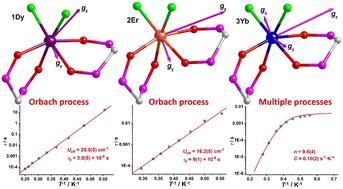
Three six-coordinate mononuclear lanthanide complexes of the formula [Ln{(O = PPh2)2CH2}2Cl2]Cl·THF based on the Kramers ions Dy3+ (1), Er3+ (2) and Yb3+ (3) have been synthesized and structurally characterized. Single-crystal X-ray diffraction reveals that these complexes adopt an octahedral geometry with cis-arranged chloride ligands and four oxygen atoms from two bidentate phosphine oxide ligands. The octahedral coordination sphere generates a crystal field environment conducive to field-induced slow magnetic relaxation for lanthanide ions with both oblate (Dy3+) and prolate (Er3+, Yb3+) electron density distributions. Under optimized direct-current fields, complexes 1Dy and 2Er show Orbach relaxation processes with effective energy barriers of 28.0(5) and 16.2(5) cm−1, respectively. In contrast, complex 3Yb exhibits more complex relaxation dynamics involving a combination of quantum tunnelling, direct, and Raman processes. Ab initio calculations demonstrate that complexes 1Dy and 2Er undergo magnetic relaxation through their first excited Kramers doublets, while the higher-lying first excited state in complex 3Yb (177 cm−1) prevents thermal relaxation via this pathway.
期刊介绍:
Dalton Transactions is a journal for all areas of inorganic chemistry, which encompasses the organometallic, bioinorganic and materials chemistry of the elements, with applications including synthesis, catalysis, energy conversion/storage, electrical devices and medicine. Dalton Transactions welcomes high-quality, original submissions in all of these areas and more, where the advancement of knowledge in inorganic chemistry is significant.




 京公网安备 11010802042870号
京ICP备2023020795号-1
京公网安备 11010802042870号
京ICP备2023020795号-1

 分享
分享
 求助内容:
求助内容: 应助结果提醒方式:
 扫码关注我们
