Truong Xuan Vuong, Duc Phuong Nguyen, Vu Huyen Ngoc Nguyen, Thi Thu Ha Pham and Thi Thu Thuy Nguyen
{"title":"芋头茎源生物炭和磷灰石改进剂对污染土壤中铅和锌的固定化作用:施用量和热解温度的比较研究","authors":"Truong Xuan Vuong, Duc Phuong Nguyen, Vu Huyen Ngoc Nguyen, Thi Thu Ha Pham and Thi Thu Thuy Nguyen","doi":"10.1039/D5RA00912J","DOIUrl":null,"url":null,"abstract":"<p >Soil contamination by heavy metals presents a substantial environmental challenge. Remediation strategies employing biochar and apatite offer promise for restoring compromised sites. However, the efficacy of apatite and biochar derived from various biomass sources remains an under-investigated area. Taro stem-derived biochar produced at 300 and 500 °C (TSB300 and TSB500) and apatite amendments were incubated in contaminated soil for one month at various ratios (biochar 3%, 6%, 10%, mixture of biochar/apatite 3 : 3%, and 6 : 6% w/w) to investigate their potential to immobilize Pb and Zn. The initial concentrations of Pb and Zn in the contaminated soil were 4165.1 ± 19.6 mg kg<small><sup>−1</sup></small> and 3424.9 ± 20.4 mg kg<small><sup>−1</sup></small>, respectively. Soil samples were subjected to Tessier's sequential extraction for analysis of Pb and Zn in five chemical fractions (F1: exchangeable fraction; F2: carbonate fraction; F3: Fe/Mn oxide fraction; F4: organic carbon fraction and F5: residual fraction). The results indicated that one-month biochar and/or apatite amendment significantly increased soil pH, organic carbon (OC), and electrical conductivity (EC) compared to the control (<em>p</em> < 0.05). Amendments also notably reduced exchangeable fractions of Pb and Zn (F1) up to 71.8% and 61.5%, respectively, while enhancing their presence in more stable fractions (F4 and F5). This immobilization effect peaked at the 10% biochar application and 6 : 6% biochar–apatite combination. These findings suggest that TSB300, TSB500, and their blends with apatite hold promise for immobilizing Pb and Zn in heavily contaminated soil, potentially mitigating environmental risks.</p>","PeriodicalId":102,"journal":{"name":"RSC Advances","volume":" 15","pages":" 11975-12000"},"PeriodicalIF":4.6000,"publicationDate":"2025-04-16","publicationTypes":"Journal Article","fieldsOfStudy":null,"isOpenAccess":false,"openAccessPdf":"https://pubs.rsc.org/en/content/articlepdf/2025/ra/d5ra00912j?page=search","citationCount":"0","resultStr":"{\"title\":\"Immobilization of lead and zinc in contaminated soil using taro stem-derived biochar and apatite amendments: a comparative study of application ratios and pyrolysis temperatures†\",\"authors\":\"Truong Xuan Vuong, Duc Phuong Nguyen, Vu Huyen Ngoc Nguyen, Thi Thu Ha Pham and Thi Thu Thuy Nguyen\",\"doi\":\"10.1039/D5RA00912J\",\"DOIUrl\":null,\"url\":null,\"abstract\":\"<p >Soil contamination by heavy metals presents a substantial environmental challenge. Remediation strategies employing biochar and apatite offer promise for restoring compromised sites. However, the efficacy of apatite and biochar derived from various biomass sources remains an under-investigated area. Taro stem-derived biochar produced at 300 and 500 °C (TSB300 and TSB500) and apatite amendments were incubated in contaminated soil for one month at various ratios (biochar 3%, 6%, 10%, mixture of biochar/apatite 3 : 3%, and 6 : 6% w/w) to investigate their potential to immobilize Pb and Zn. The initial concentrations of Pb and Zn in the contaminated soil were 4165.1 ± 19.6 mg kg<small><sup>−1</sup></small> and 3424.9 ± 20.4 mg kg<small><sup>−1</sup></small>, respectively. Soil samples were subjected to Tessier's sequential extraction for analysis of Pb and Zn in five chemical fractions (F1: exchangeable fraction; F2: carbonate fraction; F3: Fe/Mn oxide fraction; F4: organic carbon fraction and F5: residual fraction). The results indicated that one-month biochar and/or apatite amendment significantly increased soil pH, organic carbon (OC), and electrical conductivity (EC) compared to the control (<em>p</em> < 0.05). Amendments also notably reduced exchangeable fractions of Pb and Zn (F1) up to 71.8% and 61.5%, respectively, while enhancing their presence in more stable fractions (F4 and F5). This immobilization effect peaked at the 10% biochar application and 6 : 6% biochar–apatite combination. These findings suggest that TSB300, TSB500, and their blends with apatite hold promise for immobilizing Pb and Zn in heavily contaminated soil, potentially mitigating environmental risks.</p>\",\"PeriodicalId\":102,\"journal\":{\"name\":\"RSC Advances\",\"volume\":\" 15\",\"pages\":\" 11975-12000\"},\"PeriodicalIF\":4.6000,\"publicationDate\":\"2025-04-16\",\"publicationTypes\":\"Journal Article\",\"fieldsOfStudy\":null,\"isOpenAccess\":false,\"openAccessPdf\":\"https://pubs.rsc.org/en/content/articlepdf/2025/ra/d5ra00912j?page=search\",\"citationCount\":\"0\",\"resultStr\":null,\"platform\":\"Semanticscholar\",\"paperid\":null,\"PeriodicalName\":\"RSC Advances\",\"FirstCategoryId\":\"92\",\"ListUrlMain\":\"https://pubs.rsc.org/en/content/articlelanding/2025/ra/d5ra00912j\",\"RegionNum\":3,\"RegionCategory\":\"化学\",\"ArticlePicture\":[],\"TitleCN\":null,\"AbstractTextCN\":null,\"PMCID\":null,\"EPubDate\":\"\",\"PubModel\":\"\",\"JCR\":\"Q2\",\"JCRName\":\"CHEMISTRY, MULTIDISCIPLINARY\",\"Score\":null,\"Total\":0}","platform":"Semanticscholar","paperid":null,"PeriodicalName":"RSC Advances","FirstCategoryId":"92","ListUrlMain":"https://pubs.rsc.org/en/content/articlelanding/2025/ra/d5ra00912j","RegionNum":3,"RegionCategory":"化学","ArticlePicture":[],"TitleCN":null,"AbstractTextCN":null,"PMCID":null,"EPubDate":"","PubModel":"","JCR":"Q2","JCRName":"CHEMISTRY, MULTIDISCIPLINARY","Score":null,"Total":0}
引用次数: 0
摘要
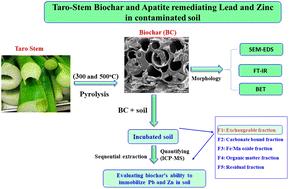
土壤重金属污染是一项重大的环境挑战。采用生物炭和磷灰石的补救策略为恢复受损场地提供了希望。然而,来自各种生物质来源的磷灰石和生物炭的功效仍然是一个未充分研究的领域。在300°C和500°C下生产的芋头茎源生物炭(TSB300和TSB500)和磷灰石添加剂在污染土壤中以不同比例(生物炭3%,6%,10%,生物炭/磷灰石混合物3:3 %和6:6% w/w)孵育一个月,以研究它们固定Pb和Zn的潜力。污染土壤中Pb和Zn的初始浓度分别为4165.1±19.6 mg kg - 1和3424.9±20.4 mg kg - 1。采用Tessier序贯萃取法对土壤样品进行5个化学组分(F1:交换组分;F2:碳酸盐馏分;F3: Fe/Mn氧化物分数;F4:有机碳分数,F5:残余分数)。结果表明,与对照相比,1个月的生物炭和/或磷灰石处理显著提高了土壤pH、有机碳(OC)和电导率(EC)。0.05)。修正还显著降低了Pb和Zn (F1)的交换性组分(分别为71.8%和61.5%),而增加了它们在更稳定组分(F4和F5)中的存在。这种固定效果在10%的生物炭应用和6.6%的生物炭-磷灰石组合时达到顶峰。这些发现表明,TSB300、TSB500及其与磷灰石的混合物有望在重污染土壤中固定铅和锌,潜在地减轻环境风险。
Immobilization of lead and zinc in contaminated soil using taro stem-derived biochar and apatite amendments: a comparative study of application ratios and pyrolysis temperatures†
Soil contamination by heavy metals presents a substantial environmental challenge. Remediation strategies employing biochar and apatite offer promise for restoring compromised sites. However, the efficacy of apatite and biochar derived from various biomass sources remains an under-investigated area. Taro stem-derived biochar produced at 300 and 500 °C (TSB300 and TSB500) and apatite amendments were incubated in contaminated soil for one month at various ratios (biochar 3%, 6%, 10%, mixture of biochar/apatite 3 : 3%, and 6 : 6% w/w) to investigate their potential to immobilize Pb and Zn. The initial concentrations of Pb and Zn in the contaminated soil were 4165.1 ± 19.6 mg kg−1 and 3424.9 ± 20.4 mg kg−1, respectively. Soil samples were subjected to Tessier's sequential extraction for analysis of Pb and Zn in five chemical fractions (F1: exchangeable fraction; F2: carbonate fraction; F3: Fe/Mn oxide fraction; F4: organic carbon fraction and F5: residual fraction). The results indicated that one-month biochar and/or apatite amendment significantly increased soil pH, organic carbon (OC), and electrical conductivity (EC) compared to the control (p < 0.05). Amendments also notably reduced exchangeable fractions of Pb and Zn (F1) up to 71.8% and 61.5%, respectively, while enhancing their presence in more stable fractions (F4 and F5). This immobilization effect peaked at the 10% biochar application and 6 : 6% biochar–apatite combination. These findings suggest that TSB300, TSB500, and their blends with apatite hold promise for immobilizing Pb and Zn in heavily contaminated soil, potentially mitigating environmental risks.
期刊介绍:
An international, peer-reviewed journal covering all of the chemical sciences, including multidisciplinary and emerging areas. RSC Advances is a gold open access journal allowing researchers free access to research articles, and offering an affordable open access publishing option for authors around the world.




 京公网安备 11010802042870号
京ICP备2023020795号-1
京公网安备 11010802042870号
京ICP备2023020795号-1

 分享
分享
 求助内容:
求助内容: 应助结果提醒方式:
 扫码关注我们
