{"title":"氮掺杂碳包覆多孔TiO2微球作为锂离子电池负极材料的电化学性能研究","authors":"Shimei Guo, Yue Wang, Shubiao Xia, Hanwei Li, Siyuan Zuo and Wangqiong Xu","doi":"10.1039/D5RA01379H","DOIUrl":null,"url":null,"abstract":"<p >TiO<small><sub>2</sub></small> has a robust structure and low cost and is non-toxic. However, its low electronic conductivity and lithium-ion diffusivity impede its practical application in LIBs. To improve the conductivity and lithium-ion dynamics of titanium dioxide (TiO<small><sub>2</sub></small>), we synthesized porous TiO<small><sub>2</sub></small> microspheres coated with nitrogen-doped carbon (TiO<small><sub>2</sub></small>@C–N) through a solvothermal method combined with pyrolysis and carbonization technology. The nitrogen-doped carbon coating was prepared using a one-pot sealed carbonization method with pyrrole as the source of carbon and nitrogen. The porous TiO<small><sub>2</sub></small> matrix in the TiO<small><sub>2</sub></small>@C–N composites provided numerous open transport pathways and storage sites for Li ions, while the nitrogen-doped carbon coating promoted the movement of electrons, leading to enhanced electrical conductivity. Undergoing 5000 cycles at 2 A g<small><sup>−1</sup></small>, the TiO<small><sub>2</sub></small>@C–N electrode delivered a cycling capacity of 71.8 mA h g<small><sup>−1</sup></small>, while the capacity of commercial graphite decayed rapidly after 3300 cycles. Rate tests of both samples under the same conditions demonstrated that the TiO<small><sub>2</sub></small>@C–N electrode was more suitable for fast charging/discharging than the graphite anode. Therefore, the TiO<small><sub>2</sub></small>@C–N composites are expected to be an alternative to commercial graphite anodes based on their electrochemical performance.</p>","PeriodicalId":102,"journal":{"name":"RSC Advances","volume":" 15","pages":" 11790-11798"},"PeriodicalIF":4.6000,"publicationDate":"2025-04-17","publicationTypes":"Journal Article","fieldsOfStudy":null,"isOpenAccess":false,"openAccessPdf":"https://pubs.rsc.org/en/content/articlepdf/2025/ra/d5ra01379h?page=search","citationCount":"0","resultStr":"{\"title\":\"Electrochemical performance of porous TiO2 microspheres coated with nitrogen-doped carbon as an anode material for lithium-ion batteries†\",\"authors\":\"Shimei Guo, Yue Wang, Shubiao Xia, Hanwei Li, Siyuan Zuo and Wangqiong Xu\",\"doi\":\"10.1039/D5RA01379H\",\"DOIUrl\":null,\"url\":null,\"abstract\":\"<p >TiO<small><sub>2</sub></small> has a robust structure and low cost and is non-toxic. However, its low electronic conductivity and lithium-ion diffusivity impede its practical application in LIBs. To improve the conductivity and lithium-ion dynamics of titanium dioxide (TiO<small><sub>2</sub></small>), we synthesized porous TiO<small><sub>2</sub></small> microspheres coated with nitrogen-doped carbon (TiO<small><sub>2</sub></small>@C–N) through a solvothermal method combined with pyrolysis and carbonization technology. The nitrogen-doped carbon coating was prepared using a one-pot sealed carbonization method with pyrrole as the source of carbon and nitrogen. The porous TiO<small><sub>2</sub></small> matrix in the TiO<small><sub>2</sub></small>@C–N composites provided numerous open transport pathways and storage sites for Li ions, while the nitrogen-doped carbon coating promoted the movement of electrons, leading to enhanced electrical conductivity. Undergoing 5000 cycles at 2 A g<small><sup>−1</sup></small>, the TiO<small><sub>2</sub></small>@C–N electrode delivered a cycling capacity of 71.8 mA h g<small><sup>−1</sup></small>, while the capacity of commercial graphite decayed rapidly after 3300 cycles. Rate tests of both samples under the same conditions demonstrated that the TiO<small><sub>2</sub></small>@C–N electrode was more suitable for fast charging/discharging than the graphite anode. Therefore, the TiO<small><sub>2</sub></small>@C–N composites are expected to be an alternative to commercial graphite anodes based on their electrochemical performance.</p>\",\"PeriodicalId\":102,\"journal\":{\"name\":\"RSC Advances\",\"volume\":\" 15\",\"pages\":\" 11790-11798\"},\"PeriodicalIF\":4.6000,\"publicationDate\":\"2025-04-17\",\"publicationTypes\":\"Journal Article\",\"fieldsOfStudy\":null,\"isOpenAccess\":false,\"openAccessPdf\":\"https://pubs.rsc.org/en/content/articlepdf/2025/ra/d5ra01379h?page=search\",\"citationCount\":\"0\",\"resultStr\":null,\"platform\":\"Semanticscholar\",\"paperid\":null,\"PeriodicalName\":\"RSC Advances\",\"FirstCategoryId\":\"92\",\"ListUrlMain\":\"https://pubs.rsc.org/en/content/articlelanding/2025/ra/d5ra01379h\",\"RegionNum\":3,\"RegionCategory\":\"化学\",\"ArticlePicture\":[],\"TitleCN\":null,\"AbstractTextCN\":null,\"PMCID\":null,\"EPubDate\":\"\",\"PubModel\":\"\",\"JCR\":\"Q2\",\"JCRName\":\"CHEMISTRY, MULTIDISCIPLINARY\",\"Score\":null,\"Total\":0}","platform":"Semanticscholar","paperid":null,"PeriodicalName":"RSC Advances","FirstCategoryId":"92","ListUrlMain":"https://pubs.rsc.org/en/content/articlelanding/2025/ra/d5ra01379h","RegionNum":3,"RegionCategory":"化学","ArticlePicture":[],"TitleCN":null,"AbstractTextCN":null,"PMCID":null,"EPubDate":"","PubModel":"","JCR":"Q2","JCRName":"CHEMISTRY, MULTIDISCIPLINARY","Score":null,"Total":0}
引用次数: 0
摘要
TiO2结构坚固,成本低,无毒。然而,它的低电子导电性和锂离子扩散率阻碍了它在锂离子电池中的实际应用。为了提高二氧化钛(TiO2)的电导率和锂离子动力学性能,我们采用溶剂热法结合热解和碳化技术合成了掺杂氮碳(TiO2@C -N)包覆的多孔TiO2微球。以吡咯为碳源和氮源,采用一锅密封炭化法制备了氮掺杂碳涂层。TiO2@C -N复合材料中的多孔TiO2基质为Li离子提供了许多开放的传输途径和存储位点,而氮掺杂碳涂层促进了电子的运动,从而提高了导电性。在2 A g−1下循环5000次,TiO2@C -N电极的循环容量为71.8 mA h g−1,而商用石墨在3300次循环后容量迅速衰减。两种样品在相同条件下的速率测试表明,TiO2@C -N电极比石墨阳极更适合快速充放电。因此,TiO2@C -N复合材料有望成为基于其电化学性能的商用石墨阳极的替代品。
Electrochemical performance of porous TiO2 microspheres coated with nitrogen-doped carbon as an anode material for lithium-ion batteries†
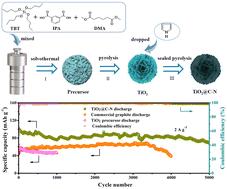
TiO2 has a robust structure and low cost and is non-toxic. However, its low electronic conductivity and lithium-ion diffusivity impede its practical application in LIBs. To improve the conductivity and lithium-ion dynamics of titanium dioxide (TiO2), we synthesized porous TiO2 microspheres coated with nitrogen-doped carbon (TiO2@C–N) through a solvothermal method combined with pyrolysis and carbonization technology. The nitrogen-doped carbon coating was prepared using a one-pot sealed carbonization method with pyrrole as the source of carbon and nitrogen. The porous TiO2 matrix in the TiO2@C–N composites provided numerous open transport pathways and storage sites for Li ions, while the nitrogen-doped carbon coating promoted the movement of electrons, leading to enhanced electrical conductivity. Undergoing 5000 cycles at 2 A g−1, the TiO2@C–N electrode delivered a cycling capacity of 71.8 mA h g−1, while the capacity of commercial graphite decayed rapidly after 3300 cycles. Rate tests of both samples under the same conditions demonstrated that the TiO2@C–N electrode was more suitable for fast charging/discharging than the graphite anode. Therefore, the TiO2@C–N composites are expected to be an alternative to commercial graphite anodes based on their electrochemical performance.
期刊介绍:
An international, peer-reviewed journal covering all of the chemical sciences, including multidisciplinary and emerging areas. RSC Advances is a gold open access journal allowing researchers free access to research articles, and offering an affordable open access publishing option for authors around the world.





 京公网安备 11010802042870号
京ICP备2023020795号-1
京公网安备 11010802042870号
京ICP备2023020795号-1

 分享
分享
 求助内容:
求助内容: 应助结果提醒方式:
 扫码关注我们
