Arijit Roy, Surendra V. Singh, R. Ramachandran, J. K. Meka, M. Ambresh, T. Vijay, P. Janardhan, V. Jayaram, V. Venkatraman, A. Das, H. Hill, Anil Bhardwaj, N. J. Mason and B. Sivaraman
{"title":"星际矿物和矿物量子点的瞬时形成†","authors":"Arijit Roy, Surendra V. Singh, R. Ramachandran, J. K. Meka, M. Ambresh, T. Vijay, P. Janardhan, V. Jayaram, V. Venkatraman, A. Das, H. Hill, Anil Bhardwaj, N. J. Mason and B. Sivaraman","doi":"10.1039/D5RA01088H","DOIUrl":null,"url":null,"abstract":"<p >Our understanding of the formation pathways of interstellar mineral dust is still evolving. This study investigated the formation of astrophysical mineral dust, such as olivine, by shock processing. Low-velocity (∼1.8 km s<small><sup>−1</sup></small>) interstellar shock conditions were simulated using high-intensity shock tubes. These conditions enabled the examination of various cosmic mineral dust precursors such as the mixtures of Mg, Fe and SiO<small><sub>2</sub></small> under a shock strength of approximately 5.6 M and temperatures around 7300 K. Analysis of the processed samples revealed the presence of Mg-rich olivine, forsterite, MgO quantum dots (QD), and magnetite. These results indicate that shockwaves can rapidly induce dust formation in interstellar space. Furthermore, we demonstrated that shock processing of mineral dust precursors could contribute to the formation of crystalline silicate dust observed in comets and the creation of chondrules, which are observed in chondritic meteorites.</p>","PeriodicalId":102,"journal":{"name":"RSC Advances","volume":" 16","pages":" 12309-12320"},"PeriodicalIF":4.6000,"publicationDate":"2025-04-17","publicationTypes":"Journal Article","fieldsOfStudy":null,"isOpenAccess":false,"openAccessPdf":"https://pubs.rsc.org/en/content/articlepdf/2025/ra/d5ra01088h?page=search","citationCount":"0","resultStr":"{\"title\":\"Instantaneous formation of interstellar minerals and mineral quantum dots†\",\"authors\":\"Arijit Roy, Surendra V. Singh, R. Ramachandran, J. K. Meka, M. Ambresh, T. Vijay, P. Janardhan, V. Jayaram, V. Venkatraman, A. Das, H. Hill, Anil Bhardwaj, N. J. Mason and B. Sivaraman\",\"doi\":\"10.1039/D5RA01088H\",\"DOIUrl\":null,\"url\":null,\"abstract\":\"<p >Our understanding of the formation pathways of interstellar mineral dust is still evolving. This study investigated the formation of astrophysical mineral dust, such as olivine, by shock processing. Low-velocity (∼1.8 km s<small><sup>−1</sup></small>) interstellar shock conditions were simulated using high-intensity shock tubes. These conditions enabled the examination of various cosmic mineral dust precursors such as the mixtures of Mg, Fe and SiO<small><sub>2</sub></small> under a shock strength of approximately 5.6 M and temperatures around 7300 K. Analysis of the processed samples revealed the presence of Mg-rich olivine, forsterite, MgO quantum dots (QD), and magnetite. These results indicate that shockwaves can rapidly induce dust formation in interstellar space. Furthermore, we demonstrated that shock processing of mineral dust precursors could contribute to the formation of crystalline silicate dust observed in comets and the creation of chondrules, which are observed in chondritic meteorites.</p>\",\"PeriodicalId\":102,\"journal\":{\"name\":\"RSC Advances\",\"volume\":\" 16\",\"pages\":\" 12309-12320\"},\"PeriodicalIF\":4.6000,\"publicationDate\":\"2025-04-17\",\"publicationTypes\":\"Journal Article\",\"fieldsOfStudy\":null,\"isOpenAccess\":false,\"openAccessPdf\":\"https://pubs.rsc.org/en/content/articlepdf/2025/ra/d5ra01088h?page=search\",\"citationCount\":\"0\",\"resultStr\":null,\"platform\":\"Semanticscholar\",\"paperid\":null,\"PeriodicalName\":\"RSC Advances\",\"FirstCategoryId\":\"92\",\"ListUrlMain\":\"https://pubs.rsc.org/en/content/articlelanding/2025/ra/d5ra01088h\",\"RegionNum\":3,\"RegionCategory\":\"化学\",\"ArticlePicture\":[],\"TitleCN\":null,\"AbstractTextCN\":null,\"PMCID\":null,\"EPubDate\":\"\",\"PubModel\":\"\",\"JCR\":\"Q2\",\"JCRName\":\"CHEMISTRY, MULTIDISCIPLINARY\",\"Score\":null,\"Total\":0}","platform":"Semanticscholar","paperid":null,"PeriodicalName":"RSC Advances","FirstCategoryId":"92","ListUrlMain":"https://pubs.rsc.org/en/content/articlelanding/2025/ra/d5ra01088h","RegionNum":3,"RegionCategory":"化学","ArticlePicture":[],"TitleCN":null,"AbstractTextCN":null,"PMCID":null,"EPubDate":"","PubModel":"","JCR":"Q2","JCRName":"CHEMISTRY, MULTIDISCIPLINARY","Score":null,"Total":0}
引用次数: 0
摘要
我们对星际矿物尘埃形成途径的理解仍在不断发展。这项研究调查了天体物理矿物尘埃的形成,如橄榄石,通过冲击处理。使用高强度激波管模拟了低速(~ 1.8 km s−1)星际激波条件。在这些条件下,可以在大约5.6 M的冲击强度和7300 K左右的温度下检查各种宇宙矿物尘埃前体,如Mg, Fe和SiO2的混合物。对处理后的样品进行分析,发现存在富镁橄榄石、橄榄石、氧化镁量子点(QD)和磁铁矿。这些结果表明,冲击波可以在星际空间中迅速诱导尘埃的形成。此外,我们证明了矿物尘埃前体的冲击处理可能有助于在彗星中观察到的结晶硅酸盐尘埃的形成和球粒陨石中观察到的球粒的形成。
Instantaneous formation of interstellar minerals and mineral quantum dots†
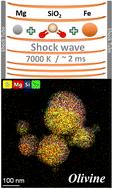
Our understanding of the formation pathways of interstellar mineral dust is still evolving. This study investigated the formation of astrophysical mineral dust, such as olivine, by shock processing. Low-velocity (∼1.8 km s−1) interstellar shock conditions were simulated using high-intensity shock tubes. These conditions enabled the examination of various cosmic mineral dust precursors such as the mixtures of Mg, Fe and SiO2 under a shock strength of approximately 5.6 M and temperatures around 7300 K. Analysis of the processed samples revealed the presence of Mg-rich olivine, forsterite, MgO quantum dots (QD), and magnetite. These results indicate that shockwaves can rapidly induce dust formation in interstellar space. Furthermore, we demonstrated that shock processing of mineral dust precursors could contribute to the formation of crystalline silicate dust observed in comets and the creation of chondrules, which are observed in chondritic meteorites.
期刊介绍:
An international, peer-reviewed journal covering all of the chemical sciences, including multidisciplinary and emerging areas. RSC Advances is a gold open access journal allowing researchers free access to research articles, and offering an affordable open access publishing option for authors around the world.




 京公网安备 11010802042870号
京ICP备2023020795号-1
京公网安备 11010802042870号
京ICP备2023020795号-1

 分享
分享
 求助内容:
求助内容: 应助结果提醒方式:
 扫码关注我们
