{"title":"纳米晶三维hofmann型自旋交叉网络{Fe1−xMx(pz)[Pd(CN)4]}的零点能量裁剪:尺寸、成分和周围矩阵的影响","authors":"Chinmoy Das, Ajana Dutta, Denisa Coltuneac, Laurentiu Stoleriu and Pradip Chakraborty","doi":"10.1039/D5DT00565E","DOIUrl":null,"url":null,"abstract":"<p >We report the variation in zero-point energies, <img> and their distribution, investigated through changes in thermal spin relaxation behavior and cooperativity, in the 3D Hofmann-type guest-free, different-sized nanocrystalline spin-crossover coordination networks, {Fe<small><sub>1−<em>x</em></sub></small>M<small><sub><em>x</em></sub></small>(pz)[Pd(CN)<small><sub>4</sub></small>]}, 0 ≤ <em>x</em> ≤ 1, where M(<small>II</small>) = Zn(<small>II</small>), Co(<small>II</small>), and Ni(<small>II</small>). Additionally, we synthesize the [Fe(pz)Pd(CN)<small><sub>4</sub></small>] nanocrystals embedded in different polymeric matrices, including Poly(methyl methacrylate) (PMMA), Polyethylene glycol 6000 (PEG-6000), and Polyvinylpyrrolidone K-30 (PVP K-30). The resulting nanostructures are phase-pure, well-crystallized and exhibit a tetragonal phase. High-resolution transmission electron microscopy (HRTEM) confirms that the nanostructures are nearly square-shaped, with well-defined sizes. The abrupt, incomplete, and gradual nature of the thermal spin relaxation behavior observed from the magnetic data for pure, doped, and polymer-embedded nanocrystals is collectively explained by the local and long-range fluctuations in the crystal fields experienced by the Fe(<small>II</small>) spin-crossover centers, variation in nucleation barrier energy influencing elastic properties, kinetic effects linked to modification in nucleation preferential sites during spin-state switching, as well as chemical pressure, lattice-strains and imperfections, thus altering the in-plane and out-of-plane interactions that influence the cooperativity variation and are responsible for the relative stabilization of the high-spin or low-spin states by modifying the <img>. A 3D mechanoelastic model is employed to interpret the observed magnetic behavior of pure, doped, and polymer-embedded nanocrystals, offering deeper insights into the underlying mechanisms governing spin-state transitions at the nanoscale.</p>","PeriodicalId":71,"journal":{"name":"Dalton Transactions","volume":" 19","pages":" 7923-7940"},"PeriodicalIF":3.3000,"publicationDate":"2025-04-17","publicationTypes":"Journal Article","fieldsOfStudy":null,"isOpenAccess":false,"openAccessPdf":"","citationCount":"0","resultStr":"{\"title\":\"Tailoring zero-point energies in nanocrystalline 3D Hofmann-type spin-crossover networks {Fe1−xMx(pz)[Pd(CN)4]}: impact of size, composition, and surrounding matrices†\",\"authors\":\"Chinmoy Das, Ajana Dutta, Denisa Coltuneac, Laurentiu Stoleriu and Pradip Chakraborty\",\"doi\":\"10.1039/D5DT00565E\",\"DOIUrl\":null,\"url\":null,\"abstract\":\"<p >We report the variation in zero-point energies, <img> and their distribution, investigated through changes in thermal spin relaxation behavior and cooperativity, in the 3D Hofmann-type guest-free, different-sized nanocrystalline spin-crossover coordination networks, {Fe<small><sub>1−<em>x</em></sub></small>M<small><sub><em>x</em></sub></small>(pz)[Pd(CN)<small><sub>4</sub></small>]}, 0 ≤ <em>x</em> ≤ 1, where M(<small>II</small>) = Zn(<small>II</small>), Co(<small>II</small>), and Ni(<small>II</small>). Additionally, we synthesize the [Fe(pz)Pd(CN)<small><sub>4</sub></small>] nanocrystals embedded in different polymeric matrices, including Poly(methyl methacrylate) (PMMA), Polyethylene glycol 6000 (PEG-6000), and Polyvinylpyrrolidone K-30 (PVP K-30). The resulting nanostructures are phase-pure, well-crystallized and exhibit a tetragonal phase. High-resolution transmission electron microscopy (HRTEM) confirms that the nanostructures are nearly square-shaped, with well-defined sizes. The abrupt, incomplete, and gradual nature of the thermal spin relaxation behavior observed from the magnetic data for pure, doped, and polymer-embedded nanocrystals is collectively explained by the local and long-range fluctuations in the crystal fields experienced by the Fe(<small>II</small>) spin-crossover centers, variation in nucleation barrier energy influencing elastic properties, kinetic effects linked to modification in nucleation preferential sites during spin-state switching, as well as chemical pressure, lattice-strains and imperfections, thus altering the in-plane and out-of-plane interactions that influence the cooperativity variation and are responsible for the relative stabilization of the high-spin or low-spin states by modifying the <img>. A 3D mechanoelastic model is employed to interpret the observed magnetic behavior of pure, doped, and polymer-embedded nanocrystals, offering deeper insights into the underlying mechanisms governing spin-state transitions at the nanoscale.</p>\",\"PeriodicalId\":71,\"journal\":{\"name\":\"Dalton Transactions\",\"volume\":\" 19\",\"pages\":\" 7923-7940\"},\"PeriodicalIF\":3.3000,\"publicationDate\":\"2025-04-17\",\"publicationTypes\":\"Journal Article\",\"fieldsOfStudy\":null,\"isOpenAccess\":false,\"openAccessPdf\":\"\",\"citationCount\":\"0\",\"resultStr\":null,\"platform\":\"Semanticscholar\",\"paperid\":null,\"PeriodicalName\":\"Dalton Transactions\",\"FirstCategoryId\":\"92\",\"ListUrlMain\":\"https://pubs.rsc.org/en/content/articlelanding/2025/dt/d5dt00565e\",\"RegionNum\":3,\"RegionCategory\":\"化学\",\"ArticlePicture\":[],\"TitleCN\":null,\"AbstractTextCN\":null,\"PMCID\":null,\"EPubDate\":\"\",\"PubModel\":\"\",\"JCR\":\"Q2\",\"JCRName\":\"CHEMISTRY, INORGANIC & NUCLEAR\",\"Score\":null,\"Total\":0}","platform":"Semanticscholar","paperid":null,"PeriodicalName":"Dalton Transactions","FirstCategoryId":"92","ListUrlMain":"https://pubs.rsc.org/en/content/articlelanding/2025/dt/d5dt00565e","RegionNum":3,"RegionCategory":"化学","ArticlePicture":[],"TitleCN":null,"AbstractTextCN":null,"PMCID":null,"EPubDate":"","PubModel":"","JCR":"Q2","JCRName":"CHEMISTRY, INORGANIC & NUCLEAR","Score":null,"Total":0}
Tailoring zero-point energies in nanocrystalline 3D Hofmann-type spin-crossover networks {Fe1−xMx(pz)[Pd(CN)4]}: impact of size, composition, and surrounding matrices†
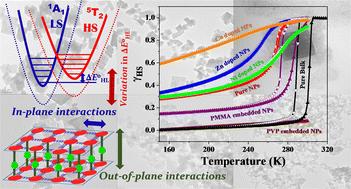
We report the variation in zero-point energies, and their distribution, investigated through changes in thermal spin relaxation behavior and cooperativity, in the 3D Hofmann-type guest-free, different-sized nanocrystalline spin-crossover coordination networks, {Fe1−xMx(pz)[Pd(CN)4]}, 0 ≤ x ≤ 1, where M(II) = Zn(II), Co(II), and Ni(II). Additionally, we synthesize the [Fe(pz)Pd(CN)4] nanocrystals embedded in different polymeric matrices, including Poly(methyl methacrylate) (PMMA), Polyethylene glycol 6000 (PEG-6000), and Polyvinylpyrrolidone K-30 (PVP K-30). The resulting nanostructures are phase-pure, well-crystallized and exhibit a tetragonal phase. High-resolution transmission electron microscopy (HRTEM) confirms that the nanostructures are nearly square-shaped, with well-defined sizes. The abrupt, incomplete, and gradual nature of the thermal spin relaxation behavior observed from the magnetic data for pure, doped, and polymer-embedded nanocrystals is collectively explained by the local and long-range fluctuations in the crystal fields experienced by the Fe(II) spin-crossover centers, variation in nucleation barrier energy influencing elastic properties, kinetic effects linked to modification in nucleation preferential sites during spin-state switching, as well as chemical pressure, lattice-strains and imperfections, thus altering the in-plane and out-of-plane interactions that influence the cooperativity variation and are responsible for the relative stabilization of the high-spin or low-spin states by modifying the . A 3D mechanoelastic model is employed to interpret the observed magnetic behavior of pure, doped, and polymer-embedded nanocrystals, offering deeper insights into the underlying mechanisms governing spin-state transitions at the nanoscale.
期刊介绍:
Dalton Transactions is a journal for all areas of inorganic chemistry, which encompasses the organometallic, bioinorganic and materials chemistry of the elements, with applications including synthesis, catalysis, energy conversion/storage, electrical devices and medicine. Dalton Transactions welcomes high-quality, original submissions in all of these areas and more, where the advancement of knowledge in inorganic chemistry is significant.



 京公网安备 11010802042870号
京ICP备2023020795号-1
京公网安备 11010802042870号
京ICP备2023020795号-1

 分享
分享
 求助内容:
求助内容: 应助结果提醒方式:
 扫码关注我们
