{"title":"迷你开放式肩袖修复联合术中鸡尾酒疗法治疗肩袖损伤的效果:鸡尾酒疗法与对照组的前瞻性比较研究","authors":"Libin Xu, Fangyong Lou, Haitao Jiang","doi":"10.1007/s00402-025-05872-2","DOIUrl":null,"url":null,"abstract":"<div><h3>Introduction</h3><p>To investigate the clinical effect of mini-open rotator cuff repair combined with intraoperative cocktail therapy in the treatment of rotator cuff injury.</p><h3>Methods</h3><p>A prospective comparative study of 78 patients with rotator cuff injury who underwent mini-open rotator cuff repair in our hospital from January 2020 to January 2022 and used block randomization to divide patients into 2 groups in this trial: The cocktail group received 150 mg ropivacaine, 40 mg of methylprednisolone succinate, 0.3 mg of epinephrine, and saline solution to a total of 100 mL, whereas the control group received 100mL of saline solution. The drug mixtures were injected into the glenohumeral joint, subacromial bursa, and anterior, middle, and posterior parts of the deltoid muscle. The patients’ visual analog scale (VAS) scores preoperatively were recorded at 6, 12, 24, and 48 h postoperatively. We also recorded the Constant-Murley function scores and passive abduction angles of the operation shoulder at two weeks, one, three and six months postoperatively. We also compared the number of patients using postoperative celecoxib capsules and receiving parecoxib sodium injections; the number of patients experiencing nausea; the patients with infection; the course of disease and the tear size.</p><h3>Results</h3><p>The cocktail group constituted 39 shoulders (50.0%), with 16 men (41.0%) and 23 women (59.0%); the mean age was 58.71 ± 6.39 years; the mean BMI was 24.25 ± 4.50 kg/m <sup>2</sup>. The control group constituted 39 shoulders (50.0%), with 18 men (46.2%) and 21 women (53.8%); the mean age was 59.71 ± 10.78 years; the mean BMI was 23.25 ± 3.73 kg/m <sup>2</sup>. We found no significant difference in sex, age and BMI between the 2 groups (<i>P</i> = 0.647, <i>P</i> = 0.620, <i>P</i> = 0.289). The VAS scores at 6, 12, 24 and 48 h postoperatively were significantly lower in the cocktail group (<i>P</i> = 0.023, <i>P</i> = 0.036, <i>P</i> = 0.014, <i>P</i> = 0.017). The number of patients receiving celecoxib capsules and parecoxib sodium injections tended to be lower in the cocktail group, and the difference was significant (<i>P</i> = 0.001, <i>P</i> = 0.001). There was no significant difference in the incidence of nausea(<i>P</i> = 0.617), infection, the course of disease(<i>P</i> = 0.182) and the tear size (<i>P</i> = 0.649)between the two groups. The Constant-Murley functional score and passive abduction angle of the operation shoulder were significantly improved in all patients after surgery, and there was no statistical difference in the functional score and active abduction angle of the operation shoulder between the two groups preoperatively (<i>P</i> = 0.430, <i>P</i> = 0.183) and at three(<i>P</i> = 0.468, <i>P</i> = 0.832) and six months postoperatively(<i>P</i> = 0.110, <i>P</i> = 0.381). However, at two weeks (<i>P</i> = 0.001, <i>P</i> = 0.001) and one month postoperatively (<i>P</i> = 0.001, <i>P</i> = 0.001), the Constant-Murley functional score and the passive abduction angle of the operation shoulder in the cocktail group were significantly higher than those in the control group.</p><h3>Conclusions</h3><p>The mini-open rotator cuff repair has satisfactory curative effect in the treatment of rotator cuff injury, and intraoperative cocktail therapy can alleviate postoperative pain and speed up postoperative functional rehabilitation and improvement of joint range of motion.</p><h3>Level of evidence</h3><p>Level III, therapeutic study.</p></div>","PeriodicalId":8326,"journal":{"name":"Archives of Orthopaedic and Trauma Surgery","volume":"145 1","pages":""},"PeriodicalIF":2.1000,"publicationDate":"2025-04-17","publicationTypes":"Journal Article","fieldsOfStudy":null,"isOpenAccess":false,"openAccessPdf":"","citationCount":"0","resultStr":"{\"title\":\"Effect of mini-open rotator cuff repair combined with intraoperative cocktail therapy in the treatment of rotator cuff injury: a prospective comparative study between the cocktail therapy and the control group\",\"authors\":\"Libin Xu, Fangyong Lou, Haitao Jiang\",\"doi\":\"10.1007/s00402-025-05872-2\",\"DOIUrl\":null,\"url\":null,\"abstract\":\"<div><h3>Introduction</h3><p>To investigate the clinical effect of mini-open rotator cuff repair combined with intraoperative cocktail therapy in the treatment of rotator cuff injury.</p><h3>Methods</h3><p>A prospective comparative study of 78 patients with rotator cuff injury who underwent mini-open rotator cuff repair in our hospital from January 2020 to January 2022 and used block randomization to divide patients into 2 groups in this trial: The cocktail group received 150 mg ropivacaine, 40 mg of methylprednisolone succinate, 0.3 mg of epinephrine, and saline solution to a total of 100 mL, whereas the control group received 100mL of saline solution. The drug mixtures were injected into the glenohumeral joint, subacromial bursa, and anterior, middle, and posterior parts of the deltoid muscle. The patients’ visual analog scale (VAS) scores preoperatively were recorded at 6, 12, 24, and 48 h postoperatively. We also recorded the Constant-Murley function scores and passive abduction angles of the operation shoulder at two weeks, one, three and six months postoperatively. We also compared the number of patients using postoperative celecoxib capsules and receiving parecoxib sodium injections; the number of patients experiencing nausea; the patients with infection; the course of disease and the tear size.</p><h3>Results</h3><p>The cocktail group constituted 39 shoulders (50.0%), with 16 men (41.0%) and 23 women (59.0%); the mean age was 58.71 ± 6.39 years; the mean BMI was 24.25 ± 4.50 kg/m <sup>2</sup>. The control group constituted 39 shoulders (50.0%), with 18 men (46.2%) and 21 women (53.8%); the mean age was 59.71 ± 10.78 years; the mean BMI was 23.25 ± 3.73 kg/m <sup>2</sup>. We found no significant difference in sex, age and BMI between the 2 groups (<i>P</i> = 0.647, <i>P</i> = 0.620, <i>P</i> = 0.289). The VAS scores at 6, 12, 24 and 48 h postoperatively were significantly lower in the cocktail group (<i>P</i> = 0.023, <i>P</i> = 0.036, <i>P</i> = 0.014, <i>P</i> = 0.017). The number of patients receiving celecoxib capsules and parecoxib sodium injections tended to be lower in the cocktail group, and the difference was significant (<i>P</i> = 0.001, <i>P</i> = 0.001). There was no significant difference in the incidence of nausea(<i>P</i> = 0.617), infection, the course of disease(<i>P</i> = 0.182) and the tear size (<i>P</i> = 0.649)between the two groups. The Constant-Murley functional score and passive abduction angle of the operation shoulder were significantly improved in all patients after surgery, and there was no statistical difference in the functional score and active abduction angle of the operation shoulder between the two groups preoperatively (<i>P</i> = 0.430, <i>P</i> = 0.183) and at three(<i>P</i> = 0.468, <i>P</i> = 0.832) and six months postoperatively(<i>P</i> = 0.110, <i>P</i> = 0.381). However, at two weeks (<i>P</i> = 0.001, <i>P</i> = 0.001) and one month postoperatively (<i>P</i> = 0.001, <i>P</i> = 0.001), the Constant-Murley functional score and the passive abduction angle of the operation shoulder in the cocktail group were significantly higher than those in the control group.</p><h3>Conclusions</h3><p>The mini-open rotator cuff repair has satisfactory curative effect in the treatment of rotator cuff injury, and intraoperative cocktail therapy can alleviate postoperative pain and speed up postoperative functional rehabilitation and improvement of joint range of motion.</p><h3>Level of evidence</h3><p>Level III, therapeutic study.</p></div>\",\"PeriodicalId\":8326,\"journal\":{\"name\":\"Archives of Orthopaedic and Trauma Surgery\",\"volume\":\"145 1\",\"pages\":\"\"},\"PeriodicalIF\":2.1000,\"publicationDate\":\"2025-04-17\",\"publicationTypes\":\"Journal Article\",\"fieldsOfStudy\":null,\"isOpenAccess\":false,\"openAccessPdf\":\"\",\"citationCount\":\"0\",\"resultStr\":null,\"platform\":\"Semanticscholar\",\"paperid\":null,\"PeriodicalName\":\"Archives of Orthopaedic and Trauma Surgery\",\"FirstCategoryId\":\"3\",\"ListUrlMain\":\"https://link.springer.com/article/10.1007/s00402-025-05872-2\",\"RegionNum\":3,\"RegionCategory\":\"医学\",\"ArticlePicture\":[],\"TitleCN\":null,\"AbstractTextCN\":null,\"PMCID\":null,\"EPubDate\":\"\",\"PubModel\":\"\",\"JCR\":\"Q2\",\"JCRName\":\"ORTHOPEDICS\",\"Score\":null,\"Total\":0}","platform":"Semanticscholar","paperid":null,"PeriodicalName":"Archives of Orthopaedic and Trauma Surgery","FirstCategoryId":"3","ListUrlMain":"https://link.springer.com/article/10.1007/s00402-025-05872-2","RegionNum":3,"RegionCategory":"医学","ArticlePicture":[],"TitleCN":null,"AbstractTextCN":null,"PMCID":null,"EPubDate":"","PubModel":"","JCR":"Q2","JCRName":"ORTHOPEDICS","Score":null,"Total":0}
引用次数: 0
摘要
前言:探讨小开口肩袖修复术联合术中鸡尾酒疗法治疗肩袖损伤的临床效果。方法对2020年1月至2022年1月在我院行微创肩袖修复术的78例肩袖损伤患者进行前瞻性比较研究,采用分组随机法将患者分为两组:鸡尾酒组给予150mg罗哌卡因、40mg琥珀酸甲泼尼龙、0.3 mg肾上腺素和生理盐水,共100mL,对照组给予生理盐水100mL。将药物混合物注射于肱骨盂关节、肩峰下滑囊和三角肌的前、中、后部分。分别于术后6、12、24、48 h记录患者术前视觉模拟评分(VAS)。术后2周、1周、3月和6个月分别记录手术肩关节的Constant-Murley功能评分和被动外展角。我们还比较了术后使用塞来昔布胶囊和接受帕雷昔布钠注射的患者数量;出现恶心的患者人数;感染患者;疾病的进程和撕裂的大小。结果鸡尾酒组39例(50.0%),其中男性16例(41.0%),女性23例(59.0%);平均年龄58.71±6.39岁;平均BMI为24.25±4.50 kg/ m2。对照组39例(50.0%),其中男性18例(46.2%),女性21例(53.8%);平均年龄59.71±10.78岁;平均BMI为23.25±3.73 kg/ m2。两组患者性别、年龄、BMI差异无统计学意义(P = 0.647, P = 0.620, P = 0.289)。鸡尾酒治疗组术后6、12、24、48 h VAS评分均显著低于对照组(P = 0.023, P = 0.036, P = 0.014, P = 0.017)。鸡尾酒治疗组接受塞来昔布胶囊和帕雷昔布钠注射液的患者人数有减少的趋势,差异有统计学意义(P = 0.001, P = 0.001)。两组患者恶心发生率(P = 0.617)、感染发生率、病程(P = 0.182)、撕裂大小(P = 0.649)差异均无统计学意义。术后两组患者的Constant-Murley功能评分和手术肩关节被动外展角均有明显改善,术前(P = 0.430, P = 0.183)、术后3个月(P = 0.468, P = 0.832)、术后6个月(P = 0.110, P = 0.381)两组患者手术肩关节功能评分和手术肩关节主动外展角比较差异均无统计学意义。然而,在术后2周(P = 0.001, P = 0.001)和1个月(P = 0.001, P = 0.001),鸡尾酒组的Constant-Murley功能评分和术肩被动外展角均显著高于对照组。结论小型开放式肩袖修复术治疗肩袖损伤疗效满意,术中鸡尾酒疗法可减轻术后疼痛,加快术后功能康复和关节活动范围的改善。证据等级:III级,治疗性研究。
Effect of mini-open rotator cuff repair combined with intraoperative cocktail therapy in the treatment of rotator cuff injury: a prospective comparative study between the cocktail therapy and the control group
Introduction
To investigate the clinical effect of mini-open rotator cuff repair combined with intraoperative cocktail therapy in the treatment of rotator cuff injury.
Methods
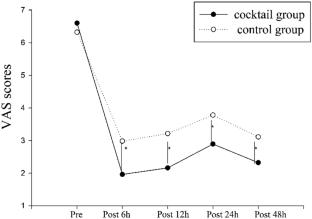
A prospective comparative study of 78 patients with rotator cuff injury who underwent mini-open rotator cuff repair in our hospital from January 2020 to January 2022 and used block randomization to divide patients into 2 groups in this trial: The cocktail group received 150 mg ropivacaine, 40 mg of methylprednisolone succinate, 0.3 mg of epinephrine, and saline solution to a total of 100 mL, whereas the control group received 100mL of saline solution. The drug mixtures were injected into the glenohumeral joint, subacromial bursa, and anterior, middle, and posterior parts of the deltoid muscle. The patients’ visual analog scale (VAS) scores preoperatively were recorded at 6, 12, 24, and 48 h postoperatively. We also recorded the Constant-Murley function scores and passive abduction angles of the operation shoulder at two weeks, one, three and six months postoperatively. We also compared the number of patients using postoperative celecoxib capsules and receiving parecoxib sodium injections; the number of patients experiencing nausea; the patients with infection; the course of disease and the tear size.
Results
The cocktail group constituted 39 shoulders (50.0%), with 16 men (41.0%) and 23 women (59.0%); the mean age was 58.71 ± 6.39 years; the mean BMI was 24.25 ± 4.50 kg/m 2. The control group constituted 39 shoulders (50.0%), with 18 men (46.2%) and 21 women (53.8%); the mean age was 59.71 ± 10.78 years; the mean BMI was 23.25 ± 3.73 kg/m 2. We found no significant difference in sex, age and BMI between the 2 groups (P = 0.647, P = 0.620, P = 0.289). The VAS scores at 6, 12, 24 and 48 h postoperatively were significantly lower in the cocktail group (P = 0.023, P = 0.036, P = 0.014, P = 0.017). The number of patients receiving celecoxib capsules and parecoxib sodium injections tended to be lower in the cocktail group, and the difference was significant (P = 0.001, P = 0.001). There was no significant difference in the incidence of nausea(P = 0.617), infection, the course of disease(P = 0.182) and the tear size (P = 0.649)between the two groups. The Constant-Murley functional score and passive abduction angle of the operation shoulder were significantly improved in all patients after surgery, and there was no statistical difference in the functional score and active abduction angle of the operation shoulder between the two groups preoperatively (P = 0.430, P = 0.183) and at three(P = 0.468, P = 0.832) and six months postoperatively(P = 0.110, P = 0.381). However, at two weeks (P = 0.001, P = 0.001) and one month postoperatively (P = 0.001, P = 0.001), the Constant-Murley functional score and the passive abduction angle of the operation shoulder in the cocktail group were significantly higher than those in the control group.
Conclusions
The mini-open rotator cuff repair has satisfactory curative effect in the treatment of rotator cuff injury, and intraoperative cocktail therapy can alleviate postoperative pain and speed up postoperative functional rehabilitation and improvement of joint range of motion.
期刊介绍:
"Archives of Orthopaedic and Trauma Surgery" is a rich source of instruction and information for physicians in clinical practice and research in the extensive field of orthopaedics and traumatology. The journal publishes papers that deal with diseases and injuries of the musculoskeletal system from all fields and aspects of medicine. The journal is particularly interested in papers that satisfy the information needs of orthopaedic clinicians and practitioners. The journal places special emphasis on clinical relevance.
"Archives of Orthopaedic and Trauma Surgery" is the official journal of the German Speaking Arthroscopy Association (AGA).




 京公网安备 11010802042870号
京ICP备2023020795号-1
京公网安备 11010802042870号
京ICP备2023020795号-1

 分享
分享
 求助内容:
求助内容: 应助结果提醒方式:
 扫码关注我们
