Xinhui Liu , Yu Yang , Nigel J D Graham , Satoshi Takizawa , How Yong Ng
{"title":"解读纳滤中由微/纳米塑料引起的膜生物污染:宏基因组的见解和间隔驱动的缓解","authors":"Xinhui Liu , Yu Yang , Nigel J D Graham , Satoshi Takizawa , How Yong Ng","doi":"10.1016/j.watres.2025.123682","DOIUrl":null,"url":null,"abstract":"<div><div>Nanofiltration (NF) is an effective process for micro-/nano-plastics (MNPs) interception, but the impact of accumulated MNPs on the microbial community structure and metabolic pathways of biofilms on NF membranes remains unclear. This provides uncertainty with respect to membrane biofouling behavior and the risks to efficient NF operations. In this study, the size-dependent (20 nm–25 μm) and concentration-dependent (0.1–50 mg·<em>L</em><sup>−1</sup>) effects of MNPs on the biofouling of a NF membrane treating secondary wastewater effluent were studied. Three MNPs-tolerant, hypermetabolic and polystyrene-degradable genera (<em>i.e., Acinetobacter, Novosphingobium</em> and <em>Asticcacaulis</em>) were detected in biofilms as dominant taxonomic compositions. MNPs led to an increase of 19.3 %–76.7 % in biomass contents and a more rapid decrease in permeate flux, with 0.1 mg·<em>L</em><sup>−1</sup> of 80 nm NPs causing the most severe membrane biofouling. Metagenomic analysis revealed that MNPs upregulated enzymes involved in exopolysaccharide (ExoA/L/M/P/Q/X/Y/Z) and tyrosine (COMT, FeaB and AOC3) biosynthesis and quorum sensing (PhzF and CiaH/R), and suppressed cell motility pathways including flagellar assembly and bacterial chemotaxis. Novel types of perforated column spacer (PCS) enhanced the hydrodynamics of the membrane feed with a lower pressure drop and higher fluid velocity, introduced micro-jets and greater mass transfer inside feed channels, thus eliminating the deposition of MNPs and mitigating membrane biofouling. Overall, a greater understanding of the interaction mechanisms between MNPs and membrane biofouling in secondary effluent filtration will help develop more effective MNPs management strategies and achieve more sustainable NF operations.</div></div>","PeriodicalId":443,"journal":{"name":"Water Research","volume":"281 ","pages":"Article 123682"},"PeriodicalIF":12.8000,"publicationDate":"2025-08-01","publicationTypes":"Journal Article","fieldsOfStudy":null,"isOpenAccess":false,"openAccessPdf":"","citationCount":"0","resultStr":"{\"title\":\"Deciphering membrane biofouling induced by micro-/nano-plastics in nanofiltration: Metagenomic insights and spacer-driven mitigations\",\"authors\":\"Xinhui Liu , Yu Yang , Nigel J D Graham , Satoshi Takizawa , How Yong Ng\",\"doi\":\"10.1016/j.watres.2025.123682\",\"DOIUrl\":null,\"url\":null,\"abstract\":\"<div><div>Nanofiltration (NF) is an effective process for micro-/nano-plastics (MNPs) interception, but the impact of accumulated MNPs on the microbial community structure and metabolic pathways of biofilms on NF membranes remains unclear. This provides uncertainty with respect to membrane biofouling behavior and the risks to efficient NF operations. In this study, the size-dependent (20 nm–25 μm) and concentration-dependent (0.1–50 mg·<em>L</em><sup>−1</sup>) effects of MNPs on the biofouling of a NF membrane treating secondary wastewater effluent were studied. Three MNPs-tolerant, hypermetabolic and polystyrene-degradable genera (<em>i.e., Acinetobacter, Novosphingobium</em> and <em>Asticcacaulis</em>) were detected in biofilms as dominant taxonomic compositions. MNPs led to an increase of 19.3 %–76.7 % in biomass contents and a more rapid decrease in permeate flux, with 0.1 mg·<em>L</em><sup>−1</sup> of 80 nm NPs causing the most severe membrane biofouling. Metagenomic analysis revealed that MNPs upregulated enzymes involved in exopolysaccharide (ExoA/L/M/P/Q/X/Y/Z) and tyrosine (COMT, FeaB and AOC3) biosynthesis and quorum sensing (PhzF and CiaH/R), and suppressed cell motility pathways including flagellar assembly and bacterial chemotaxis. Novel types of perforated column spacer (PCS) enhanced the hydrodynamics of the membrane feed with a lower pressure drop and higher fluid velocity, introduced micro-jets and greater mass transfer inside feed channels, thus eliminating the deposition of MNPs and mitigating membrane biofouling. Overall, a greater understanding of the interaction mechanisms between MNPs and membrane biofouling in secondary effluent filtration will help develop more effective MNPs management strategies and achieve more sustainable NF operations.</div></div>\",\"PeriodicalId\":443,\"journal\":{\"name\":\"Water Research\",\"volume\":\"281 \",\"pages\":\"Article 123682\"},\"PeriodicalIF\":12.8000,\"publicationDate\":\"2025-08-01\",\"publicationTypes\":\"Journal Article\",\"fieldsOfStudy\":null,\"isOpenAccess\":false,\"openAccessPdf\":\"\",\"citationCount\":\"0\",\"resultStr\":null,\"platform\":\"Semanticscholar\",\"paperid\":null,\"PeriodicalName\":\"Water Research\",\"FirstCategoryId\":\"93\",\"ListUrlMain\":\"https://www.sciencedirect.com/science/article/pii/S0043135425005913\",\"RegionNum\":1,\"RegionCategory\":\"环境科学与生态学\",\"ArticlePicture\":[],\"TitleCN\":null,\"AbstractTextCN\":null,\"PMCID\":null,\"EPubDate\":\"2025/4/19 0:00:00\",\"PubModel\":\"Epub\",\"JCR\":\"Q1\",\"JCRName\":\"ENGINEERING, ENVIRONMENTAL\",\"Score\":null,\"Total\":0}","platform":"Semanticscholar","paperid":null,"PeriodicalName":"Water Research","FirstCategoryId":"93","ListUrlMain":"https://www.sciencedirect.com/science/article/pii/S0043135425005913","RegionNum":1,"RegionCategory":"环境科学与生态学","ArticlePicture":[],"TitleCN":null,"AbstractTextCN":null,"PMCID":null,"EPubDate":"2025/4/19 0:00:00","PubModel":"Epub","JCR":"Q1","JCRName":"ENGINEERING, ENVIRONMENTAL","Score":null,"Total":0}
Deciphering membrane biofouling induced by micro-/nano-plastics in nanofiltration: Metagenomic insights and spacer-driven mitigations
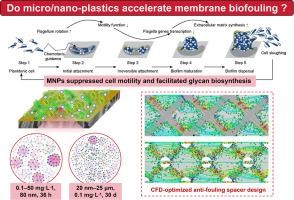
Nanofiltration (NF) is an effective process for micro-/nano-plastics (MNPs) interception, but the impact of accumulated MNPs on the microbial community structure and metabolic pathways of biofilms on NF membranes remains unclear. This provides uncertainty with respect to membrane biofouling behavior and the risks to efficient NF operations. In this study, the size-dependent (20 nm–25 μm) and concentration-dependent (0.1–50 mg·L−1) effects of MNPs on the biofouling of a NF membrane treating secondary wastewater effluent were studied. Three MNPs-tolerant, hypermetabolic and polystyrene-degradable genera (i.e., Acinetobacter, Novosphingobium and Asticcacaulis) were detected in biofilms as dominant taxonomic compositions. MNPs led to an increase of 19.3 %–76.7 % in biomass contents and a more rapid decrease in permeate flux, with 0.1 mg·L−1 of 80 nm NPs causing the most severe membrane biofouling. Metagenomic analysis revealed that MNPs upregulated enzymes involved in exopolysaccharide (ExoA/L/M/P/Q/X/Y/Z) and tyrosine (COMT, FeaB and AOC3) biosynthesis and quorum sensing (PhzF and CiaH/R), and suppressed cell motility pathways including flagellar assembly and bacterial chemotaxis. Novel types of perforated column spacer (PCS) enhanced the hydrodynamics of the membrane feed with a lower pressure drop and higher fluid velocity, introduced micro-jets and greater mass transfer inside feed channels, thus eliminating the deposition of MNPs and mitigating membrane biofouling. Overall, a greater understanding of the interaction mechanisms between MNPs and membrane biofouling in secondary effluent filtration will help develop more effective MNPs management strategies and achieve more sustainable NF operations.
期刊介绍:
Water Research, along with its open access companion journal Water Research X, serves as a platform for publishing original research papers covering various aspects of the science and technology related to the anthropogenic water cycle, water quality, and its management worldwide. The audience targeted by the journal comprises biologists, chemical engineers, chemists, civil engineers, environmental engineers, limnologists, and microbiologists. The scope of the journal include:
•Treatment processes for water and wastewaters (municipal, agricultural, industrial, and on-site treatment), including resource recovery and residuals management;
•Urban hydrology including sewer systems, stormwater management, and green infrastructure;
•Drinking water treatment and distribution;
•Potable and non-potable water reuse;
•Sanitation, public health, and risk assessment;
•Anaerobic digestion, solid and hazardous waste management, including source characterization and the effects and control of leachates and gaseous emissions;
•Contaminants (chemical, microbial, anthropogenic particles such as nanoparticles or microplastics) and related water quality sensing, monitoring, fate, and assessment;
•Anthropogenic impacts on inland, tidal, coastal and urban waters, focusing on surface and ground waters, and point and non-point sources of pollution;
•Environmental restoration, linked to surface water, groundwater and groundwater remediation;
•Analysis of the interfaces between sediments and water, and between water and atmosphere, focusing specifically on anthropogenic impacts;
•Mathematical modelling, systems analysis, machine learning, and beneficial use of big data related to the anthropogenic water cycle;
•Socio-economic, policy, and regulations studies.





 京公网安备 11010802042870号
京ICP备2023020795号-1
京公网安备 11010802042870号
京ICP备2023020795号-1

 分享
分享
 求助内容:
求助内容: 应助结果提醒方式:
 扫码关注我们
