Lina Zhang , Chongwen Shi , Qianli Xie , Zhen Qi , Fangzhou Li , Guanghe Li , Fang Zhang
{"title":"利用高稳定性蛭石膜对酸性矿山废水进行选择性酸回收和金属分离","authors":"Lina Zhang , Chongwen Shi , Qianli Xie , Zhen Qi , Fangzhou Li , Guanghe Li , Fang Zhang","doi":"10.1016/j.watres.2025.123676","DOIUrl":null,"url":null,"abstract":"<div><div>Selective ion separation from acid mine drainage (AMD) under extreme acidic conditions presents a critical environmental challenge. While membrane-based technologies show promise for advancing water treatment processes, implementation in AMD treatment requires membranes that combine exceptional acid stability with precise ion sieving capabilities. Inspired by the ion retention characteristics of natural clay minerals, we have developed cation-selective membranes using vermiculite nanosheets as building blocks. The vermiculite membranes (VM) featured high acid stability and well-ordered two-dimensional nanochannels (2 Å), achieving a high H<sup>+</sup> permeation rate of 3.24 mol m<sup>−2</sup> h<sup>−1</sup>. The VM demonstrated exceptional selectivity between monovalent and metals ions, with a H<sup>+</sup>/Fe<sup>3+</sup> selectivity factor of 1284 in single-cation transport process. In complex multi-ion environments, the VM maintained stable separation performance, achieving a H<sup>+</sup>/Fe<sup>3+</sup> selectivity of 1000 in mixed solutions containing H<sup>+</sup>, K<sup>+</sup>, Na<sup>+</sup>, Ca<sup>2+</sup>, Mg<sup>2+</sup> and Fe<sup>3+</sup>. Additionally, VM effectively blocked other common AMD metals, including Cu<sup>2+</sup>, Co<sup>2+</sup>, Ni<sup>2+</sup> and Mn<sup>2+</sup>, while maintaining stable separation performance even at extreme low pH values (pH = 1). Through integrated theoretical calculations and experiments, we revealed that the synergistic effects of ultra-confined nanochannels (4∼5 Å) and surface charge created enhanced energy barriers for trivalent ion transport, resulting in high ion selectivity. Beyond providing an effective solution for AMD remediation, this work establishes vermiculite-based membranes as promising candidates for ion separation applications.</div></div>","PeriodicalId":443,"journal":{"name":"Water Research","volume":"281 ","pages":"Article 123676"},"PeriodicalIF":12.4000,"publicationDate":"2025-08-01","publicationTypes":"Journal Article","fieldsOfStudy":null,"isOpenAccess":false,"openAccessPdf":"","citationCount":"0","resultStr":"{\"title\":\"Selective acid recovery and metal separation from acid mine drainage using a highly stable vermiculite membrane\",\"authors\":\"Lina Zhang , Chongwen Shi , Qianli Xie , Zhen Qi , Fangzhou Li , Guanghe Li , Fang Zhang\",\"doi\":\"10.1016/j.watres.2025.123676\",\"DOIUrl\":null,\"url\":null,\"abstract\":\"<div><div>Selective ion separation from acid mine drainage (AMD) under extreme acidic conditions presents a critical environmental challenge. While membrane-based technologies show promise for advancing water treatment processes, implementation in AMD treatment requires membranes that combine exceptional acid stability with precise ion sieving capabilities. Inspired by the ion retention characteristics of natural clay minerals, we have developed cation-selective membranes using vermiculite nanosheets as building blocks. The vermiculite membranes (VM) featured high acid stability and well-ordered two-dimensional nanochannels (2 Å), achieving a high H<sup>+</sup> permeation rate of 3.24 mol m<sup>−2</sup> h<sup>−1</sup>. The VM demonstrated exceptional selectivity between monovalent and metals ions, with a H<sup>+</sup>/Fe<sup>3+</sup> selectivity factor of 1284 in single-cation transport process. In complex multi-ion environments, the VM maintained stable separation performance, achieving a H<sup>+</sup>/Fe<sup>3+</sup> selectivity of 1000 in mixed solutions containing H<sup>+</sup>, K<sup>+</sup>, Na<sup>+</sup>, Ca<sup>2+</sup>, Mg<sup>2+</sup> and Fe<sup>3+</sup>. Additionally, VM effectively blocked other common AMD metals, including Cu<sup>2+</sup>, Co<sup>2+</sup>, Ni<sup>2+</sup> and Mn<sup>2+</sup>, while maintaining stable separation performance even at extreme low pH values (pH = 1). Through integrated theoretical calculations and experiments, we revealed that the synergistic effects of ultra-confined nanochannels (4∼5 Å) and surface charge created enhanced energy barriers for trivalent ion transport, resulting in high ion selectivity. Beyond providing an effective solution for AMD remediation, this work establishes vermiculite-based membranes as promising candidates for ion separation applications.</div></div>\",\"PeriodicalId\":443,\"journal\":{\"name\":\"Water Research\",\"volume\":\"281 \",\"pages\":\"Article 123676\"},\"PeriodicalIF\":12.4000,\"publicationDate\":\"2025-08-01\",\"publicationTypes\":\"Journal Article\",\"fieldsOfStudy\":null,\"isOpenAccess\":false,\"openAccessPdf\":\"\",\"citationCount\":\"0\",\"resultStr\":null,\"platform\":\"Semanticscholar\",\"paperid\":null,\"PeriodicalName\":\"Water Research\",\"FirstCategoryId\":\"93\",\"ListUrlMain\":\"https://www.sciencedirect.com/science/article/pii/S0043135425005858\",\"RegionNum\":1,\"RegionCategory\":\"环境科学与生态学\",\"ArticlePicture\":[],\"TitleCN\":null,\"AbstractTextCN\":null,\"PMCID\":null,\"EPubDate\":\"2025/4/18 0:00:00\",\"PubModel\":\"Epub\",\"JCR\":\"Q1\",\"JCRName\":\"ENGINEERING, ENVIRONMENTAL\",\"Score\":null,\"Total\":0}","platform":"Semanticscholar","paperid":null,"PeriodicalName":"Water Research","FirstCategoryId":"93","ListUrlMain":"https://www.sciencedirect.com/science/article/pii/S0043135425005858","RegionNum":1,"RegionCategory":"环境科学与生态学","ArticlePicture":[],"TitleCN":null,"AbstractTextCN":null,"PMCID":null,"EPubDate":"2025/4/18 0:00:00","PubModel":"Epub","JCR":"Q1","JCRName":"ENGINEERING, ENVIRONMENTAL","Score":null,"Total":0}
Selective acid recovery and metal separation from acid mine drainage using a highly stable vermiculite membrane
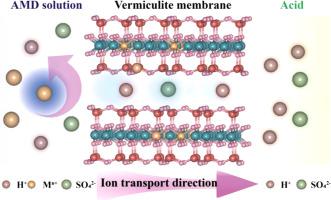
Selective ion separation from acid mine drainage (AMD) under extreme acidic conditions presents a critical environmental challenge. While membrane-based technologies show promise for advancing water treatment processes, implementation in AMD treatment requires membranes that combine exceptional acid stability with precise ion sieving capabilities. Inspired by the ion retention characteristics of natural clay minerals, we have developed cation-selective membranes using vermiculite nanosheets as building blocks. The vermiculite membranes (VM) featured high acid stability and well-ordered two-dimensional nanochannels (2 Å), achieving a high H+ permeation rate of 3.24 mol m−2 h−1. The VM demonstrated exceptional selectivity between monovalent and metals ions, with a H+/Fe3+ selectivity factor of 1284 in single-cation transport process. In complex multi-ion environments, the VM maintained stable separation performance, achieving a H+/Fe3+ selectivity of 1000 in mixed solutions containing H+, K+, Na+, Ca2+, Mg2+ and Fe3+. Additionally, VM effectively blocked other common AMD metals, including Cu2+, Co2+, Ni2+ and Mn2+, while maintaining stable separation performance even at extreme low pH values (pH = 1). Through integrated theoretical calculations and experiments, we revealed that the synergistic effects of ultra-confined nanochannels (4∼5 Å) and surface charge created enhanced energy barriers for trivalent ion transport, resulting in high ion selectivity. Beyond providing an effective solution for AMD remediation, this work establishes vermiculite-based membranes as promising candidates for ion separation applications.
期刊介绍:
Water Research, along with its open access companion journal Water Research X, serves as a platform for publishing original research papers covering various aspects of the science and technology related to the anthropogenic water cycle, water quality, and its management worldwide. The audience targeted by the journal comprises biologists, chemical engineers, chemists, civil engineers, environmental engineers, limnologists, and microbiologists. The scope of the journal include:
•Treatment processes for water and wastewaters (municipal, agricultural, industrial, and on-site treatment), including resource recovery and residuals management;
•Urban hydrology including sewer systems, stormwater management, and green infrastructure;
•Drinking water treatment and distribution;
•Potable and non-potable water reuse;
•Sanitation, public health, and risk assessment;
•Anaerobic digestion, solid and hazardous waste management, including source characterization and the effects and control of leachates and gaseous emissions;
•Contaminants (chemical, microbial, anthropogenic particles such as nanoparticles or microplastics) and related water quality sensing, monitoring, fate, and assessment;
•Anthropogenic impacts on inland, tidal, coastal and urban waters, focusing on surface and ground waters, and point and non-point sources of pollution;
•Environmental restoration, linked to surface water, groundwater and groundwater remediation;
•Analysis of the interfaces between sediments and water, and between water and atmosphere, focusing specifically on anthropogenic impacts;
•Mathematical modelling, systems analysis, machine learning, and beneficial use of big data related to the anthropogenic water cycle;
•Socio-economic, policy, and regulations studies.





 京公网安备 11010802042870号
京ICP备2023020795号-1
京公网安备 11010802042870号
京ICP备2023020795号-1

 分享
分享
 求助内容:
求助内容: 应助结果提醒方式:
 扫码关注我们
