Changqing Liu , Shenghan Yan , Xingguang Luo , Yuyi Zheng , Guangyin Zhen
{"title":"铁基材料维持生物膜的动态平衡,并作为外部电容器,以减少MEC-AD甲烷生产过程中间歇性电源的电子损失","authors":"Changqing Liu , Shenghan Yan , Xingguang Luo , Yuyi Zheng , Guangyin Zhen","doi":"10.1016/j.watres.2025.123677","DOIUrl":null,"url":null,"abstract":"<div><div>Microbial electrolysis cell-anaerobic digestion (MEC-AD) is a cost-effective approach for methane (CH₄) recovery from food waste, but its CH₄ conversion efficiency requires improvement. To address this, a MIL-100(Fe)-modified carbon cloth anode was developed to enhance anodic biofilm formation and CH₄ bioconversion efficiency. At an applied voltage of 0.8 V, the highest daily CH₄ yield reached 141.6 mL/g COD/d, a 61 % increase, and increased further to 227.5 mL/g COD/d under intermittent power supply. By facilitating extracellular electron transfer (EET) in electrogenic bacteria, MIL-100(Fe) regulated biofilm thickness and maintained dynamic biofilm equilibrium. Additionally, as an external capacitor, MIL-100(Fe) functioned as a “temporary storage site” for electrons under intermittent power supply, reducing bioelectron loss. Metagenomic analysis revealed that MIL-100(Fe) significantly enriched <em>Bacteroidia</em> and <em>Methanosarcina</em>, promoting carbohydrate metabolism and CH₄ production. Under intermittent power supply, MIL-100(Fe) further enriched <em>Geobacter</em>, enhancing electron transfer efficiency. This study demonstrates that iron-based anode modification effectively enhances CH₄ production from food waste by optimizing biofilm structure and metabolic pathways, providing a promising strategy for improving MEC-AD performance.</div></div>","PeriodicalId":443,"journal":{"name":"Water Research","volume":"281 ","pages":"Article 123677"},"PeriodicalIF":12.4000,"publicationDate":"2025-08-01","publicationTypes":"Journal Article","fieldsOfStudy":null,"isOpenAccess":false,"openAccessPdf":"","citationCount":"0","resultStr":"{\"title\":\"Iron-based materials maintain biofilm equilibrium and function as external capacitors to minimize electron loss under intermittent power supply in MEC-AD methane production\",\"authors\":\"Changqing Liu , Shenghan Yan , Xingguang Luo , Yuyi Zheng , Guangyin Zhen\",\"doi\":\"10.1016/j.watres.2025.123677\",\"DOIUrl\":null,\"url\":null,\"abstract\":\"<div><div>Microbial electrolysis cell-anaerobic digestion (MEC-AD) is a cost-effective approach for methane (CH₄) recovery from food waste, but its CH₄ conversion efficiency requires improvement. To address this, a MIL-100(Fe)-modified carbon cloth anode was developed to enhance anodic biofilm formation and CH₄ bioconversion efficiency. At an applied voltage of 0.8 V, the highest daily CH₄ yield reached 141.6 mL/g COD/d, a 61 % increase, and increased further to 227.5 mL/g COD/d under intermittent power supply. By facilitating extracellular electron transfer (EET) in electrogenic bacteria, MIL-100(Fe) regulated biofilm thickness and maintained dynamic biofilm equilibrium. Additionally, as an external capacitor, MIL-100(Fe) functioned as a “temporary storage site” for electrons under intermittent power supply, reducing bioelectron loss. Metagenomic analysis revealed that MIL-100(Fe) significantly enriched <em>Bacteroidia</em> and <em>Methanosarcina</em>, promoting carbohydrate metabolism and CH₄ production. Under intermittent power supply, MIL-100(Fe) further enriched <em>Geobacter</em>, enhancing electron transfer efficiency. This study demonstrates that iron-based anode modification effectively enhances CH₄ production from food waste by optimizing biofilm structure and metabolic pathways, providing a promising strategy for improving MEC-AD performance.</div></div>\",\"PeriodicalId\":443,\"journal\":{\"name\":\"Water Research\",\"volume\":\"281 \",\"pages\":\"Article 123677\"},\"PeriodicalIF\":12.4000,\"publicationDate\":\"2025-08-01\",\"publicationTypes\":\"Journal Article\",\"fieldsOfStudy\":null,\"isOpenAccess\":false,\"openAccessPdf\":\"\",\"citationCount\":\"0\",\"resultStr\":null,\"platform\":\"Semanticscholar\",\"paperid\":null,\"PeriodicalName\":\"Water Research\",\"FirstCategoryId\":\"93\",\"ListUrlMain\":\"https://www.sciencedirect.com/science/article/pii/S004313542500586X\",\"RegionNum\":1,\"RegionCategory\":\"环境科学与生态学\",\"ArticlePicture\":[],\"TitleCN\":null,\"AbstractTextCN\":null,\"PMCID\":null,\"EPubDate\":\"2025/4/18 0:00:00\",\"PubModel\":\"Epub\",\"JCR\":\"Q1\",\"JCRName\":\"ENGINEERING, ENVIRONMENTAL\",\"Score\":null,\"Total\":0}","platform":"Semanticscholar","paperid":null,"PeriodicalName":"Water Research","FirstCategoryId":"93","ListUrlMain":"https://www.sciencedirect.com/science/article/pii/S004313542500586X","RegionNum":1,"RegionCategory":"环境科学与生态学","ArticlePicture":[],"TitleCN":null,"AbstractTextCN":null,"PMCID":null,"EPubDate":"2025/4/18 0:00:00","PubModel":"Epub","JCR":"Q1","JCRName":"ENGINEERING, ENVIRONMENTAL","Score":null,"Total":0}
Iron-based materials maintain biofilm equilibrium and function as external capacitors to minimize electron loss under intermittent power supply in MEC-AD methane production
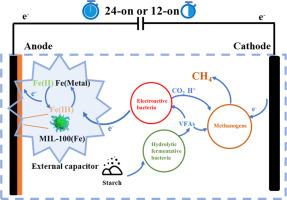
Microbial electrolysis cell-anaerobic digestion (MEC-AD) is a cost-effective approach for methane (CH₄) recovery from food waste, but its CH₄ conversion efficiency requires improvement. To address this, a MIL-100(Fe)-modified carbon cloth anode was developed to enhance anodic biofilm formation and CH₄ bioconversion efficiency. At an applied voltage of 0.8 V, the highest daily CH₄ yield reached 141.6 mL/g COD/d, a 61 % increase, and increased further to 227.5 mL/g COD/d under intermittent power supply. By facilitating extracellular electron transfer (EET) in electrogenic bacteria, MIL-100(Fe) regulated biofilm thickness and maintained dynamic biofilm equilibrium. Additionally, as an external capacitor, MIL-100(Fe) functioned as a “temporary storage site” for electrons under intermittent power supply, reducing bioelectron loss. Metagenomic analysis revealed that MIL-100(Fe) significantly enriched Bacteroidia and Methanosarcina, promoting carbohydrate metabolism and CH₄ production. Under intermittent power supply, MIL-100(Fe) further enriched Geobacter, enhancing electron transfer efficiency. This study demonstrates that iron-based anode modification effectively enhances CH₄ production from food waste by optimizing biofilm structure and metabolic pathways, providing a promising strategy for improving MEC-AD performance.
期刊介绍:
Water Research, along with its open access companion journal Water Research X, serves as a platform for publishing original research papers covering various aspects of the science and technology related to the anthropogenic water cycle, water quality, and its management worldwide. The audience targeted by the journal comprises biologists, chemical engineers, chemists, civil engineers, environmental engineers, limnologists, and microbiologists. The scope of the journal include:
•Treatment processes for water and wastewaters (municipal, agricultural, industrial, and on-site treatment), including resource recovery and residuals management;
•Urban hydrology including sewer systems, stormwater management, and green infrastructure;
•Drinking water treatment and distribution;
•Potable and non-potable water reuse;
•Sanitation, public health, and risk assessment;
•Anaerobic digestion, solid and hazardous waste management, including source characterization and the effects and control of leachates and gaseous emissions;
•Contaminants (chemical, microbial, anthropogenic particles such as nanoparticles or microplastics) and related water quality sensing, monitoring, fate, and assessment;
•Anthropogenic impacts on inland, tidal, coastal and urban waters, focusing on surface and ground waters, and point and non-point sources of pollution;
•Environmental restoration, linked to surface water, groundwater and groundwater remediation;
•Analysis of the interfaces between sediments and water, and between water and atmosphere, focusing specifically on anthropogenic impacts;
•Mathematical modelling, systems analysis, machine learning, and beneficial use of big data related to the anthropogenic water cycle;
•Socio-economic, policy, and regulations studies.





 京公网安备 11010802042870号
京ICP备2023020795号-1
京公网安备 11010802042870号
京ICP备2023020795号-1

 分享
分享
 求助内容:
求助内容: 应助结果提醒方式:
 扫码关注我们
