Vladimir S. Pavlov , Daniil V. Bruter , Andrey V. Efimov , Andrey G. Popov , Irina I. Ivanova , Vladimir L. Zholobenko
{"title":"MFI沸石的两阶段结晶:高效催化剂开发的动力学控制","authors":"Vladimir S. Pavlov , Daniil V. Bruter , Andrey V. Efimov , Andrey G. Popov , Irina I. Ivanova , Vladimir L. Zholobenko","doi":"10.1016/j.micromeso.2025.113649","DOIUrl":null,"url":null,"abstract":"<div><div>A detailed investigation of the MFI zeolite crystallisation mechanism in an alkaline synthetic gel system has been carried out using XRD, SEM, nitrogen adsorption, ammonia TPD, elemental analysis, NMR and FTIR spectroscopy. During the first stage of the synthesis, a highly crystalline zeolite is formed via solid hydrogel transformation mechanism, while for a prolonged synthesis, a second stage of crystallisation is clearly distinguished. The zeolite yield and its Si/Al ratio increase during the second stage, whereas the number of defect sites and the mesopore volume decrease. The second stage leads to increased diffusion limitations owing to the blockage of the transport mesopores and to shortened catalyst lifetime in the MTH and butenes oligomerisation processes as well as to a lower activity in toluene alkylation with methanol. Identification of the second stage of crystallisation potentially allows for fine tuning of the zeolite catalytic properties by varying the crystallisation time.</div></div>","PeriodicalId":392,"journal":{"name":"Microporous and Mesoporous Materials","volume":"392 ","pages":"Article 113649"},"PeriodicalIF":4.5000,"publicationDate":"2025-06-15","publicationTypes":"Journal Article","fieldsOfStudy":null,"isOpenAccess":false,"openAccessPdf":"","citationCount":"0","resultStr":"{\"title\":\"Two-stage crystallisation of the MFI zeolite: kinetic control for efficient catalyst development\",\"authors\":\"Vladimir S. Pavlov , Daniil V. Bruter , Andrey V. Efimov , Andrey G. Popov , Irina I. Ivanova , Vladimir L. Zholobenko\",\"doi\":\"10.1016/j.micromeso.2025.113649\",\"DOIUrl\":null,\"url\":null,\"abstract\":\"<div><div>A detailed investigation of the MFI zeolite crystallisation mechanism in an alkaline synthetic gel system has been carried out using XRD, SEM, nitrogen adsorption, ammonia TPD, elemental analysis, NMR and FTIR spectroscopy. During the first stage of the synthesis, a highly crystalline zeolite is formed via solid hydrogel transformation mechanism, while for a prolonged synthesis, a second stage of crystallisation is clearly distinguished. The zeolite yield and its Si/Al ratio increase during the second stage, whereas the number of defect sites and the mesopore volume decrease. The second stage leads to increased diffusion limitations owing to the blockage of the transport mesopores and to shortened catalyst lifetime in the MTH and butenes oligomerisation processes as well as to a lower activity in toluene alkylation with methanol. Identification of the second stage of crystallisation potentially allows for fine tuning of the zeolite catalytic properties by varying the crystallisation time.</div></div>\",\"PeriodicalId\":392,\"journal\":{\"name\":\"Microporous and Mesoporous Materials\",\"volume\":\"392 \",\"pages\":\"Article 113649\"},\"PeriodicalIF\":4.5000,\"publicationDate\":\"2025-06-15\",\"publicationTypes\":\"Journal Article\",\"fieldsOfStudy\":null,\"isOpenAccess\":false,\"openAccessPdf\":\"\",\"citationCount\":\"0\",\"resultStr\":null,\"platform\":\"Semanticscholar\",\"paperid\":null,\"PeriodicalName\":\"Microporous and Mesoporous Materials\",\"FirstCategoryId\":\"88\",\"ListUrlMain\":\"https://www.sciencedirect.com/science/article/pii/S1387181125001635\",\"RegionNum\":3,\"RegionCategory\":\"材料科学\",\"ArticlePicture\":[],\"TitleCN\":null,\"AbstractTextCN\":null,\"PMCID\":null,\"EPubDate\":\"2025/4/17 0:00:00\",\"PubModel\":\"Epub\",\"JCR\":\"Q1\",\"JCRName\":\"CHEMISTRY, APPLIED\",\"Score\":null,\"Total\":0}","platform":"Semanticscholar","paperid":null,"PeriodicalName":"Microporous and Mesoporous Materials","FirstCategoryId":"88","ListUrlMain":"https://www.sciencedirect.com/science/article/pii/S1387181125001635","RegionNum":3,"RegionCategory":"材料科学","ArticlePicture":[],"TitleCN":null,"AbstractTextCN":null,"PMCID":null,"EPubDate":"2025/4/17 0:00:00","PubModel":"Epub","JCR":"Q1","JCRName":"CHEMISTRY, APPLIED","Score":null,"Total":0}
Two-stage crystallisation of the MFI zeolite: kinetic control for efficient catalyst development
A detailed investigation of the MFI zeolite crystallisation mechanism in an alkaline synthetic gel system has been carried out using XRD, SEM, nitrogen adsorption, ammonia TPD, elemental analysis, NMR and FTIR spectroscopy. During the first stage of the synthesis, a highly crystalline zeolite is formed via solid hydrogel transformation mechanism, while for a prolonged synthesis, a second stage of crystallisation is clearly distinguished. The zeolite yield and its Si/Al ratio increase during the second stage, whereas the number of defect sites and the mesopore volume decrease. The second stage leads to increased diffusion limitations owing to the blockage of the transport mesopores and to shortened catalyst lifetime in the MTH and butenes oligomerisation processes as well as to a lower activity in toluene alkylation with methanol. Identification of the second stage of crystallisation potentially allows for fine tuning of the zeolite catalytic properties by varying the crystallisation time.
期刊介绍:
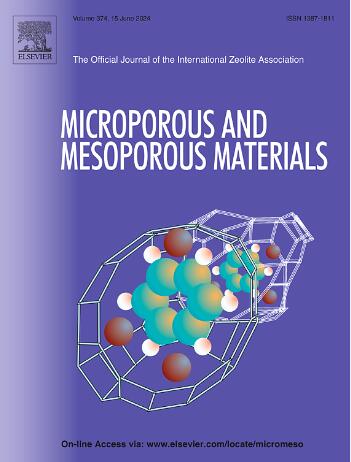
Microporous and Mesoporous Materials covers novel and significant aspects of porous solids classified as either microporous (pore size up to 2 nm) or mesoporous (pore size 2 to 50 nm). The porosity should have a specific impact on the material properties or application. Typical examples are zeolites and zeolite-like materials, pillared materials, clathrasils and clathrates, carbon molecular sieves, ordered mesoporous materials, organic/inorganic porous hybrid materials, or porous metal oxides. Both natural and synthetic porous materials are within the scope of the journal.
Topics which are particularly of interest include:
All aspects of natural microporous and mesoporous solids
The synthesis of crystalline or amorphous porous materials
The physico-chemical characterization of microporous and mesoporous solids, especially spectroscopic and microscopic
The modification of microporous and mesoporous solids, for example by ion exchange or solid-state reactions
All topics related to diffusion of mobile species in the pores of microporous and mesoporous materials
Adsorption (and other separation techniques) using microporous or mesoporous adsorbents
Catalysis by microporous and mesoporous materials
Host/guest interactions
Theoretical chemistry and modelling of host/guest interactions
All topics related to the application of microporous and mesoporous materials in industrial catalysis, separation technology, environmental protection, electrochemistry, membranes, sensors, optical devices, etc.





 京公网安备 11010802042870号
京ICP备2023020795号-1
京公网安备 11010802042870号
京ICP备2023020795号-1

 分享
分享
 求助内容:
求助内容: 应助结果提醒方式:
 扫码关注我们
