{"title":"低温条件下VOx/TiO2催化剂上水解氧化的协同增强驱动氯化芳烃的高效催化去除","authors":"Yunfeng Ma, Jianwen Lai, Bingcheng Lin, Xiaoqing Lin, Jiabao Lv, Fanxiang Meng, Zhongkang Han, Runtong Dong, Rong Jin, Guorui Liu, Masaki Takaoka, Xiaodong Li, Minghui Zheng","doi":"10.1021/acs.est.4c13995","DOIUrl":null,"url":null,"abstract":"The efficient catalytic elimination of toxic chlorinated aromatics (i.e., dioxins, chlorobenzenes, etc.) at low temperature is still a great challenge. Based on the VO<sub><i>x</i></sub>/TiO<sub>2</sub> catalyst, a hydrolysis-oxidation strategy (CeO<sub><i>x</i></sub> and WO<sub><i>x</i></sub> doping) was built for desirable low-temperature catalytic activity, product selectivity, H<sub>2</sub>O tolerance, and chlorine desorption. The in situ and ex situ experimental characterizations and density functional theory calculations revealed that hydrolysis sites favored molecular adsorption, C–Cl cleavage, and HCl formation; meanwhile, oxidation sites enhanced the activation of reactive oxygen species and improved oxygen mobility and redox properties. The enhanced oxygen storage/release capacity (33–53 fold) and extended redox cycle (e.g., from V<sup>5+</sup>↔V<sup>4+</sup> to V<sup>5+</sup>↔V<sup>4+</sup>↔V<sup>3+</sup>) favored the deep oxidation. The introduction of H<sub>2</sub>O triggered the hydrolysis–oxidation process that promoted the catalytic activity and chlorine desorption due to the elevated generation of ·O<sub>2</sub><sup>–</sup> and higher-activity ·OH. Furthermore, the water resistance of the VO<sub><i>x</i></sub>/TiO<sub>2</sub>-based catalyst was enhanced after the application of the hydrolysis–oxidation strategy. The V–Ce–W/Ti catalyst exhibited remarkable removal efficiency of dioxins (96.7–98.2%), which was reduced from 0.34–0.48 ng I-TEQ Nm<sup>–3</sup> to 0.006–0.016 ng I-TEQ Nm<sup>–3</sup> during pilot tests at 160–180 °C, achieving ultralow emissions. This work provides practical guidance for industry development for efficiently eliminating chlorinated organics in flue gas.","PeriodicalId":36,"journal":{"name":"环境科学与技术","volume":"6 1","pages":""},"PeriodicalIF":12.2000,"publicationDate":"2025-04-21","publicationTypes":"Journal Article","fieldsOfStudy":null,"isOpenAccess":false,"openAccessPdf":"","citationCount":"0","resultStr":"{\"title\":\"Synergistic Enhancement of Hydrolysis–Oxidation Drives Efficient Catalytic Elimination of Chlorinated Aromatics over VOx/TiO2 Catalysts at Low Temperature\",\"authors\":\"Yunfeng Ma, Jianwen Lai, Bingcheng Lin, Xiaoqing Lin, Jiabao Lv, Fanxiang Meng, Zhongkang Han, Runtong Dong, Rong Jin, Guorui Liu, Masaki Takaoka, Xiaodong Li, Minghui Zheng\",\"doi\":\"10.1021/acs.est.4c13995\",\"DOIUrl\":null,\"url\":null,\"abstract\":\"The efficient catalytic elimination of toxic chlorinated aromatics (i.e., dioxins, chlorobenzenes, etc.) at low temperature is still a great challenge. Based on the VO<sub><i>x</i></sub>/TiO<sub>2</sub> catalyst, a hydrolysis-oxidation strategy (CeO<sub><i>x</i></sub> and WO<sub><i>x</i></sub> doping) was built for desirable low-temperature catalytic activity, product selectivity, H<sub>2</sub>O tolerance, and chlorine desorption. The in situ and ex situ experimental characterizations and density functional theory calculations revealed that hydrolysis sites favored molecular adsorption, C–Cl cleavage, and HCl formation; meanwhile, oxidation sites enhanced the activation of reactive oxygen species and improved oxygen mobility and redox properties. The enhanced oxygen storage/release capacity (33–53 fold) and extended redox cycle (e.g., from V<sup>5+</sup>↔V<sup>4+</sup> to V<sup>5+</sup>↔V<sup>4+</sup>↔V<sup>3+</sup>) favored the deep oxidation. The introduction of H<sub>2</sub>O triggered the hydrolysis–oxidation process that promoted the catalytic activity and chlorine desorption due to the elevated generation of ·O<sub>2</sub><sup>–</sup> and higher-activity ·OH. Furthermore, the water resistance of the VO<sub><i>x</i></sub>/TiO<sub>2</sub>-based catalyst was enhanced after the application of the hydrolysis–oxidation strategy. The V–Ce–W/Ti catalyst exhibited remarkable removal efficiency of dioxins (96.7–98.2%), which was reduced from 0.34–0.48 ng I-TEQ Nm<sup>–3</sup> to 0.006–0.016 ng I-TEQ Nm<sup>–3</sup> during pilot tests at 160–180 °C, achieving ultralow emissions. This work provides practical guidance for industry development for efficiently eliminating chlorinated organics in flue gas.\",\"PeriodicalId\":36,\"journal\":{\"name\":\"环境科学与技术\",\"volume\":\"6 1\",\"pages\":\"\"},\"PeriodicalIF\":12.2000,\"publicationDate\":\"2025-04-21\",\"publicationTypes\":\"Journal Article\",\"fieldsOfStudy\":null,\"isOpenAccess\":false,\"openAccessPdf\":\"\",\"citationCount\":\"0\",\"resultStr\":null,\"platform\":\"Semanticscholar\",\"paperid\":null,\"PeriodicalName\":\"环境科学与技术\",\"FirstCategoryId\":\"1\",\"ListUrlMain\":\"https://doi.org/10.1021/acs.est.4c13995\",\"RegionNum\":1,\"RegionCategory\":\"环境科学与生态学\",\"ArticlePicture\":[],\"TitleCN\":null,\"AbstractTextCN\":null,\"PMCID\":null,\"EPubDate\":\"\",\"PubModel\":\"\",\"JCR\":\"Q1\",\"JCRName\":\"ENGINEERING, ENVIRONMENTAL\",\"Score\":null,\"Total\":0}","platform":"Semanticscholar","paperid":null,"PeriodicalName":"环境科学与技术","FirstCategoryId":"1","ListUrlMain":"https://doi.org/10.1021/acs.est.4c13995","RegionNum":1,"RegionCategory":"环境科学与生态学","ArticlePicture":[],"TitleCN":null,"AbstractTextCN":null,"PMCID":null,"EPubDate":"","PubModel":"","JCR":"Q1","JCRName":"ENGINEERING, ENVIRONMENTAL","Score":null,"Total":0}
引用次数: 0
摘要
在低温下高效催化去除有毒的氯化芳烃(如二恶英、氯苯等)仍然是一个很大的挑战。基于VOx/TiO2催化剂,建立了一种水解氧化策略(CeOx和WOx掺杂),具有理想的低温催化活性,产物选择性,水耐受性和氯脱附。原位和非原位实验表征和密度泛函理论计算表明,水解位点有利于分子吸附、C-Cl裂解和HCl形成;同时,氧化位点增强了活性氧的活性,改善了氧的迁移率和氧化还原性能。增强的氧储存/释放能力(33-53倍)和延长的氧化还原循环(例如,从V5+↔V4+到V5+↔V4+)有利于深度氧化。H2O的引入触发了水解-氧化过程,由于·O2 -的生成增加和活性更高的·OH的生成,促进了催化活性和氯的脱附。此外,采用水解-氧化策略后,VOx/ tio2基催化剂的耐水性得到增强。在160 ~ 180℃中试条件下,V-Ce-W /Ti催化剂对二恶英的去除率达到967 ~ 98.2%,从0.34 ~ 0.48 ng I-TEQ Nm-3降至0.006 ~ 0.016 ng I-TEQ Nm-3,实现了超低排放。这项工作为工业发展提供了有效消除烟气中含氯有机物的实践指导。
Synergistic Enhancement of Hydrolysis–Oxidation Drives Efficient Catalytic Elimination of Chlorinated Aromatics over VOx/TiO2 Catalysts at Low Temperature
The efficient catalytic elimination of toxic chlorinated aromatics (i.e., dioxins, chlorobenzenes, etc.) at low temperature is still a great challenge. Based on the VOx/TiO2 catalyst, a hydrolysis-oxidation strategy (CeOx and WOx doping) was built for desirable low-temperature catalytic activity, product selectivity, H2O tolerance, and chlorine desorption. The in situ and ex situ experimental characterizations and density functional theory calculations revealed that hydrolysis sites favored molecular adsorption, C–Cl cleavage, and HCl formation; meanwhile, oxidation sites enhanced the activation of reactive oxygen species and improved oxygen mobility and redox properties. The enhanced oxygen storage/release capacity (33–53 fold) and extended redox cycle (e.g., from V5+↔V4+ to V5+↔V4+↔V3+) favored the deep oxidation. The introduction of H2O triggered the hydrolysis–oxidation process that promoted the catalytic activity and chlorine desorption due to the elevated generation of ·O2– and higher-activity ·OH. Furthermore, the water resistance of the VOx/TiO2-based catalyst was enhanced after the application of the hydrolysis–oxidation strategy. The V–Ce–W/Ti catalyst exhibited remarkable removal efficiency of dioxins (96.7–98.2%), which was reduced from 0.34–0.48 ng I-TEQ Nm–3 to 0.006–0.016 ng I-TEQ Nm–3 during pilot tests at 160–180 °C, achieving ultralow emissions. This work provides practical guidance for industry development for efficiently eliminating chlorinated organics in flue gas.
期刊介绍:
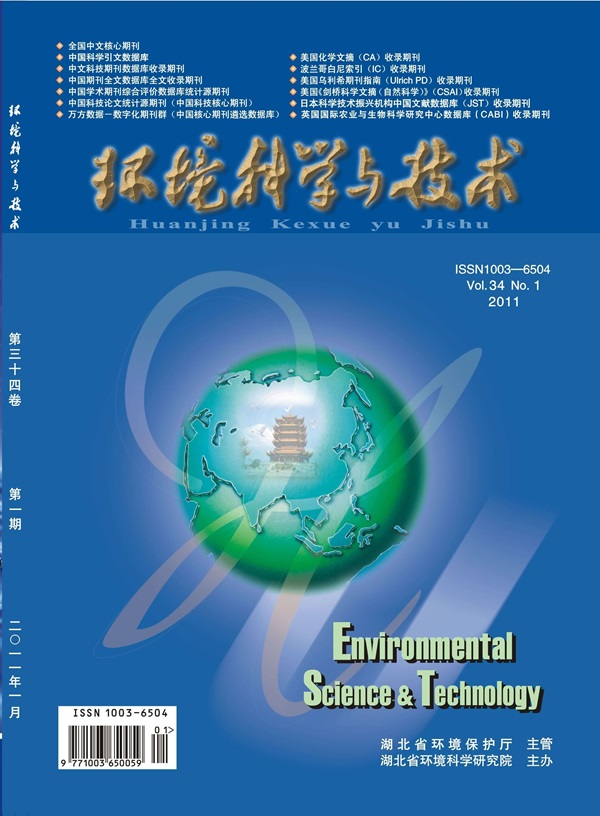
Environmental Science & Technology (ES&T) is a co-sponsored academic and technical magazine by the Hubei Provincial Environmental Protection Bureau and the Hubei Provincial Academy of Environmental Sciences.
Environmental Science & Technology (ES&T) holds the status of Chinese core journals, scientific papers source journals of China, Chinese Science Citation Database source journals, and Chinese Academic Journal Comprehensive Evaluation Database source journals. This publication focuses on the academic field of environmental protection, featuring articles related to environmental protection and technical advancements.





 京公网安备 11010802042870号
京ICP备2023020795号-1
京公网安备 11010802042870号
京ICP备2023020795号-1

 分享
分享
 求助内容:
求助内容: 应助结果提醒方式:
 扫码关注我们
