Ming-Chao Zhu , Guo-Li Chen , Kun Song , Jian-Jiao Xin , Xiao-Ming Huang
{"title":"采用四方双锥体形貌的ZnO纳米颗粒制备双选择性高灵敏度二丁胺和二异丙胺传感器","authors":"Ming-Chao Zhu , Guo-Li Chen , Kun Song , Jian-Jiao Xin , Xiao-Ming Huang","doi":"10.1016/j.apsusc.2025.163322","DOIUrl":null,"url":null,"abstract":"<div><div>The simultaneous detection of the toxic gases Dibutylamine (DBA) and Diisopropylamine (DIPA) by ZnO has not been reported, making dual detection of these gases a challenge. In this paper, a tetragonal dipyramid-like ZnO precursor was prepared using a hydrothermal method, focusing on microstructural changes at different calcination temperatures and their effects on gas sensing performance. After calcination at 550 °C, tetragonal dipyramid-like ZnO (ZnO<sub>TD</sub>-550) was obtained, featuring two grooves that serve as “bridges” between the two tetragonal cones. The structure consists of uniform nanoparticles with a broad mesoporous distribution, high specific surface area, and abundant oxygen vacancies. These features collectively enable rapid gas reactions, enhancing sensor sensititity. The tetragonal dipyramid-like ZnO sensor exhibits an significant response to 100 ppm DBA at 133 °C (<em>S</em> = 300.6), and a comparable response to the same concentration of DIPA at 217 °C (<em>S</em> = 271.5). The ZnO<sub>TD</sub>-550 sensor also demonstrates a low detection limit, excellent long-term stability, reproducibility and humidity resistance for DBA/DIPA detection. This pioneering study reveals the capability of ZnO-based sensors for highly sensitivity and dual-selectivity detection of the toxic gases DBA and DIPA at distinct operating temperatures. In addition, the dual-sensitivity mechanisms have been thoroughly explored and analyzed.</div></div>","PeriodicalId":247,"journal":{"name":"Applied Surface Science","volume":"701 ","pages":"Article 163322"},"PeriodicalIF":6.9000,"publicationDate":"2025-08-30","publicationTypes":"Journal Article","fieldsOfStudy":null,"isOpenAccess":false,"openAccessPdf":"","citationCount":"0","resultStr":"{\"title\":\"Dual-selectivity and high-sensitivity sensor for dibutylamine and diisopropylamine detection using ZnO nanoparticles with tetragonal dipyramidal morphology\",\"authors\":\"Ming-Chao Zhu , Guo-Li Chen , Kun Song , Jian-Jiao Xin , Xiao-Ming Huang\",\"doi\":\"10.1016/j.apsusc.2025.163322\",\"DOIUrl\":null,\"url\":null,\"abstract\":\"<div><div>The simultaneous detection of the toxic gases Dibutylamine (DBA) and Diisopropylamine (DIPA) by ZnO has not been reported, making dual detection of these gases a challenge. In this paper, a tetragonal dipyramid-like ZnO precursor was prepared using a hydrothermal method, focusing on microstructural changes at different calcination temperatures and their effects on gas sensing performance. After calcination at 550 °C, tetragonal dipyramid-like ZnO (ZnO<sub>TD</sub>-550) was obtained, featuring two grooves that serve as “bridges” between the two tetragonal cones. The structure consists of uniform nanoparticles with a broad mesoporous distribution, high specific surface area, and abundant oxygen vacancies. These features collectively enable rapid gas reactions, enhancing sensor sensititity. The tetragonal dipyramid-like ZnO sensor exhibits an significant response to 100 ppm DBA at 133 °C (<em>S</em> = 300.6), and a comparable response to the same concentration of DIPA at 217 °C (<em>S</em> = 271.5). The ZnO<sub>TD</sub>-550 sensor also demonstrates a low detection limit, excellent long-term stability, reproducibility and humidity resistance for DBA/DIPA detection. This pioneering study reveals the capability of ZnO-based sensors for highly sensitivity and dual-selectivity detection of the toxic gases DBA and DIPA at distinct operating temperatures. In addition, the dual-sensitivity mechanisms have been thoroughly explored and analyzed.</div></div>\",\"PeriodicalId\":247,\"journal\":{\"name\":\"Applied Surface Science\",\"volume\":\"701 \",\"pages\":\"Article 163322\"},\"PeriodicalIF\":6.9000,\"publicationDate\":\"2025-08-30\",\"publicationTypes\":\"Journal Article\",\"fieldsOfStudy\":null,\"isOpenAccess\":false,\"openAccessPdf\":\"\",\"citationCount\":\"0\",\"resultStr\":null,\"platform\":\"Semanticscholar\",\"paperid\":null,\"PeriodicalName\":\"Applied Surface Science\",\"FirstCategoryId\":\"88\",\"ListUrlMain\":\"https://www.sciencedirect.com/science/article/pii/S0169433225010360\",\"RegionNum\":2,\"RegionCategory\":\"材料科学\",\"ArticlePicture\":[],\"TitleCN\":null,\"AbstractTextCN\":null,\"PMCID\":null,\"EPubDate\":\"2025/4/20 0:00:00\",\"PubModel\":\"Epub\",\"JCR\":\"Q2\",\"JCRName\":\"CHEMISTRY, PHYSICAL\",\"Score\":null,\"Total\":0}","platform":"Semanticscholar","paperid":null,"PeriodicalName":"Applied Surface Science","FirstCategoryId":"88","ListUrlMain":"https://www.sciencedirect.com/science/article/pii/S0169433225010360","RegionNum":2,"RegionCategory":"材料科学","ArticlePicture":[],"TitleCN":null,"AbstractTextCN":null,"PMCID":null,"EPubDate":"2025/4/20 0:00:00","PubModel":"Epub","JCR":"Q2","JCRName":"CHEMISTRY, PHYSICAL","Score":null,"Total":0}
引用次数: 0
摘要
用氧化锌同时检测有毒气体二丁胺(DBA)和二异丙胺(DIPA)尚未见报道,这使得对这些气体的双重检测成为一个挑战。本文采用水热法制备了一种类似四方双锥体的ZnO前驱体,重点研究了不同煅烧温度下ZnO前驱体的微观结构变化及其对气敏性能的影响。在550 °C下煅烧后,得到了方形双锥体状ZnO (ZnOTD-550),具有两个凹槽作为两个方形锥体之间的“桥梁”。该结构由均匀的纳米颗粒组成,具有广泛的介孔分布、高比表面积和丰富的氧空位。这些特点共同使快速气体反应,提高传感器灵敏度。在133 °C (S = 300.6)下,对100 ppm DBA具有显著的响应,在217 °C (S = 271.5)下,对相同浓度的DIPA具有相当的响应。ZnOTD-550传感器还具有低检测限,出色的长期稳定性,重复性和耐湿度的DBA/DIPA检测。这项开创性的研究揭示了zno传感器在不同工作温度下对有毒气体DBA和DIPA进行高灵敏度和双选择性检测的能力。此外,还对双敏感机理进行了深入的探讨和分析。
Dual-selectivity and high-sensitivity sensor for dibutylamine and diisopropylamine detection using ZnO nanoparticles with tetragonal dipyramidal morphology
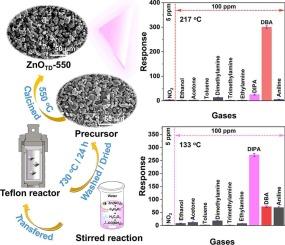
The simultaneous detection of the toxic gases Dibutylamine (DBA) and Diisopropylamine (DIPA) by ZnO has not been reported, making dual detection of these gases a challenge. In this paper, a tetragonal dipyramid-like ZnO precursor was prepared using a hydrothermal method, focusing on microstructural changes at different calcination temperatures and their effects on gas sensing performance. After calcination at 550 °C, tetragonal dipyramid-like ZnO (ZnOTD-550) was obtained, featuring two grooves that serve as “bridges” between the two tetragonal cones. The structure consists of uniform nanoparticles with a broad mesoporous distribution, high specific surface area, and abundant oxygen vacancies. These features collectively enable rapid gas reactions, enhancing sensor sensititity. The tetragonal dipyramid-like ZnO sensor exhibits an significant response to 100 ppm DBA at 133 °C (S = 300.6), and a comparable response to the same concentration of DIPA at 217 °C (S = 271.5). The ZnOTD-550 sensor also demonstrates a low detection limit, excellent long-term stability, reproducibility and humidity resistance for DBA/DIPA detection. This pioneering study reveals the capability of ZnO-based sensors for highly sensitivity and dual-selectivity detection of the toxic gases DBA and DIPA at distinct operating temperatures. In addition, the dual-sensitivity mechanisms have been thoroughly explored and analyzed.
期刊介绍:
Applied Surface Science covers topics contributing to a better understanding of surfaces, interfaces, nanostructures and their applications. The journal is concerned with scientific research on the atomic and molecular level of material properties determined with specific surface analytical techniques and/or computational methods, as well as the processing of such structures.





 京公网安备 11010802042870号
京ICP备2023020795号-1
京公网安备 11010802042870号
京ICP备2023020795号-1

 分享
分享
 求助内容:
求助内容: 应助结果提醒方式:
 扫码关注我们
