{"title":"具有强大界面电场的 Z 型 Ni(OH)2/CoTiO3 纳米复合材料在可见光驱动下高效还原二氧化碳","authors":"Lanyang Wang, Chao Qu, Fanwei Meng, Decai Yang, Zezhong Zhao, Qing Ye","doi":"10.1016/j.seppur.2025.133169","DOIUrl":null,"url":null,"abstract":"<div><div>Visible-light-driven CO<sub>2</sub> conversion into industry-beneficial chemicals is regarded as a sustainable environmental technology. However, its effectiveness was hindered by poor CO<sub>2</sub> adsorption activation and high rates of electron-hole recombination. To address these challenges, novel Z-scheme Ni(OH)<sub>2</sub>/CoTiO<sub>3</sub> (NO/CTO) heterostructure photocatalysts are synthesized via a facile chemical precipitation method, which demonstrate significant photocatalytic activity potential under visible light. In this study, the incorporation of Ni(OH)<sub>2</sub> enhances the specific surface area of the photocatalyst, thereby augmenting its CO<sub>2</sub> adsorption capacity. The optimized NO/CTO (0.2NO/CTO) photocatalysts exhibit the highest activity and CO selectivity, with CO production rates and selectivity reaching 10441 μmol·g<sup>−1</sup>·h<sup>−1</sup> and 85.2 %, respectively, which are 4.0 and 5.8 times higher than those of pristine CoTiO<sub>3</sub>. In-situ Diffuse Reflectance Infrared Fourier Transform spectroscopy (DRIFT) analysis reveals effective CO<sub>2</sub> adsorption on the NO/CTO surface and the formation mechanism of intermediates in the reaction. X-ray photoelectron spectroscopy (XPS) analysis indicates strong electronic coupling between Ni(OH)<sub>2</sub> and CoTiO<sub>3</sub>. Density Functional Theory (DFT) simulations further elucidate the generation of interfacial electric field (IEF), facilitating the formation of an effective Z-scheme heterojunction. This study provides a promising strategy to produce low-cost transition metal based nanocomposites for efficient CO<sub>2</sub> photoreduction.</div></div>","PeriodicalId":427,"journal":{"name":"Separation and Purification Technology","volume":"369 ","pages":"Article 133169"},"PeriodicalIF":9.1000,"publicationDate":"2025-10-07","publicationTypes":"Journal Article","fieldsOfStudy":null,"isOpenAccess":false,"openAccessPdf":"","citationCount":"0","resultStr":"{\"title\":\"Efficient visible-light-driven CO2 reduction on Z-scheme Ni(OH)2/CoTiO3 nanocomposites with robust interfacial electric field\",\"authors\":\"Lanyang Wang, Chao Qu, Fanwei Meng, Decai Yang, Zezhong Zhao, Qing Ye\",\"doi\":\"10.1016/j.seppur.2025.133169\",\"DOIUrl\":null,\"url\":null,\"abstract\":\"<div><div>Visible-light-driven CO<sub>2</sub> conversion into industry-beneficial chemicals is regarded as a sustainable environmental technology. However, its effectiveness was hindered by poor CO<sub>2</sub> adsorption activation and high rates of electron-hole recombination. To address these challenges, novel Z-scheme Ni(OH)<sub>2</sub>/CoTiO<sub>3</sub> (NO/CTO) heterostructure photocatalysts are synthesized via a facile chemical precipitation method, which demonstrate significant photocatalytic activity potential under visible light. In this study, the incorporation of Ni(OH)<sub>2</sub> enhances the specific surface area of the photocatalyst, thereby augmenting its CO<sub>2</sub> adsorption capacity. The optimized NO/CTO (0.2NO/CTO) photocatalysts exhibit the highest activity and CO selectivity, with CO production rates and selectivity reaching 10441 μmol·g<sup>−1</sup>·h<sup>−1</sup> and 85.2 %, respectively, which are 4.0 and 5.8 times higher than those of pristine CoTiO<sub>3</sub>. In-situ Diffuse Reflectance Infrared Fourier Transform spectroscopy (DRIFT) analysis reveals effective CO<sub>2</sub> adsorption on the NO/CTO surface and the formation mechanism of intermediates in the reaction. X-ray photoelectron spectroscopy (XPS) analysis indicates strong electronic coupling between Ni(OH)<sub>2</sub> and CoTiO<sub>3</sub>. Density Functional Theory (DFT) simulations further elucidate the generation of interfacial electric field (IEF), facilitating the formation of an effective Z-scheme heterojunction. This study provides a promising strategy to produce low-cost transition metal based nanocomposites for efficient CO<sub>2</sub> photoreduction.</div></div>\",\"PeriodicalId\":427,\"journal\":{\"name\":\"Separation and Purification Technology\",\"volume\":\"369 \",\"pages\":\"Article 133169\"},\"PeriodicalIF\":9.1000,\"publicationDate\":\"2025-10-07\",\"publicationTypes\":\"Journal Article\",\"fieldsOfStudy\":null,\"isOpenAccess\":false,\"openAccessPdf\":\"\",\"citationCount\":\"0\",\"resultStr\":null,\"platform\":\"Semanticscholar\",\"paperid\":null,\"PeriodicalName\":\"Separation and Purification Technology\",\"FirstCategoryId\":\"5\",\"ListUrlMain\":\"https://www.sciencedirect.com/science/article/pii/S1383586625017666\",\"RegionNum\":1,\"RegionCategory\":\"工程技术\",\"ArticlePicture\":[],\"TitleCN\":null,\"AbstractTextCN\":null,\"PMCID\":null,\"EPubDate\":\"2025/4/22 0:00:00\",\"PubModel\":\"Epub\",\"JCR\":\"Q1\",\"JCRName\":\"ENGINEERING, CHEMICAL\",\"Score\":null,\"Total\":0}","platform":"Semanticscholar","paperid":null,"PeriodicalName":"Separation and Purification Technology","FirstCategoryId":"5","ListUrlMain":"https://www.sciencedirect.com/science/article/pii/S1383586625017666","RegionNum":1,"RegionCategory":"工程技术","ArticlePicture":[],"TitleCN":null,"AbstractTextCN":null,"PMCID":null,"EPubDate":"2025/4/22 0:00:00","PubModel":"Epub","JCR":"Q1","JCRName":"ENGINEERING, CHEMICAL","Score":null,"Total":0}
引用次数: 0
摘要
可见光驱动的二氧化碳转化为对工业有益的化学品被认为是一种可持续的环保技术。然而,二氧化碳吸附活化性能差和电子-空穴高重组率阻碍了该技术的有效性。为了应对这些挑战,研究人员通过简便的化学沉淀法合成了新型 Z 型 Ni(OH)2/CoTiO3 (NO/CTO)异质结构光催化剂,该催化剂在可见光下具有显著的光催化活性潜力。在本研究中,Ni(OH)2 的加入提高了光催化剂的比表面积,从而增强了其对 CO2 的吸附能力。优化后的 NO/CTO (0.2NO/CTO)光催化剂表现出最高的活性和 CO 选择性,CO 生成率和选择性分别达到 10441 mmol-g-1-h-1 和 85.2%,分别是原始 CoTiO3 的 4.0 倍和 5.8 倍。原位漫反射红外傅立叶变换光谱(DRIFT)分析揭示了 NO/CTO 表面对 CO2 的有效吸附以及反应中间产物的形成机理。X 射线光电子能谱 (XPS) 分析表明,Ni(OH)2 和 CoTiO3 之间存在很强的电子耦合。密度泛函理论(DFT)模拟进一步阐明了界面电场(IEF)的产生,促进了有效 Z 型异质结的形成。这项研究为生产基于过渡金属的低成本纳米复合材料以实现高效的二氧化碳光还原提供了一种可行的策略。
Efficient visible-light-driven CO2 reduction on Z-scheme Ni(OH)2/CoTiO3 nanocomposites with robust interfacial electric field
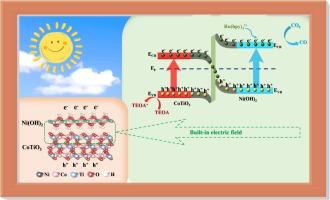
Visible-light-driven CO2 conversion into industry-beneficial chemicals is regarded as a sustainable environmental technology. However, its effectiveness was hindered by poor CO2 adsorption activation and high rates of electron-hole recombination. To address these challenges, novel Z-scheme Ni(OH)2/CoTiO3 (NO/CTO) heterostructure photocatalysts are synthesized via a facile chemical precipitation method, which demonstrate significant photocatalytic activity potential under visible light. In this study, the incorporation of Ni(OH)2 enhances the specific surface area of the photocatalyst, thereby augmenting its CO2 adsorption capacity. The optimized NO/CTO (0.2NO/CTO) photocatalysts exhibit the highest activity and CO selectivity, with CO production rates and selectivity reaching 10441 μmol·g−1·h−1 and 85.2 %, respectively, which are 4.0 and 5.8 times higher than those of pristine CoTiO3. In-situ Diffuse Reflectance Infrared Fourier Transform spectroscopy (DRIFT) analysis reveals effective CO2 adsorption on the NO/CTO surface and the formation mechanism of intermediates in the reaction. X-ray photoelectron spectroscopy (XPS) analysis indicates strong electronic coupling between Ni(OH)2 and CoTiO3. Density Functional Theory (DFT) simulations further elucidate the generation of interfacial electric field (IEF), facilitating the formation of an effective Z-scheme heterojunction. This study provides a promising strategy to produce low-cost transition metal based nanocomposites for efficient CO2 photoreduction.
期刊介绍:
Separation and Purification Technology is a premier journal committed to sharing innovative methods for separation and purification in chemical and environmental engineering, encompassing both homogeneous solutions and heterogeneous mixtures. Our scope includes the separation and/or purification of liquids, vapors, and gases, as well as carbon capture and separation techniques. However, it's important to note that methods solely intended for analytical purposes are not within the scope of the journal. Additionally, disciplines such as soil science, polymer science, and metallurgy fall outside the purview of Separation and Purification Technology. Join us in advancing the field of separation and purification methods for sustainable solutions in chemical and environmental engineering.





 京公网安备 11010802042870号
京ICP备2023020795号-1
京公网安备 11010802042870号
京ICP备2023020795号-1

 分享
分享
 求助内容:
求助内容: 应助结果提醒方式:
 扫码关注我们
