{"title":"氮掺杂空心碳球上原子分散钴位作为高性能锂硫电池的高效电催化剂","authors":"Xunli Guo, Mingzhi Yang, Jiahao Hou, Hongyun Li, Zhewen Liu, Yuheng Cui, Dong Shi, Haixiao Hu, Baoguo Zhang, Yongliang Shao, Yongzhong Wu, Xiaopeng Hao","doi":"10.1016/j.cej.2025.162955","DOIUrl":null,"url":null,"abstract":"Lithium-sulfur batteries (LSBs) face substantial performance limitations, primarily due to the slow kinetics of conversion and the detrimental shuttling effect of lithium polysulfides (LiPSs). In this study, cobalt single-atom catalysts were synthesized on nitrogen-doped hollow carbon spheres through the impregnation adsorption method. The combination of atomically dispersed Co sites with hollow carbon spheres enables the formation of nitrogen-doped hollow carbon spheres loaded with cobalt single-atom catalysts (NHCS@CoSAs), which act as efficient sulfur hosts. While being employed as a bifunctional electrocatalyst, the Co-N<sub>4</sub> catalytic sites not only inhibit the detrimental shuttle effect by adsorbing LiPSs but also accelerate their interfacial redox conversion, promoting faster conversion kinetics. This results in LSBs achieving a stable cycling life exceeding 2000 cycles, with a capacity fade of just 0.026 % per cycle at 2C. In addition, Li-S pouch cells featuring NHCS@CoSAs exhibit a remarkable initial capacity of 972.2 mAh g<sup>−1</sup> at a rate of 0.1C, even under a high sulfur loading of 4.16 mg cm<sup>−2</sup>. This study could offer fresh perspectives on developing high-performance sulfur-based cathodes for LSBs.","PeriodicalId":270,"journal":{"name":"Chemical Engineering Journal","volume":"51 1","pages":""},"PeriodicalIF":12.5000,"publicationDate":"2025-04-22","publicationTypes":"Journal Article","fieldsOfStudy":null,"isOpenAccess":false,"openAccessPdf":"","citationCount":"0","resultStr":"{\"title\":\"Atomically dispersed cobalt sites on nitrogen-doped hollow carbon spheres as efficient electrocatalysts for high performance lithium-sulfur batteries\",\"authors\":\"Xunli Guo, Mingzhi Yang, Jiahao Hou, Hongyun Li, Zhewen Liu, Yuheng Cui, Dong Shi, Haixiao Hu, Baoguo Zhang, Yongliang Shao, Yongzhong Wu, Xiaopeng Hao\",\"doi\":\"10.1016/j.cej.2025.162955\",\"DOIUrl\":null,\"url\":null,\"abstract\":\"Lithium-sulfur batteries (LSBs) face substantial performance limitations, primarily due to the slow kinetics of conversion and the detrimental shuttling effect of lithium polysulfides (LiPSs). In this study, cobalt single-atom catalysts were synthesized on nitrogen-doped hollow carbon spheres through the impregnation adsorption method. The combination of atomically dispersed Co sites with hollow carbon spheres enables the formation of nitrogen-doped hollow carbon spheres loaded with cobalt single-atom catalysts (NHCS@CoSAs), which act as efficient sulfur hosts. While being employed as a bifunctional electrocatalyst, the Co-N<sub>4</sub> catalytic sites not only inhibit the detrimental shuttle effect by adsorbing LiPSs but also accelerate their interfacial redox conversion, promoting faster conversion kinetics. This results in LSBs achieving a stable cycling life exceeding 2000 cycles, with a capacity fade of just 0.026 % per cycle at 2C. In addition, Li-S pouch cells featuring NHCS@CoSAs exhibit a remarkable initial capacity of 972.2 mAh g<sup>−1</sup> at a rate of 0.1C, even under a high sulfur loading of 4.16 mg cm<sup>−2</sup>. This study could offer fresh perspectives on developing high-performance sulfur-based cathodes for LSBs.\",\"PeriodicalId\":270,\"journal\":{\"name\":\"Chemical Engineering Journal\",\"volume\":\"51 1\",\"pages\":\"\"},\"PeriodicalIF\":12.5000,\"publicationDate\":\"2025-04-22\",\"publicationTypes\":\"Journal Article\",\"fieldsOfStudy\":null,\"isOpenAccess\":false,\"openAccessPdf\":\"\",\"citationCount\":\"0\",\"resultStr\":null,\"platform\":\"Semanticscholar\",\"paperid\":null,\"PeriodicalName\":\"Chemical Engineering Journal\",\"FirstCategoryId\":\"5\",\"ListUrlMain\":\"https://doi.org/10.1016/j.cej.2025.162955\",\"RegionNum\":1,\"RegionCategory\":\"工程技术\",\"ArticlePicture\":[],\"TitleCN\":null,\"AbstractTextCN\":null,\"PMCID\":null,\"EPubDate\":\"\",\"PubModel\":\"\",\"JCR\":\"Q1\",\"JCRName\":\"ENGINEERING, CHEMICAL\",\"Score\":null,\"Total\":0}","platform":"Semanticscholar","paperid":null,"PeriodicalName":"Chemical Engineering Journal","FirstCategoryId":"5","ListUrlMain":"https://doi.org/10.1016/j.cej.2025.162955","RegionNum":1,"RegionCategory":"工程技术","ArticlePicture":[],"TitleCN":null,"AbstractTextCN":null,"PMCID":null,"EPubDate":"","PubModel":"","JCR":"Q1","JCRName":"ENGINEERING, CHEMICAL","Score":null,"Total":0}
引用次数: 0
摘要
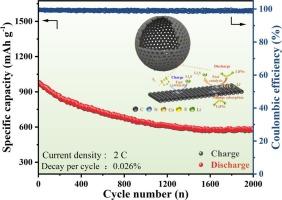
锂硫电池(LSBs)面临着很大的性能限制,主要是由于转换动力学缓慢和锂多硫化物(LiPSs)的有害穿梭效应。本研究采用浸渍吸附法在氮掺杂的空心碳球上合成钴单原子催化剂。原子分散的Co位点与空心碳球的结合可以形成装载钴单原子催化剂的氮掺杂空心碳球(NHCS@CoSAs),作为有效的硫宿主。作为双功能电催化剂,Co-N4催化位点不仅可以通过吸附LiPSs抑制有害的穿梭效应,还可以加速其界面氧化还原转化,促进更快的转化动力学。这导致lsb实现了超过2000次循环的稳定循环寿命,在2C时每个循环的容量衰减仅为0.026 %。此外,含有NHCS@CoSAs的Li-S袋电池在0.1C的速率下,即使在4.16 mg cm−2的高硫负载下,也表现出了972.2 mAh g−1的显着初始容量。该研究为开发高性能硫基lbs阴极提供了新的思路。
Atomically dispersed cobalt sites on nitrogen-doped hollow carbon spheres as efficient electrocatalysts for high performance lithium-sulfur batteries
Lithium-sulfur batteries (LSBs) face substantial performance limitations, primarily due to the slow kinetics of conversion and the detrimental shuttling effect of lithium polysulfides (LiPSs). In this study, cobalt single-atom catalysts were synthesized on nitrogen-doped hollow carbon spheres through the impregnation adsorption method. The combination of atomically dispersed Co sites with hollow carbon spheres enables the formation of nitrogen-doped hollow carbon spheres loaded with cobalt single-atom catalysts (NHCS@CoSAs), which act as efficient sulfur hosts. While being employed as a bifunctional electrocatalyst, the Co-N4 catalytic sites not only inhibit the detrimental shuttle effect by adsorbing LiPSs but also accelerate their interfacial redox conversion, promoting faster conversion kinetics. This results in LSBs achieving a stable cycling life exceeding 2000 cycles, with a capacity fade of just 0.026 % per cycle at 2C. In addition, Li-S pouch cells featuring NHCS@CoSAs exhibit a remarkable initial capacity of 972.2 mAh g−1 at a rate of 0.1C, even under a high sulfur loading of 4.16 mg cm−2. This study could offer fresh perspectives on developing high-performance sulfur-based cathodes for LSBs.
期刊介绍:
The Chemical Engineering Journal is an international research journal that invites contributions of original and novel fundamental research. It aims to provide an international platform for presenting original fundamental research, interpretative reviews, and discussions on new developments in chemical engineering. The journal welcomes papers that describe novel theory and its practical application, as well as those that demonstrate the transfer of techniques from other disciplines. It also welcomes reports on carefully conducted experimental work that is soundly interpreted. The main focus of the journal is on original and rigorous research results that have broad significance. The Catalysis section within the Chemical Engineering Journal focuses specifically on Experimental and Theoretical studies in the fields of heterogeneous catalysis, molecular catalysis, and biocatalysis. These studies have industrial impact on various sectors such as chemicals, energy, materials, foods, healthcare, and environmental protection.




 京公网安备 11010802042870号
京ICP备2023020795号-1
京公网安备 11010802042870号
京ICP备2023020795号-1

 分享
分享
 求助内容:
求助内容: 应助结果提醒方式:
 扫码关注我们
