Miao Sun, Xinyao Ji, Meichen Li, Yuan Yu, Kai Zhang, Chengyu Wang, Haiyue Yang
{"title":"用于海水淡化、热电发电和种植的低导热各向异性太阳能蒸发器","authors":"Miao Sun, Xinyao Ji, Meichen Li, Yuan Yu, Kai Zhang, Chengyu Wang, Haiyue Yang","doi":"10.1016/j.seppur.2025.133124","DOIUrl":null,"url":null,"abstract":"Solar-driven evaporation technology is considered an effective approach for obtaining fresh water. However, unnecessary heat loss and inefficient energy utilization decrease evaporation rate of solar evaporator. Herein, a multifunctional integrated aerogel-based evaporator is fabricated with anisotropic porous structure and low thermal diffusivity by the freeze-casting method, which not only reduces heat loss in evaporation process but also enables the formation of a power generation system and a desalination and cultivation system. The oriented pores of the aerogel-based evaporator enhance light refraction, promoting light absorption, which is beneficial for capillary action in seawater desalination. Additionally, the aerogel-based evaporator with anisotropic low thermal conductivities (0.066 W m<sup>−1</sup> K<sup>−1</sup> at axial direction and 0.058 W m<sup>−1</sup> K<sup>−1</sup> at radial direction) effectively minimizes thermal loss to the surrounding water. Under 1 sun irradiation (1 kW m<sup>−2</sup>), the aerogel-based evaporator exhibits the evaporation rate of 2.00 kg m<sup>−2</sup>h<sup>−1</sup> and 92.83 % evaporation efficiency. This effectiveness of the power generation system strategy in thermoelectric generation results in an output power of 1.14 W m<sup>−2</sup>, with a voltage of 92.9 mV and a current of 11.04 mA. Furthermore, a desalination and cultivation system are designed to enable concurrent evaporation, condensation, and collection of freshwater, demonstrating its potential for agriculture applications. This work demonstrates the feasibility of achieving high evaporation rates in seawater desalination through the design of an insulating aerogel evaporator with low thermal conductivity and provides a solution for alleviating freshwater shortages in remote coastal areas.","PeriodicalId":427,"journal":{"name":"Separation and Purification Technology","volume":"219 1","pages":""},"PeriodicalIF":9.1000,"publicationDate":"2025-04-22","publicationTypes":"Journal Article","fieldsOfStudy":null,"isOpenAccess":false,"openAccessPdf":"","citationCount":"0","resultStr":"{\"title\":\"Anisotropic solar evaporator with low thermal conductivity for desalination, thermoelectric generation and cultivation\",\"authors\":\"Miao Sun, Xinyao Ji, Meichen Li, Yuan Yu, Kai Zhang, Chengyu Wang, Haiyue Yang\",\"doi\":\"10.1016/j.seppur.2025.133124\",\"DOIUrl\":null,\"url\":null,\"abstract\":\"Solar-driven evaporation technology is considered an effective approach for obtaining fresh water. However, unnecessary heat loss and inefficient energy utilization decrease evaporation rate of solar evaporator. Herein, a multifunctional integrated aerogel-based evaporator is fabricated with anisotropic porous structure and low thermal diffusivity by the freeze-casting method, which not only reduces heat loss in evaporation process but also enables the formation of a power generation system and a desalination and cultivation system. The oriented pores of the aerogel-based evaporator enhance light refraction, promoting light absorption, which is beneficial for capillary action in seawater desalination. Additionally, the aerogel-based evaporator with anisotropic low thermal conductivities (0.066 W m<sup>−1</sup> K<sup>−1</sup> at axial direction and 0.058 W m<sup>−1</sup> K<sup>−1</sup> at radial direction) effectively minimizes thermal loss to the surrounding water. Under 1 sun irradiation (1 kW m<sup>−2</sup>), the aerogel-based evaporator exhibits the evaporation rate of 2.00 kg m<sup>−2</sup>h<sup>−1</sup> and 92.83 % evaporation efficiency. This effectiveness of the power generation system strategy in thermoelectric generation results in an output power of 1.14 W m<sup>−2</sup>, with a voltage of 92.9 mV and a current of 11.04 mA. Furthermore, a desalination and cultivation system are designed to enable concurrent evaporation, condensation, and collection of freshwater, demonstrating its potential for agriculture applications. This work demonstrates the feasibility of achieving high evaporation rates in seawater desalination through the design of an insulating aerogel evaporator with low thermal conductivity and provides a solution for alleviating freshwater shortages in remote coastal areas.\",\"PeriodicalId\":427,\"journal\":{\"name\":\"Separation and Purification Technology\",\"volume\":\"219 1\",\"pages\":\"\"},\"PeriodicalIF\":9.1000,\"publicationDate\":\"2025-04-22\",\"publicationTypes\":\"Journal Article\",\"fieldsOfStudy\":null,\"isOpenAccess\":false,\"openAccessPdf\":\"\",\"citationCount\":\"0\",\"resultStr\":null,\"platform\":\"Semanticscholar\",\"paperid\":null,\"PeriodicalName\":\"Separation and Purification Technology\",\"FirstCategoryId\":\"5\",\"ListUrlMain\":\"https://doi.org/10.1016/j.seppur.2025.133124\",\"RegionNum\":1,\"RegionCategory\":\"工程技术\",\"ArticlePicture\":[],\"TitleCN\":null,\"AbstractTextCN\":null,\"PMCID\":null,\"EPubDate\":\"\",\"PubModel\":\"\",\"JCR\":\"Q1\",\"JCRName\":\"ENGINEERING, CHEMICAL\",\"Score\":null,\"Total\":0}","platform":"Semanticscholar","paperid":null,"PeriodicalName":"Separation and Purification Technology","FirstCategoryId":"5","ListUrlMain":"https://doi.org/10.1016/j.seppur.2025.133124","RegionNum":1,"RegionCategory":"工程技术","ArticlePicture":[],"TitleCN":null,"AbstractTextCN":null,"PMCID":null,"EPubDate":"","PubModel":"","JCR":"Q1","JCRName":"ENGINEERING, CHEMICAL","Score":null,"Total":0}
引用次数: 0
摘要
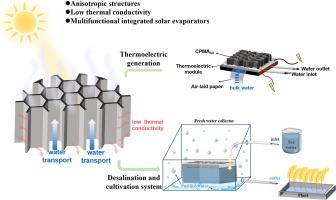
太阳能蒸发技术被认为是获取淡水的有效方法。然而,不必要的热损失和低效的能源利用降低了太阳能蒸发器的蒸发率。在此,利用冷冻铸造法制造了一种具有各向异性多孔结构和低热扩散性的气凝胶基多功能集成蒸发器,不仅减少了蒸发过程中的热量损失,还能形成发电系统和海水淡化及培养系统。气凝胶蒸发器的定向孔隙可增强光折射,促进光吸收,有利于海水淡化过程中的毛细作用。此外,气凝胶蒸发器具有各向异性的低导热系数(轴向 0.066 W m-1 K-1,径向 0.058 W m-1 K-1),可有效减少向周围水体的热损失。在太阳光照射(1 kW m-2)下,气凝胶蒸发器的蒸发率为 2.00 kg m-2h-1,蒸发效率为 92.83%。热电发电系统战略的这一有效性使输出功率达到 1.14 W m-2,电压为 92.9 mV,电流为 11.04 mA。此外,还设计了一个脱盐和培养系统,可同时蒸发、冷凝和收集淡水,证明了其在农业应用方面的潜力。这项工作证明了通过设计具有低热导率的绝缘气凝胶蒸发器实现海水淡化的高蒸发率的可行性,并为缓解偏远沿海地区的淡水短缺问题提供了一种解决方案。
Anisotropic solar evaporator with low thermal conductivity for desalination, thermoelectric generation and cultivation
Solar-driven evaporation technology is considered an effective approach for obtaining fresh water. However, unnecessary heat loss and inefficient energy utilization decrease evaporation rate of solar evaporator. Herein, a multifunctional integrated aerogel-based evaporator is fabricated with anisotropic porous structure and low thermal diffusivity by the freeze-casting method, which not only reduces heat loss in evaporation process but also enables the formation of a power generation system and a desalination and cultivation system. The oriented pores of the aerogel-based evaporator enhance light refraction, promoting light absorption, which is beneficial for capillary action in seawater desalination. Additionally, the aerogel-based evaporator with anisotropic low thermal conductivities (0.066 W m−1 K−1 at axial direction and 0.058 W m−1 K−1 at radial direction) effectively minimizes thermal loss to the surrounding water. Under 1 sun irradiation (1 kW m−2), the aerogel-based evaporator exhibits the evaporation rate of 2.00 kg m−2h−1 and 92.83 % evaporation efficiency. This effectiveness of the power generation system strategy in thermoelectric generation results in an output power of 1.14 W m−2, with a voltage of 92.9 mV and a current of 11.04 mA. Furthermore, a desalination and cultivation system are designed to enable concurrent evaporation, condensation, and collection of freshwater, demonstrating its potential for agriculture applications. This work demonstrates the feasibility of achieving high evaporation rates in seawater desalination through the design of an insulating aerogel evaporator with low thermal conductivity and provides a solution for alleviating freshwater shortages in remote coastal areas.
期刊介绍:
Separation and Purification Technology is a premier journal committed to sharing innovative methods for separation and purification in chemical and environmental engineering, encompassing both homogeneous solutions and heterogeneous mixtures. Our scope includes the separation and/or purification of liquids, vapors, and gases, as well as carbon capture and separation techniques. However, it's important to note that methods solely intended for analytical purposes are not within the scope of the journal. Additionally, disciplines such as soil science, polymer science, and metallurgy fall outside the purview of Separation and Purification Technology. Join us in advancing the field of separation and purification methods for sustainable solutions in chemical and environmental engineering.




 京公网安备 11010802042870号
京ICP备2023020795号-1
京公网安备 11010802042870号
京ICP备2023020795号-1

 分享
分享
 求助内容:
求助内容: 应助结果提醒方式:
 扫码关注我们
