{"title":"通过可持续食品消费减少碳排放:A-S-I框架在北京居民中的应用","authors":"Xuan YANG , Jiaxin ZOU , Jingyao GAO , Shu YANG","doi":"10.1016/j.resconrec.2025.108301","DOIUrl":null,"url":null,"abstract":"<div><div>The food sector represents one of the largest contributors to global climate change, making it urgent for the public to transform their food consumption behavior. However, food consumption behaviors that can facilitate carbon reduction, and how to classify these behaviors from the perspective of behavioral science, have not been deeply explored. This study pioneers a novel categorization of carbon-mitigating food consumption behaviors based on an A-S-I framework (i.e., “Avoid” food loss and waste, “Shift” to low-carbon alternatives, and “Improve” dietary structure). Such a classification not only encompasses the full spectrum of emission-altering behaviors but also enables identification of common determinants across behavioral categories. Integrating existing behavioral theories and literature on the influencing factors of these behaviors, we systematically construct three models containing both constraints and motivating factors underpinning “A-S-I” behaviors. Our analysis reveals substantial variations in influencing factors across behavioral types. Notably, we found that factors such as face motivation, knowledge, and perceived behavioral control outweigh traditional psychological constructs (such as attitudes and norms) in predicting these behaviors among Chinese consumers. Based on these findings, we propose targeted measures to further enhance the feasibility of behavioral changes. These measures could effectively facilitate low-carbon dietary transformations, potentially generating dual benefits for climate change mitigation and food safety.</div></div>","PeriodicalId":21153,"journal":{"name":"Resources Conservation and Recycling","volume":"219 ","pages":"Article 108301"},"PeriodicalIF":10.4000,"publicationDate":"2025-06-01","publicationTypes":"Journal Article","fieldsOfStudy":null,"isOpenAccess":false,"openAccessPdf":"","citationCount":"0","resultStr":"{\"title\":\"Reducing carbon emissions through sustainable food consumption: Applying an A-S-I framework on Beijing residents\",\"authors\":\"Xuan YANG , Jiaxin ZOU , Jingyao GAO , Shu YANG\",\"doi\":\"10.1016/j.resconrec.2025.108301\",\"DOIUrl\":null,\"url\":null,\"abstract\":\"<div><div>The food sector represents one of the largest contributors to global climate change, making it urgent for the public to transform their food consumption behavior. However, food consumption behaviors that can facilitate carbon reduction, and how to classify these behaviors from the perspective of behavioral science, have not been deeply explored. This study pioneers a novel categorization of carbon-mitigating food consumption behaviors based on an A-S-I framework (i.e., “Avoid” food loss and waste, “Shift” to low-carbon alternatives, and “Improve” dietary structure). Such a classification not only encompasses the full spectrum of emission-altering behaviors but also enables identification of common determinants across behavioral categories. Integrating existing behavioral theories and literature on the influencing factors of these behaviors, we systematically construct three models containing both constraints and motivating factors underpinning “A-S-I” behaviors. Our analysis reveals substantial variations in influencing factors across behavioral types. Notably, we found that factors such as face motivation, knowledge, and perceived behavioral control outweigh traditional psychological constructs (such as attitudes and norms) in predicting these behaviors among Chinese consumers. Based on these findings, we propose targeted measures to further enhance the feasibility of behavioral changes. These measures could effectively facilitate low-carbon dietary transformations, potentially generating dual benefits for climate change mitigation and food safety.</div></div>\",\"PeriodicalId\":21153,\"journal\":{\"name\":\"Resources Conservation and Recycling\",\"volume\":\"219 \",\"pages\":\"Article 108301\"},\"PeriodicalIF\":10.4000,\"publicationDate\":\"2025-06-01\",\"publicationTypes\":\"Journal Article\",\"fieldsOfStudy\":null,\"isOpenAccess\":false,\"openAccessPdf\":\"\",\"citationCount\":\"0\",\"resultStr\":null,\"platform\":\"Semanticscholar\",\"paperid\":null,\"PeriodicalName\":\"Resources Conservation and Recycling\",\"FirstCategoryId\":\"93\",\"ListUrlMain\":\"https://www.sciencedirect.com/science/article/pii/S0921344925001806\",\"RegionNum\":1,\"RegionCategory\":\"环境科学与生态学\",\"ArticlePicture\":[],\"TitleCN\":null,\"AbstractTextCN\":null,\"PMCID\":null,\"EPubDate\":\"2025/4/22 0:00:00\",\"PubModel\":\"Epub\",\"JCR\":\"Q1\",\"JCRName\":\"ENGINEERING, ENVIRONMENTAL\",\"Score\":null,\"Total\":0}","platform":"Semanticscholar","paperid":null,"PeriodicalName":"Resources Conservation and Recycling","FirstCategoryId":"93","ListUrlMain":"https://www.sciencedirect.com/science/article/pii/S0921344925001806","RegionNum":1,"RegionCategory":"环境科学与生态学","ArticlePicture":[],"TitleCN":null,"AbstractTextCN":null,"PMCID":null,"EPubDate":"2025/4/22 0:00:00","PubModel":"Epub","JCR":"Q1","JCRName":"ENGINEERING, ENVIRONMENTAL","Score":null,"Total":0}
引用次数: 0
摘要
食品行业是全球气候变化的最大贡献者之一,因此公众迫切需要改变他们的食品消费行为。然而,能够促进碳减排的食物消费行为,以及如何从行为科学的角度对这些行为进行分类,尚未得到深入的探讨。本研究基于a - s - i框架(即“避免”食物损失和浪费、“转向”低碳替代品和“改善”饮食结构),开创了一种新的碳减排食品消费行为分类。这样的分类不仅涵盖了改变排放行为的全部范围,而且还能够识别跨行为类别的共同决定因素。结合已有的行为理论和影响因素的文献,我们系统地构建了“A-S-I”行为的约束因素和激励因素的三个模型。我们的分析显示,不同行为类型的影响因素存在很大差异。值得注意的是,我们发现,在预测中国消费者的这些行为时,面孔动机、知识和感知行为控制等因素超过了传统的心理结构(如态度和规范)。基于这些发现,我们提出了有针对性的措施,以进一步提高行为改变的可行性。这些措施可有效促进低碳饮食转型,可能为减缓气候变化和食品安全带来双重效益。
Reducing carbon emissions through sustainable food consumption: Applying an A-S-I framework on Beijing residents
The food sector represents one of the largest contributors to global climate change, making it urgent for the public to transform their food consumption behavior. However, food consumption behaviors that can facilitate carbon reduction, and how to classify these behaviors from the perspective of behavioral science, have not been deeply explored. This study pioneers a novel categorization of carbon-mitigating food consumption behaviors based on an A-S-I framework (i.e., “Avoid” food loss and waste, “Shift” to low-carbon alternatives, and “Improve” dietary structure). Such a classification not only encompasses the full spectrum of emission-altering behaviors but also enables identification of common determinants across behavioral categories. Integrating existing behavioral theories and literature on the influencing factors of these behaviors, we systematically construct three models containing both constraints and motivating factors underpinning “A-S-I” behaviors. Our analysis reveals substantial variations in influencing factors across behavioral types. Notably, we found that factors such as face motivation, knowledge, and perceived behavioral control outweigh traditional psychological constructs (such as attitudes and norms) in predicting these behaviors among Chinese consumers. Based on these findings, we propose targeted measures to further enhance the feasibility of behavioral changes. These measures could effectively facilitate low-carbon dietary transformations, potentially generating dual benefits for climate change mitigation and food safety.
期刊介绍:
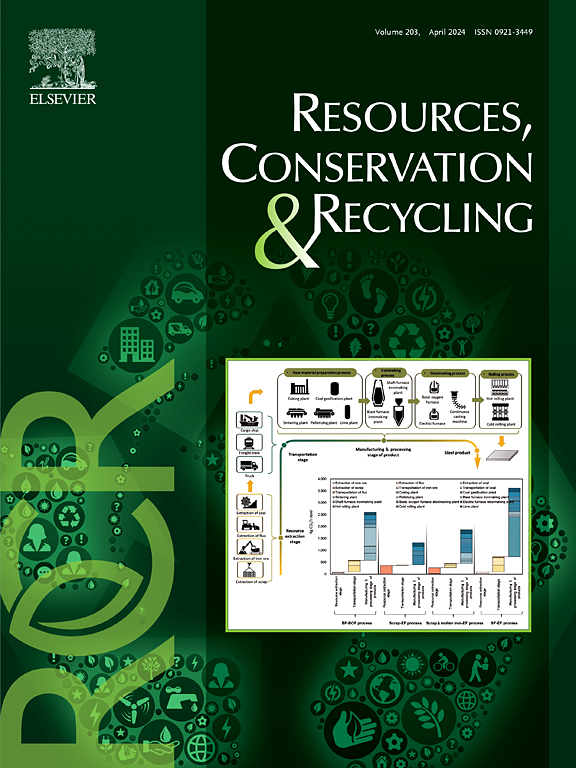
The journal Resources, Conservation & Recycling welcomes contributions from research, which consider sustainable management and conservation of resources. The journal prioritizes understanding the transformation processes crucial for transitioning toward more sustainable production and consumption systems. It highlights technological, economic, institutional, and policy aspects related to specific resource management practices such as conservation, recycling, and resource substitution, as well as broader strategies like improving resource productivity and restructuring production and consumption patterns.
Contributions may address regional, national, or international scales and can range from individual resources or technologies to entire sectors or systems. Authors are encouraged to explore scientific and methodological issues alongside practical, environmental, and economic implications. However, manuscripts focusing solely on laboratory experiments without discussing their broader implications will not be considered for publication in the journal.





 京公网安备 11010802042870号
京ICP备2023020795号-1
京公网安备 11010802042870号
京ICP备2023020795号-1

 分享
分享
 求助内容:
求助内容: 应助结果提醒方式:
 扫码关注我们
