Cristhian Chicaiza-Ortiz , Zhang Beihan , Jingxin Zhang , Yiliang He , Tong Yen Wah
{"title":"二氧化碳驱动的厌氧消化与零价铁加强食物垃圾的生物甲烷化","authors":"Cristhian Chicaiza-Ortiz , Zhang Beihan , Jingxin Zhang , Yiliang He , Tong Yen Wah","doi":"10.1016/j.biortech.2025.132529","DOIUrl":null,"url":null,"abstract":"<div><div>To improve biomethanation in the anaerobic digestion of food waste (FW), carbon dioxide (CO<sub>2</sub>) and zero-valent iron (ZVI) were applied, and the impact of varying dosages and injection times was assessed. The conditions of 1 g/L ZVI and 3-min CO<sub>2</sub> injection resulted in significant methane yield improvements, with FW4 reaching a peak of 624.4 mL/gVS at day 18, 44.7 % higher than the control (FW0). Hydrolysis efficiencies for proteins, polysaccharides, and lipids increased by 41 %, 65 %, and 57 %, while acidogenesis efficiencies rose by 48 %, 44 %, and 24 %, respectively. Additionally, CO<sub>2</sub> optimized the microbial community composition, notably increasing <em>Methanobacterium</em> abundance by 25.7 %. Finally, three-dimensional excitation-emission matrix (3D-EEM) fluorescence spectrograms confirmed the degradation of organic compounds, while cyclic and differential pulse voltammetry revealed increased reduction–oxidation activity. These findings underscore a promising strategy to enhance AD processes’ stability and methanogenic efficiency by combining CO<sub>2</sub>-driven approaches with ZVI.</div></div>","PeriodicalId":258,"journal":{"name":"Bioresource Technology","volume":"430 ","pages":"Article 132529"},"PeriodicalIF":9.0000,"publicationDate":"2025-08-01","publicationTypes":"Journal Article","fieldsOfStudy":null,"isOpenAccess":false,"openAccessPdf":"","citationCount":"0","resultStr":"{\"title\":\"Carbon Dioxide-Driven anaerobic digestion with Zero-Valent iron for enhanced biomethanation of food waste\",\"authors\":\"Cristhian Chicaiza-Ortiz , Zhang Beihan , Jingxin Zhang , Yiliang He , Tong Yen Wah\",\"doi\":\"10.1016/j.biortech.2025.132529\",\"DOIUrl\":null,\"url\":null,\"abstract\":\"<div><div>To improve biomethanation in the anaerobic digestion of food waste (FW), carbon dioxide (CO<sub>2</sub>) and zero-valent iron (ZVI) were applied, and the impact of varying dosages and injection times was assessed. The conditions of 1 g/L ZVI and 3-min CO<sub>2</sub> injection resulted in significant methane yield improvements, with FW4 reaching a peak of 624.4 mL/gVS at day 18, 44.7 % higher than the control (FW0). Hydrolysis efficiencies for proteins, polysaccharides, and lipids increased by 41 %, 65 %, and 57 %, while acidogenesis efficiencies rose by 48 %, 44 %, and 24 %, respectively. Additionally, CO<sub>2</sub> optimized the microbial community composition, notably increasing <em>Methanobacterium</em> abundance by 25.7 %. Finally, three-dimensional excitation-emission matrix (3D-EEM) fluorescence spectrograms confirmed the degradation of organic compounds, while cyclic and differential pulse voltammetry revealed increased reduction–oxidation activity. These findings underscore a promising strategy to enhance AD processes’ stability and methanogenic efficiency by combining CO<sub>2</sub>-driven approaches with ZVI.</div></div>\",\"PeriodicalId\":258,\"journal\":{\"name\":\"Bioresource Technology\",\"volume\":\"430 \",\"pages\":\"Article 132529\"},\"PeriodicalIF\":9.0000,\"publicationDate\":\"2025-08-01\",\"publicationTypes\":\"Journal Article\",\"fieldsOfStudy\":null,\"isOpenAccess\":false,\"openAccessPdf\":\"\",\"citationCount\":\"0\",\"resultStr\":null,\"platform\":\"Semanticscholar\",\"paperid\":null,\"PeriodicalName\":\"Bioresource Technology\",\"FirstCategoryId\":\"5\",\"ListUrlMain\":\"https://www.sciencedirect.com/science/article/pii/S096085242500495X\",\"RegionNum\":1,\"RegionCategory\":\"环境科学与生态学\",\"ArticlePicture\":[],\"TitleCN\":null,\"AbstractTextCN\":null,\"PMCID\":null,\"EPubDate\":\"2025/4/21 0:00:00\",\"PubModel\":\"Epub\",\"JCR\":\"Q1\",\"JCRName\":\"AGRICULTURAL ENGINEERING\",\"Score\":null,\"Total\":0}","platform":"Semanticscholar","paperid":null,"PeriodicalName":"Bioresource Technology","FirstCategoryId":"5","ListUrlMain":"https://www.sciencedirect.com/science/article/pii/S096085242500495X","RegionNum":1,"RegionCategory":"环境科学与生态学","ArticlePicture":[],"TitleCN":null,"AbstractTextCN":null,"PMCID":null,"EPubDate":"2025/4/21 0:00:00","PubModel":"Epub","JCR":"Q1","JCRName":"AGRICULTURAL ENGINEERING","Score":null,"Total":0}
引用次数: 0
摘要
为了改善食物垃圾厌氧消化过程中的生物甲烷化,研究了二氧化碳(CO2)和零价铁(ZVI)的作用,并评估了不同剂量和注射时间对生物甲烷化的影响。在1 g/L ZVI和3 min CO2注入条件下,甲烷产率显著提高,其中FW4在第18天达到624.4 mL/gVS的峰值,比对照(FW0)提高44.7%。蛋白质、多糖和脂质的水解效率分别提高了41%、65%和57%,而产酸效率分别提高了48%、44%和24%。此外,CO2优化了微生物群落组成,甲烷杆菌丰度显著增加25.7%。最后,三维激发-发射矩阵(3D-EEM)荧光光谱图证实了有机化合物的降解,而循环和差分脉冲伏安法显示了还原氧化活性的增加。这些发现强调了通过将co2驱动方法与ZVI相结合来提高AD过程稳定性和产甲烷效率的有希望的策略。
Carbon Dioxide-Driven anaerobic digestion with Zero-Valent iron for enhanced biomethanation of food waste
To improve biomethanation in the anaerobic digestion of food waste (FW), carbon dioxide (CO2) and zero-valent iron (ZVI) were applied, and the impact of varying dosages and injection times was assessed. The conditions of 1 g/L ZVI and 3-min CO2 injection resulted in significant methane yield improvements, with FW4 reaching a peak of 624.4 mL/gVS at day 18, 44.7 % higher than the control (FW0). Hydrolysis efficiencies for proteins, polysaccharides, and lipids increased by 41 %, 65 %, and 57 %, while acidogenesis efficiencies rose by 48 %, 44 %, and 24 %, respectively. Additionally, CO2 optimized the microbial community composition, notably increasing Methanobacterium abundance by 25.7 %. Finally, three-dimensional excitation-emission matrix (3D-EEM) fluorescence spectrograms confirmed the degradation of organic compounds, while cyclic and differential pulse voltammetry revealed increased reduction–oxidation activity. These findings underscore a promising strategy to enhance AD processes’ stability and methanogenic efficiency by combining CO2-driven approaches with ZVI.
期刊介绍:
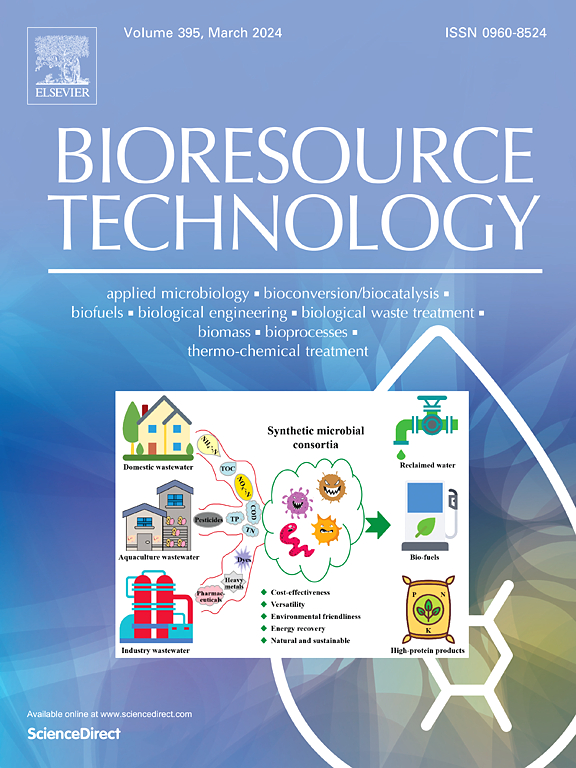
Bioresource Technology publishes original articles, review articles, case studies, and short communications covering the fundamentals, applications, and management of bioresource technology. The journal seeks to advance and disseminate knowledge across various areas related to biomass, biological waste treatment, bioenergy, biotransformations, bioresource systems analysis, and associated conversion or production technologies.
Topics include:
• Biofuels: liquid and gaseous biofuels production, modeling and economics
• Bioprocesses and bioproducts: biocatalysis and fermentations
• Biomass and feedstocks utilization: bioconversion of agro-industrial residues
• Environmental protection: biological waste treatment
• Thermochemical conversion of biomass: combustion, pyrolysis, gasification, catalysis.




 京公网安备 11010802042870号
京ICP备2023020795号-1
京公网安备 11010802042870号
京ICP备2023020795号-1

 分享
分享
 求助内容:
求助内容: 应助结果提醒方式:
 扫码关注我们
