Kimberley Desjardins, Dominic E. Ponton, François Bilodeau, Maikel Rosabal, Marc Amyot
{"title":"加拿大东部软壳蛤(Mya arenaria)中微量元素积累的决定因素及其对人类食用的影响","authors":"Kimberley Desjardins, Dominic E. Ponton, François Bilodeau, Maikel Rosabal, Marc Amyot","doi":"10.1016/j.jhazmat.2025.138385","DOIUrl":null,"url":null,"abstract":"Marine clams are an important country food with high nutritional value while being a route of human exposure to metals. The fresh- and salt-water interface in estuaries may impact metal speciation, leading to changes in bioavailability and bioaccumulation in clams. We evaluated which environmental variables correlate best with bioaccumulation of total mercury (THg), methylmercury (MeHg), and the sum of rare earth elements (ΣREEY) by the soft-shell clam (<em>Mya arenaria</em>) at the mouth of two contrasting rivers. We measured essential and non-essential elements, and nine arsenic (As) species in clams to assess the consumption risks and benefits to consumers. Results showed that clams near the coast of the higher DOC and dammed Romaine River yielded higher THg, MeHg, and ΣREEY concentrations than clams collected at the mouth of the undammed Mingan River. Clams more exposed to saline waters, as inferred from carbon (δ<sup>13</sup>C) and sulfur (δ<sup>34</sup>S) isotopic signatures, had lower THg, MeHg, and ΣREEY bioaccumulation. Positive correlations were identified between THg in clams and sediments, as well as ΣREEY concentrations in both matrices, suggesting a transfer to clams from this compartment through filter feeding. The evaluation of the nutritional intake indicated that clams were a good source of iron (Fe) and selenium (Se). More than 40% of total As were organic forms of arsenobetaine (AsB). Therefore, a monthly portion of 188<!-- --> <!-- -->g of soft-shell clam for elderly adults and pregnant or childbearing women and a monthly portion of 94<!-- --> <!-- -->g for children should not lead to intake risks from non-essential elements.","PeriodicalId":361,"journal":{"name":"Journal of Hazardous Materials","volume":"24 1","pages":""},"PeriodicalIF":10.6000,"publicationDate":"2025-04-22","publicationTypes":"Journal Article","fieldsOfStudy":null,"isOpenAccess":false,"openAccessPdf":"","citationCount":"0","resultStr":"{\"title\":\"Determinants of Trace Element Accumulation in Soft-Shell Clams (Mya arenaria) in Eastern Canada and Implications for Human Consumption\",\"authors\":\"Kimberley Desjardins, Dominic E. Ponton, François Bilodeau, Maikel Rosabal, Marc Amyot\",\"doi\":\"10.1016/j.jhazmat.2025.138385\",\"DOIUrl\":null,\"url\":null,\"abstract\":\"Marine clams are an important country food with high nutritional value while being a route of human exposure to metals. The fresh- and salt-water interface in estuaries may impact metal speciation, leading to changes in bioavailability and bioaccumulation in clams. We evaluated which environmental variables correlate best with bioaccumulation of total mercury (THg), methylmercury (MeHg), and the sum of rare earth elements (ΣREEY) by the soft-shell clam (<em>Mya arenaria</em>) at the mouth of two contrasting rivers. We measured essential and non-essential elements, and nine arsenic (As) species in clams to assess the consumption risks and benefits to consumers. Results showed that clams near the coast of the higher DOC and dammed Romaine River yielded higher THg, MeHg, and ΣREEY concentrations than clams collected at the mouth of the undammed Mingan River. Clams more exposed to saline waters, as inferred from carbon (δ<sup>13</sup>C) and sulfur (δ<sup>34</sup>S) isotopic signatures, had lower THg, MeHg, and ΣREEY bioaccumulation. Positive correlations were identified between THg in clams and sediments, as well as ΣREEY concentrations in both matrices, suggesting a transfer to clams from this compartment through filter feeding. The evaluation of the nutritional intake indicated that clams were a good source of iron (Fe) and selenium (Se). More than 40% of total As were organic forms of arsenobetaine (AsB). Therefore, a monthly portion of 188<!-- --> <!-- -->g of soft-shell clam for elderly adults and pregnant or childbearing women and a monthly portion of 94<!-- --> <!-- -->g for children should not lead to intake risks from non-essential elements.\",\"PeriodicalId\":361,\"journal\":{\"name\":\"Journal of Hazardous Materials\",\"volume\":\"24 1\",\"pages\":\"\"},\"PeriodicalIF\":10.6000,\"publicationDate\":\"2025-04-22\",\"publicationTypes\":\"Journal Article\",\"fieldsOfStudy\":null,\"isOpenAccess\":false,\"openAccessPdf\":\"\",\"citationCount\":\"0\",\"resultStr\":null,\"platform\":\"Semanticscholar\",\"paperid\":null,\"PeriodicalName\":\"Journal of Hazardous Materials\",\"FirstCategoryId\":\"93\",\"ListUrlMain\":\"https://doi.org/10.1016/j.jhazmat.2025.138385\",\"RegionNum\":1,\"RegionCategory\":\"环境科学与生态学\",\"ArticlePicture\":[],\"TitleCN\":null,\"AbstractTextCN\":null,\"PMCID\":null,\"EPubDate\":\"\",\"PubModel\":\"\",\"JCR\":\"Q1\",\"JCRName\":\"ENGINEERING, ENVIRONMENTAL\",\"Score\":null,\"Total\":0}","platform":"Semanticscholar","paperid":null,"PeriodicalName":"Journal of Hazardous Materials","FirstCategoryId":"93","ListUrlMain":"https://doi.org/10.1016/j.jhazmat.2025.138385","RegionNum":1,"RegionCategory":"环境科学与生态学","ArticlePicture":[],"TitleCN":null,"AbstractTextCN":null,"PMCID":null,"EPubDate":"","PubModel":"","JCR":"Q1","JCRName":"ENGINEERING, ENVIRONMENTAL","Score":null,"Total":0}
Determinants of Trace Element Accumulation in Soft-Shell Clams (Mya arenaria) in Eastern Canada and Implications for Human Consumption
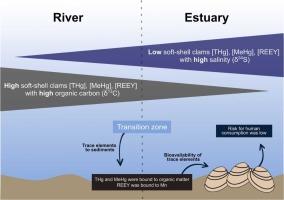
Marine clams are an important country food with high nutritional value while being a route of human exposure to metals. The fresh- and salt-water interface in estuaries may impact metal speciation, leading to changes in bioavailability and bioaccumulation in clams. We evaluated which environmental variables correlate best with bioaccumulation of total mercury (THg), methylmercury (MeHg), and the sum of rare earth elements (ΣREEY) by the soft-shell clam (Mya arenaria) at the mouth of two contrasting rivers. We measured essential and non-essential elements, and nine arsenic (As) species in clams to assess the consumption risks and benefits to consumers. Results showed that clams near the coast of the higher DOC and dammed Romaine River yielded higher THg, MeHg, and ΣREEY concentrations than clams collected at the mouth of the undammed Mingan River. Clams more exposed to saline waters, as inferred from carbon (δ13C) and sulfur (δ34S) isotopic signatures, had lower THg, MeHg, and ΣREEY bioaccumulation. Positive correlations were identified between THg in clams and sediments, as well as ΣREEY concentrations in both matrices, suggesting a transfer to clams from this compartment through filter feeding. The evaluation of the nutritional intake indicated that clams were a good source of iron (Fe) and selenium (Se). More than 40% of total As were organic forms of arsenobetaine (AsB). Therefore, a monthly portion of 188 g of soft-shell clam for elderly adults and pregnant or childbearing women and a monthly portion of 94 g for children should not lead to intake risks from non-essential elements.
期刊介绍:
The Journal of Hazardous Materials serves as a global platform for promoting cutting-edge research in the field of Environmental Science and Engineering. Our publication features a wide range of articles, including full-length research papers, review articles, and perspectives, with the aim of enhancing our understanding of the dangers and risks associated with various materials concerning public health and the environment. It is important to note that the term "environmental contaminants" refers specifically to substances that pose hazardous effects through contamination, while excluding those that do not have such impacts on the environment or human health. Moreover, we emphasize the distinction between wastes and hazardous materials in order to provide further clarity on the scope of the journal. We have a keen interest in exploring specific compounds and microbial agents that have adverse effects on the environment.




 京公网安备 11010802042870号
京ICP备2023020795号-1
京公网安备 11010802042870号
京ICP备2023020795号-1

 分享
分享
 求助内容:
求助内容: 应助结果提醒方式:
 扫码关注我们
