{"title":"含Mn+1AXn相的纳米纤维膜作为极端环境下耐用光热蒸发器的基础","authors":"Yuting Li, Xiang Liu, Mingxue Xiang, Qinhuan Wang, Yu Zhang, Yu Wang","doi":"10.1021/acsnano.5c03189","DOIUrl":null,"url":null,"abstract":"Solar-driven interfacial evaporation (SDIE) has emerged as an efficient approach for sustainable freshwater generation, with current research predominantly focusing on photothermal materials and evaporator configurations. However, there is less attention from a practical engineering perspective for SDIE applications in extreme environments or industrial requirements, such as strong acids, alkalis, and high-salinity wastewater. Herein, we propose a one-dimensional (1D) MAX phase-based photothermal evaporator that combines exceptional solar-thermal conversion efficiency with high chemical stability, enabling efficient solar energy conversion to produce freshwater in various extreme environments. The engineered Ti<sub>2</sub>AlSnC nanofiber membrane evaporator demonstrates a continuous 30-day operation in concentrated acids (pH < 1) while maintaining a stable evaporation rate of 2.8 kg m<sup>–2</sup> h<sup>–1</sup>. Furthermore, the integrated Joule heating module enables all-day operation under low-light conditions with a minimal energy input (≤3 V). The development of such a material establishes a promising strategy for more practical and durable water treatment solutions to harsh environments.","PeriodicalId":21,"journal":{"name":"ACS Nano","volume":"24 1","pages":""},"PeriodicalIF":16.0000,"publicationDate":"2025-04-22","publicationTypes":"Journal Article","fieldsOfStudy":null,"isOpenAccess":false,"openAccessPdf":"","citationCount":"0","resultStr":"{\"title\":\"Nanofiber Membranes Comprising Mn+1AXn Phases as the Basis of Durable Photothermal Evaporators in Extreme Environments\",\"authors\":\"Yuting Li, Xiang Liu, Mingxue Xiang, Qinhuan Wang, Yu Zhang, Yu Wang\",\"doi\":\"10.1021/acsnano.5c03189\",\"DOIUrl\":null,\"url\":null,\"abstract\":\"Solar-driven interfacial evaporation (SDIE) has emerged as an efficient approach for sustainable freshwater generation, with current research predominantly focusing on photothermal materials and evaporator configurations. However, there is less attention from a practical engineering perspective for SDIE applications in extreme environments or industrial requirements, such as strong acids, alkalis, and high-salinity wastewater. Herein, we propose a one-dimensional (1D) MAX phase-based photothermal evaporator that combines exceptional solar-thermal conversion efficiency with high chemical stability, enabling efficient solar energy conversion to produce freshwater in various extreme environments. The engineered Ti<sub>2</sub>AlSnC nanofiber membrane evaporator demonstrates a continuous 30-day operation in concentrated acids (pH < 1) while maintaining a stable evaporation rate of 2.8 kg m<sup>–2</sup> h<sup>–1</sup>. Furthermore, the integrated Joule heating module enables all-day operation under low-light conditions with a minimal energy input (≤3 V). The development of such a material establishes a promising strategy for more practical and durable water treatment solutions to harsh environments.\",\"PeriodicalId\":21,\"journal\":{\"name\":\"ACS Nano\",\"volume\":\"24 1\",\"pages\":\"\"},\"PeriodicalIF\":16.0000,\"publicationDate\":\"2025-04-22\",\"publicationTypes\":\"Journal Article\",\"fieldsOfStudy\":null,\"isOpenAccess\":false,\"openAccessPdf\":\"\",\"citationCount\":\"0\",\"resultStr\":null,\"platform\":\"Semanticscholar\",\"paperid\":null,\"PeriodicalName\":\"ACS Nano\",\"FirstCategoryId\":\"88\",\"ListUrlMain\":\"https://doi.org/10.1021/acsnano.5c03189\",\"RegionNum\":1,\"RegionCategory\":\"材料科学\",\"ArticlePicture\":[],\"TitleCN\":null,\"AbstractTextCN\":null,\"PMCID\":null,\"EPubDate\":\"\",\"PubModel\":\"\",\"JCR\":\"Q1\",\"JCRName\":\"CHEMISTRY, MULTIDISCIPLINARY\",\"Score\":null,\"Total\":0}","platform":"Semanticscholar","paperid":null,"PeriodicalName":"ACS Nano","FirstCategoryId":"88","ListUrlMain":"https://doi.org/10.1021/acsnano.5c03189","RegionNum":1,"RegionCategory":"材料科学","ArticlePicture":[],"TitleCN":null,"AbstractTextCN":null,"PMCID":null,"EPubDate":"","PubModel":"","JCR":"Q1","JCRName":"CHEMISTRY, MULTIDISCIPLINARY","Score":null,"Total":0}
引用次数: 0
摘要
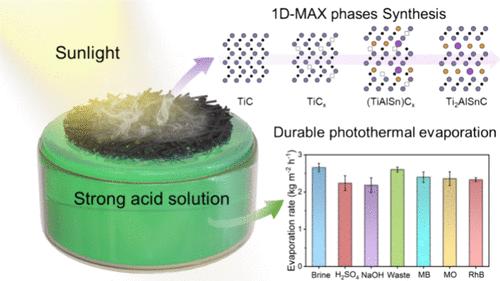
太阳能驱动界面蒸发(SDIE)已成为可持续淡水发电的有效方法,目前的研究主要集中在光热材料和蒸发器配置上。然而,从实际工程的角度来看,SDIE在极端环境或工业要求中的应用很少受到关注,例如强酸、强碱和高盐度废水。在此,我们提出了一种基于一维(1D) MAX相的光热蒸发器,它结合了卓越的光热转换效率和高化学稳定性,能够在各种极端环境下实现高效的太阳能转换以生产淡水。经过改造的Ti2AlSnC纳米纤维膜蒸发器在浓酸(pH <;1)保持2.8 kg m-2 h-1的稳定蒸发速率。此外,集成的焦耳加热模块可以在低光照条件下全天运行,能量输入最小(≤3 V)。这种材料的开发为恶劣环境下更实用、更持久的水处理解决方案奠定了一个有前途的策略。
Nanofiber Membranes Comprising Mn+1AXn Phases as the Basis of Durable Photothermal Evaporators in Extreme Environments
Solar-driven interfacial evaporation (SDIE) has emerged as an efficient approach for sustainable freshwater generation, with current research predominantly focusing on photothermal materials and evaporator configurations. However, there is less attention from a practical engineering perspective for SDIE applications in extreme environments or industrial requirements, such as strong acids, alkalis, and high-salinity wastewater. Herein, we propose a one-dimensional (1D) MAX phase-based photothermal evaporator that combines exceptional solar-thermal conversion efficiency with high chemical stability, enabling efficient solar energy conversion to produce freshwater in various extreme environments. The engineered Ti2AlSnC nanofiber membrane evaporator demonstrates a continuous 30-day operation in concentrated acids (pH < 1) while maintaining a stable evaporation rate of 2.8 kg m–2 h–1. Furthermore, the integrated Joule heating module enables all-day operation under low-light conditions with a minimal energy input (≤3 V). The development of such a material establishes a promising strategy for more practical and durable water treatment solutions to harsh environments.
期刊介绍:
ACS Nano, published monthly, serves as an international forum for comprehensive articles on nanoscience and nanotechnology research at the intersections of chemistry, biology, materials science, physics, and engineering. The journal fosters communication among scientists in these communities, facilitating collaboration, new research opportunities, and advancements through discoveries. ACS Nano covers synthesis, assembly, characterization, theory, and simulation of nanostructures, nanobiotechnology, nanofabrication, methods and tools for nanoscience and nanotechnology, and self- and directed-assembly. Alongside original research articles, it offers thorough reviews, perspectives on cutting-edge research, and discussions envisioning the future of nanoscience and nanotechnology.




 京公网安备 11010802042870号
京ICP备2023020795号-1
京公网安备 11010802042870号
京ICP备2023020795号-1

 分享
分享
 求助内容:
求助内容: 应助结果提醒方式:
 扫码关注我们
