Xueqi Liang, Eva E. Stüeken, Daniel S. Alessi, Kurt O. Konhauser, Long Li
{"title":"在大氧化事件之前由铁形成记录的海水氧振荡","authors":"Xueqi Liang, Eva E. Stüeken, Daniel S. Alessi, Kurt O. Konhauser, Long Li","doi":"10.1038/s41561-025-01683-7","DOIUrl":null,"url":null,"abstract":"Earth’s atmosphere underwent permanent oxidation during the Great Oxidation Event approximately 2.45–2.22 billion years ago (Ga) due to excess oxygen (O2) generated by marine cyanobacteria. However, understanding the timing and tempo of seawater oxygenation before the Great Oxidation Event has been hindered by the absence of sensitive tracers. Nitrogen (N) isotopes can be an indicator of marine oxygenation. Here we present an ~200 Myr nitrogen isotope oscillation recorded by Neoarchaean and Palaeoproterozoic banded iron formations from the Hamersley Basin, Western Australia, that were deposited in relatively deep marine shelf environments. Paired with the Jeerinah Formation shale record, our data from the Marra Mamba Iron Formation suggest that oxic conditions expanded to banded iron formation depositional environments from ~2.63 to 2.60 Ga. Subsequently, a positive δ15N excursion occurred in the ~2.48 Ga Dale Gorge Member, marking a decline in seawater O2 and enhanced denitrification. This O2 deficit was followed by a second phase of increasing O2 levels as indicated by a gradual return to moderately positive δ15N values in the ~2.46 Ga Joffre Member and 2.45 Ga Weeli Wolli Iron Formation. These variations underscore a nonlinear history of marine oxygenation and reveal a previously unrecognized oscillation in seawater O2 levels preceding the Great Oxidation Event. Deep marine shelf environments experienced fluctuating levels of seawater oxygenation before the Great Oxidation Event, as reflected by oscillations between nitrogen fixation and denitrification recorded by nitrogen isotopes in banded iron formations.","PeriodicalId":19053,"journal":{"name":"Nature Geoscience","volume":"18 5","pages":"417-422"},"PeriodicalIF":20.6000,"publicationDate":"2025-04-23","publicationTypes":"Journal Article","fieldsOfStudy":null,"isOpenAccess":false,"openAccessPdf":"","citationCount":"0","resultStr":"{\"title\":\"A seawater oxygen oscillation recorded by iron formations prior to the Great Oxidation Event\",\"authors\":\"Xueqi Liang, Eva E. Stüeken, Daniel S. Alessi, Kurt O. Konhauser, Long Li\",\"doi\":\"10.1038/s41561-025-01683-7\",\"DOIUrl\":null,\"url\":null,\"abstract\":\"Earth’s atmosphere underwent permanent oxidation during the Great Oxidation Event approximately 2.45–2.22 billion years ago (Ga) due to excess oxygen (O2) generated by marine cyanobacteria. However, understanding the timing and tempo of seawater oxygenation before the Great Oxidation Event has been hindered by the absence of sensitive tracers. Nitrogen (N) isotopes can be an indicator of marine oxygenation. Here we present an ~200 Myr nitrogen isotope oscillation recorded by Neoarchaean and Palaeoproterozoic banded iron formations from the Hamersley Basin, Western Australia, that were deposited in relatively deep marine shelf environments. Paired with the Jeerinah Formation shale record, our data from the Marra Mamba Iron Formation suggest that oxic conditions expanded to banded iron formation depositional environments from ~2.63 to 2.60 Ga. Subsequently, a positive δ15N excursion occurred in the ~2.48 Ga Dale Gorge Member, marking a decline in seawater O2 and enhanced denitrification. This O2 deficit was followed by a second phase of increasing O2 levels as indicated by a gradual return to moderately positive δ15N values in the ~2.46 Ga Joffre Member and 2.45 Ga Weeli Wolli Iron Formation. These variations underscore a nonlinear history of marine oxygenation and reveal a previously unrecognized oscillation in seawater O2 levels preceding the Great Oxidation Event. Deep marine shelf environments experienced fluctuating levels of seawater oxygenation before the Great Oxidation Event, as reflected by oscillations between nitrogen fixation and denitrification recorded by nitrogen isotopes in banded iron formations.\",\"PeriodicalId\":19053,\"journal\":{\"name\":\"Nature Geoscience\",\"volume\":\"18 5\",\"pages\":\"417-422\"},\"PeriodicalIF\":20.6000,\"publicationDate\":\"2025-04-23\",\"publicationTypes\":\"Journal Article\",\"fieldsOfStudy\":null,\"isOpenAccess\":false,\"openAccessPdf\":\"\",\"citationCount\":\"0\",\"resultStr\":null,\"platform\":\"Semanticscholar\",\"paperid\":null,\"PeriodicalName\":\"Nature Geoscience\",\"FirstCategoryId\":\"89\",\"ListUrlMain\":\"https://www.nature.com/articles/s41561-025-01683-7\",\"RegionNum\":1,\"RegionCategory\":\"地球科学\",\"ArticlePicture\":[],\"TitleCN\":null,\"AbstractTextCN\":null,\"PMCID\":null,\"EPubDate\":\"\",\"PubModel\":\"\",\"JCR\":\"Q1\",\"JCRName\":\"GEOSCIENCES, MULTIDISCIPLINARY\",\"Score\":null,\"Total\":0}","platform":"Semanticscholar","paperid":null,"PeriodicalName":"Nature Geoscience","FirstCategoryId":"89","ListUrlMain":"https://www.nature.com/articles/s41561-025-01683-7","RegionNum":1,"RegionCategory":"地球科学","ArticlePicture":[],"TitleCN":null,"AbstractTextCN":null,"PMCID":null,"EPubDate":"","PubModel":"","JCR":"Q1","JCRName":"GEOSCIENCES, MULTIDISCIPLINARY","Score":null,"Total":0}
引用次数: 0
摘要
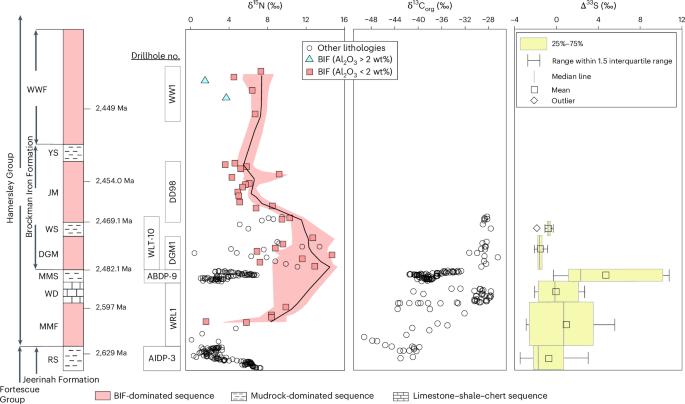
在大约24.5亿至22.2亿年前(Ga)的大氧化事件中,由于海洋蓝藻产生的过量氧气(O2),地球大气经历了永久性氧化。然而,由于缺乏敏感的示踪剂,对大氧化事件前海水氧化的时间和速度的理解一直受到阻碍。氮(N)同位素可以作为海洋氧合的指示物。本文研究了西澳大利亚哈默斯利盆地新太古代和古元古代的带状铁组沉积在相对较深的陆架环境中,记录了一个~200 Myr的氮同位素振荡。结合Jeerinah组页岩记录,我们的Marra Mamba铁组数据表明,氧化条件在~2.63 ~ 2.60 Ga扩展到带状铁组沉积环境。随后,在~2.48 Ga谷地段发生了δ15N正偏移,表明海水O2减少,反硝化作用增强。在~2.46 Ga Joffre段和2.45 Ga Weeli Wolli铁组中,δ15N逐渐恢复到中等正值,这表明O2水平的第二阶段增加。这些变化强调了海洋氧合的非线性历史,并揭示了在大氧化事件之前海水氧水平的以前未被认识到的振荡。
A seawater oxygen oscillation recorded by iron formations prior to the Great Oxidation Event
Earth’s atmosphere underwent permanent oxidation during the Great Oxidation Event approximately 2.45–2.22 billion years ago (Ga) due to excess oxygen (O2) generated by marine cyanobacteria. However, understanding the timing and tempo of seawater oxygenation before the Great Oxidation Event has been hindered by the absence of sensitive tracers. Nitrogen (N) isotopes can be an indicator of marine oxygenation. Here we present an ~200 Myr nitrogen isotope oscillation recorded by Neoarchaean and Palaeoproterozoic banded iron formations from the Hamersley Basin, Western Australia, that were deposited in relatively deep marine shelf environments. Paired with the Jeerinah Formation shale record, our data from the Marra Mamba Iron Formation suggest that oxic conditions expanded to banded iron formation depositional environments from ~2.63 to 2.60 Ga. Subsequently, a positive δ15N excursion occurred in the ~2.48 Ga Dale Gorge Member, marking a decline in seawater O2 and enhanced denitrification. This O2 deficit was followed by a second phase of increasing O2 levels as indicated by a gradual return to moderately positive δ15N values in the ~2.46 Ga Joffre Member and 2.45 Ga Weeli Wolli Iron Formation. These variations underscore a nonlinear history of marine oxygenation and reveal a previously unrecognized oscillation in seawater O2 levels preceding the Great Oxidation Event. Deep marine shelf environments experienced fluctuating levels of seawater oxygenation before the Great Oxidation Event, as reflected by oscillations between nitrogen fixation and denitrification recorded by nitrogen isotopes in banded iron formations.
期刊介绍:
Nature Geoscience is a monthly interdisciplinary journal that gathers top-tier research spanning Earth Sciences and related fields.
The journal covers all geoscience disciplines, including fieldwork, modeling, and theoretical studies.
Topics include atmospheric science, biogeochemistry, climate science, geobiology, geochemistry, geoinformatics, remote sensing, geology, geomagnetism, paleomagnetism, geomorphology, geophysics, glaciology, hydrology, limnology, mineralogy, oceanography, paleontology, paleoclimatology, paleoceanography, petrology, planetary science, seismology, space physics, tectonics, and volcanology.
Nature Geoscience upholds its commitment to publishing significant, high-quality Earth Sciences research through fair, rapid, and rigorous peer review, overseen by a team of full-time professional editors.





 京公网安备 11010802042870号
京ICP备2023020795号-1
京公网安备 11010802042870号
京ICP备2023020795号-1

 分享
分享
 求助内容:
求助内容: 应助结果提醒方式:
 扫码关注我们
