Xiaoyu Liu, Lingui Huang, Xiuan Xi, Yan Yi, Giday Fisseha, Jie Gao, Yong Xi, Yuanfeng Liao, Jianwen Liu, Jiujun Zhang, Xian-Zhu Fu, Jing-Li Luo
{"title":"Cu掺杂调控高性能固体氧化物燃料电池正极BaCo0.4Fe0.4Zr0.1Y0.1O3-δ的d-p轨道杂化","authors":"Xiaoyu Liu, Lingui Huang, Xiuan Xi, Yan Yi, Giday Fisseha, Jie Gao, Yong Xi, Yuanfeng Liao, Jianwen Liu, Jiujun Zhang, Xian-Zhu Fu, Jing-Li Luo","doi":"10.1016/j.cej.2025.162958","DOIUrl":null,"url":null,"abstract":"The BaCo<sub>0.4</sub>Fe<sub>0.4</sub>Zr<sub>0.1</sub>Y<sub>0.1</sub>O<sub>3-δ</sub> (BCFZY) perovskite oxide is a highly promising cathode material for solid oxide fuel cells (SOFCs), mainly due to its exceptional three-phase conductivity at the elevated temperatures and remarkable oxygen reduction reaction (ORR) activity. Nevertheless, its limited electronic and ionic conductivities at relatively lower temperatures poses a significant challenge for its low-temperature applications. To address this issue, the Cu doping in the B-site of BCFZY is proposed. It is observed that Cu doping significantly enhances both the electronic conductivity and oxygen exchange kinetics, leading to a notable reduction in polarization resistance and a substantial improvement in ORR catalytic activity. Specifically, the Ni-YSZ anode-supported single cell equipped with BCFZYCu4 as the cathode exhibits a remarkable power density of 1.30 W cm<sup>−2</sup> at 700 ℃, which surpasses that of the single cell with BCFZY cathode by 51.16 %. An in-depth mechanism study has revealed that the enhanced performance is closely linked to the increased orbitals hybridization induced by Cu doping. This not only enlarges the covalency of the Co-O/Cu–O bonds but also shifts the metal 3<em>d</em> and O 2<em>p</em> band center closer to the Fermi level, which significantly facilitates the oxygen adsorption, dissociation, and oxygen ion exchange processes of the BCFZYCu4 cathode.","PeriodicalId":270,"journal":{"name":"Chemical Engineering Journal","volume":"6 1","pages":""},"PeriodicalIF":13.2000,"publicationDate":"2025-04-22","publicationTypes":"Journal Article","fieldsOfStudy":null,"isOpenAccess":false,"openAccessPdf":"","citationCount":"0","resultStr":"{\"title\":\"Regulating the d-p orbital hybridization in BaCo0.4Fe0.4Zr0.1Y0.1O3-δ via Cu doping for high-performance solid oxide fuel cells cathode\",\"authors\":\"Xiaoyu Liu, Lingui Huang, Xiuan Xi, Yan Yi, Giday Fisseha, Jie Gao, Yong Xi, Yuanfeng Liao, Jianwen Liu, Jiujun Zhang, Xian-Zhu Fu, Jing-Li Luo\",\"doi\":\"10.1016/j.cej.2025.162958\",\"DOIUrl\":null,\"url\":null,\"abstract\":\"The BaCo<sub>0.4</sub>Fe<sub>0.4</sub>Zr<sub>0.1</sub>Y<sub>0.1</sub>O<sub>3-δ</sub> (BCFZY) perovskite oxide is a highly promising cathode material for solid oxide fuel cells (SOFCs), mainly due to its exceptional three-phase conductivity at the elevated temperatures and remarkable oxygen reduction reaction (ORR) activity. Nevertheless, its limited electronic and ionic conductivities at relatively lower temperatures poses a significant challenge for its low-temperature applications. To address this issue, the Cu doping in the B-site of BCFZY is proposed. It is observed that Cu doping significantly enhances both the electronic conductivity and oxygen exchange kinetics, leading to a notable reduction in polarization resistance and a substantial improvement in ORR catalytic activity. Specifically, the Ni-YSZ anode-supported single cell equipped with BCFZYCu4 as the cathode exhibits a remarkable power density of 1.30 W cm<sup>−2</sup> at 700 ℃, which surpasses that of the single cell with BCFZY cathode by 51.16 %. An in-depth mechanism study has revealed that the enhanced performance is closely linked to the increased orbitals hybridization induced by Cu doping. This not only enlarges the covalency of the Co-O/Cu–O bonds but also shifts the metal 3<em>d</em> and O 2<em>p</em> band center closer to the Fermi level, which significantly facilitates the oxygen adsorption, dissociation, and oxygen ion exchange processes of the BCFZYCu4 cathode.\",\"PeriodicalId\":270,\"journal\":{\"name\":\"Chemical Engineering Journal\",\"volume\":\"6 1\",\"pages\":\"\"},\"PeriodicalIF\":13.2000,\"publicationDate\":\"2025-04-22\",\"publicationTypes\":\"Journal Article\",\"fieldsOfStudy\":null,\"isOpenAccess\":false,\"openAccessPdf\":\"\",\"citationCount\":\"0\",\"resultStr\":null,\"platform\":\"Semanticscholar\",\"paperid\":null,\"PeriodicalName\":\"Chemical Engineering Journal\",\"FirstCategoryId\":\"5\",\"ListUrlMain\":\"https://doi.org/10.1016/j.cej.2025.162958\",\"RegionNum\":1,\"RegionCategory\":\"工程技术\",\"ArticlePicture\":[],\"TitleCN\":null,\"AbstractTextCN\":null,\"PMCID\":null,\"EPubDate\":\"\",\"PubModel\":\"\",\"JCR\":\"Q1\",\"JCRName\":\"ENGINEERING, CHEMICAL\",\"Score\":null,\"Total\":0}","platform":"Semanticscholar","paperid":null,"PeriodicalName":"Chemical Engineering Journal","FirstCategoryId":"5","ListUrlMain":"https://doi.org/10.1016/j.cej.2025.162958","RegionNum":1,"RegionCategory":"工程技术","ArticlePicture":[],"TitleCN":null,"AbstractTextCN":null,"PMCID":null,"EPubDate":"","PubModel":"","JCR":"Q1","JCRName":"ENGINEERING, CHEMICAL","Score":null,"Total":0}
引用次数: 0
摘要
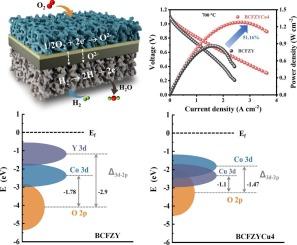
BaCo0.4Fe0.4Zr0.1Y0.1O3-δ(BCFZY)包晶氧化物是一种非常有前途的固体氧化物燃料电池(SOFC)阴极材料,这主要是因为它在高温下具有优异的三相电导率和显著的氧还原反应(ORR)活性。然而,在相对较低的温度下,其有限的电子和离子导电性为其低温应用带来了巨大挑战。为了解决这一问题,有人提出在 BCFZY 的 B 位掺杂铜。研究发现,掺杂铜可显著提高电子传导性和氧交换动力学,从而明显降低极化电阻,大幅提高 ORR 催化活性。具体而言,以 BCFZYCu4 为阴极的 Ni-YSZ 阳极支持单电池在 700 ℃ 时的功率密度达到了 1.30 W cm-2,比以 BCFZY 为阴极的单电池高出 51.16%。深入的机理研究表明,性能的提高与铜掺杂引起的轨道杂化增加密切相关。这不仅扩大了 Co-O/Cu-O 键的共价性,还使金属 3d 和 O 2p 带中心更接近费米级,从而极大地促进了 BCFZYCu4 阴极的氧吸附、解离和氧离子交换过程。
Regulating the d-p orbital hybridization in BaCo0.4Fe0.4Zr0.1Y0.1O3-δ via Cu doping for high-performance solid oxide fuel cells cathode
The BaCo0.4Fe0.4Zr0.1Y0.1O3-δ (BCFZY) perovskite oxide is a highly promising cathode material for solid oxide fuel cells (SOFCs), mainly due to its exceptional three-phase conductivity at the elevated temperatures and remarkable oxygen reduction reaction (ORR) activity. Nevertheless, its limited electronic and ionic conductivities at relatively lower temperatures poses a significant challenge for its low-temperature applications. To address this issue, the Cu doping in the B-site of BCFZY is proposed. It is observed that Cu doping significantly enhances both the electronic conductivity and oxygen exchange kinetics, leading to a notable reduction in polarization resistance and a substantial improvement in ORR catalytic activity. Specifically, the Ni-YSZ anode-supported single cell equipped with BCFZYCu4 as the cathode exhibits a remarkable power density of 1.30 W cm−2 at 700 ℃, which surpasses that of the single cell with BCFZY cathode by 51.16 %. An in-depth mechanism study has revealed that the enhanced performance is closely linked to the increased orbitals hybridization induced by Cu doping. This not only enlarges the covalency of the Co-O/Cu–O bonds but also shifts the metal 3d and O 2p band center closer to the Fermi level, which significantly facilitates the oxygen adsorption, dissociation, and oxygen ion exchange processes of the BCFZYCu4 cathode.
期刊介绍:
The Chemical Engineering Journal is an international research journal that invites contributions of original and novel fundamental research. It aims to provide an international platform for presenting original fundamental research, interpretative reviews, and discussions on new developments in chemical engineering. The journal welcomes papers that describe novel theory and its practical application, as well as those that demonstrate the transfer of techniques from other disciplines. It also welcomes reports on carefully conducted experimental work that is soundly interpreted. The main focus of the journal is on original and rigorous research results that have broad significance. The Catalysis section within the Chemical Engineering Journal focuses specifically on Experimental and Theoretical studies in the fields of heterogeneous catalysis, molecular catalysis, and biocatalysis. These studies have industrial impact on various sectors such as chemicals, energy, materials, foods, healthcare, and environmental protection.




 京公网安备 11010802042870号
京ICP备2023020795号-1
京公网安备 11010802042870号
京ICP备2023020795号-1

 分享
分享
 求助内容:
求助内容: 应助结果提醒方式:
 扫码关注我们
