{"title":"通过微调表面特性,研究纳米通道中二氧化碳和丙烷稀薄气体输运的剧烈而明显的变化","authors":"Lian Duan, Zhehui Jin","doi":"10.1016/j.cej.2025.162957","DOIUrl":null,"url":null,"abstract":"Rarefied gas transports with similar molecular weights (such as CO<sub>2</sub> and propane) render similar Knudsen diffusivity in nanochannels. Nevertheless, by using molecular dynamics (MD) simulations, we find that the Knudsen theory breaks down for rarefied CO<sub>2</sub> and propane transport in β-cristobalite nanochannels with width of 5 nm under ambient conditions (298 K and 1 atm): CO<sub>2</sub> self-diffusivity is only half of that of propane. The drastic differences in their self-diffusivity are due to the penetration of CO<sub>2</sub> into the three-dimensional hexagonal ring structures on β-cristobalite surface, resulting in substantial CO<sub>2</sub> rotations and curved topological accessible plane, which are detrimental to its diffusion. In contrast, propane cannot penetrate into pore surface. On the other hand, by finely-tuning surface properties (the size of surface Oxygen atoms), we observe drastic-yet-distinct alterations in their self-diffusivities: the enhancement in CO<sub>2</sub> self-diffusivities is more than 8-fold of that for propane (290 % v.s. 35 %). This is achieved by prohibiting CO<sub>2</sub> penetration and consequently limiting its rotations, thereby largely promoting its transport. On the other hand, the bending structure of propane, coupled with its larger size, always prevents its penetration into regular or tuned (pseudo) surface. Our study indicates that the collective effects of fluid and surface characteristics are instrumental to rarefied gas transport in nanochannels which are largely overlooked in conventional diffusion models and previous experimental as well as simulation studies. This work offers novel insights into rarefied gas transport mechanisms and the development and optimization of advanced materials for gas capture and separation.","PeriodicalId":270,"journal":{"name":"Chemical Engineering Journal","volume":"13 1","pages":""},"PeriodicalIF":12.5000,"publicationDate":"2025-04-22","publicationTypes":"Journal Article","fieldsOfStudy":null,"isOpenAccess":false,"openAccessPdf":"","citationCount":"0","resultStr":"{\"title\":\"Drastic-yet-distinct alterations in rarefied gas transport of CO2 and propane in nanochannels by finely-tuning surface characteristics\",\"authors\":\"Lian Duan, Zhehui Jin\",\"doi\":\"10.1016/j.cej.2025.162957\",\"DOIUrl\":null,\"url\":null,\"abstract\":\"Rarefied gas transports with similar molecular weights (such as CO<sub>2</sub> and propane) render similar Knudsen diffusivity in nanochannels. Nevertheless, by using molecular dynamics (MD) simulations, we find that the Knudsen theory breaks down for rarefied CO<sub>2</sub> and propane transport in β-cristobalite nanochannels with width of 5 nm under ambient conditions (298 K and 1 atm): CO<sub>2</sub> self-diffusivity is only half of that of propane. The drastic differences in their self-diffusivity are due to the penetration of CO<sub>2</sub> into the three-dimensional hexagonal ring structures on β-cristobalite surface, resulting in substantial CO<sub>2</sub> rotations and curved topological accessible plane, which are detrimental to its diffusion. In contrast, propane cannot penetrate into pore surface. On the other hand, by finely-tuning surface properties (the size of surface Oxygen atoms), we observe drastic-yet-distinct alterations in their self-diffusivities: the enhancement in CO<sub>2</sub> self-diffusivities is more than 8-fold of that for propane (290 % v.s. 35 %). This is achieved by prohibiting CO<sub>2</sub> penetration and consequently limiting its rotations, thereby largely promoting its transport. On the other hand, the bending structure of propane, coupled with its larger size, always prevents its penetration into regular or tuned (pseudo) surface. Our study indicates that the collective effects of fluid and surface characteristics are instrumental to rarefied gas transport in nanochannels which are largely overlooked in conventional diffusion models and previous experimental as well as simulation studies. This work offers novel insights into rarefied gas transport mechanisms and the development and optimization of advanced materials for gas capture and separation.\",\"PeriodicalId\":270,\"journal\":{\"name\":\"Chemical Engineering Journal\",\"volume\":\"13 1\",\"pages\":\"\"},\"PeriodicalIF\":12.5000,\"publicationDate\":\"2025-04-22\",\"publicationTypes\":\"Journal Article\",\"fieldsOfStudy\":null,\"isOpenAccess\":false,\"openAccessPdf\":\"\",\"citationCount\":\"0\",\"resultStr\":null,\"platform\":\"Semanticscholar\",\"paperid\":null,\"PeriodicalName\":\"Chemical Engineering Journal\",\"FirstCategoryId\":\"5\",\"ListUrlMain\":\"https://doi.org/10.1016/j.cej.2025.162957\",\"RegionNum\":1,\"RegionCategory\":\"工程技术\",\"ArticlePicture\":[],\"TitleCN\":null,\"AbstractTextCN\":null,\"PMCID\":null,\"EPubDate\":\"\",\"PubModel\":\"\",\"JCR\":\"Q1\",\"JCRName\":\"ENGINEERING, CHEMICAL\",\"Score\":null,\"Total\":0}","platform":"Semanticscholar","paperid":null,"PeriodicalName":"Chemical Engineering Journal","FirstCategoryId":"5","ListUrlMain":"https://doi.org/10.1016/j.cej.2025.162957","RegionNum":1,"RegionCategory":"工程技术","ArticlePicture":[],"TitleCN":null,"AbstractTextCN":null,"PMCID":null,"EPubDate":"","PubModel":"","JCR":"Q1","JCRName":"ENGINEERING, CHEMICAL","Score":null,"Total":0}
引用次数: 0
摘要
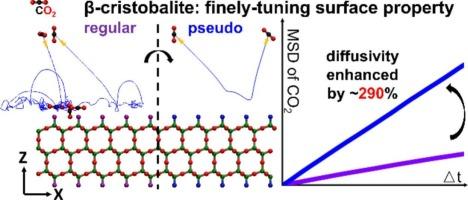
具有相似分子量的稀薄气体输送(如二氧化碳和丙烷)在纳米通道中产生相似的克努森扩散系数。然而,通过分子动力学(MD)模拟,我们发现,在环境条件下(298 K和1 atm),宽度为5 nm的β-石沸石纳米通道中,Knudsen理论对稀薄的CO2和丙烷的运输不适用:CO2的自扩散率仅为丙烷的一半。它们自扩散率的巨大差异是由于CO2渗透到β-方石石表面的三维六角形环结构中,导致CO2大量旋转和弯曲的拓扑可达面,不利于其扩散。而丙烷则不能渗透到孔隙表面。另一方面,通过微调表面性质(表面氧原子的大小),我们观察到它们的自扩散率发生了剧烈而明显的变化:二氧化碳自扩散率的增强是丙烷的8倍多(290 % vs . 35 %)。这是通过禁止二氧化碳渗透,从而限制其旋转,从而在很大程度上促进其运输来实现的。另一方面,丙烷的弯曲结构,加上其较大的尺寸,总是阻止其渗透到规则或调谐(伪)表面。我们的研究表明,流体和表面特性的集体效应有助于纳米通道中稀薄气体的传输,这在传统的扩散模型和以前的实验和模拟研究中很大程度上被忽视了。这项工作为稀薄气体传输机制以及气体捕获和分离先进材料的开发和优化提供了新的见解。
Drastic-yet-distinct alterations in rarefied gas transport of CO2 and propane in nanochannels by finely-tuning surface characteristics
Rarefied gas transports with similar molecular weights (such as CO2 and propane) render similar Knudsen diffusivity in nanochannels. Nevertheless, by using molecular dynamics (MD) simulations, we find that the Knudsen theory breaks down for rarefied CO2 and propane transport in β-cristobalite nanochannels with width of 5 nm under ambient conditions (298 K and 1 atm): CO2 self-diffusivity is only half of that of propane. The drastic differences in their self-diffusivity are due to the penetration of CO2 into the three-dimensional hexagonal ring structures on β-cristobalite surface, resulting in substantial CO2 rotations and curved topological accessible plane, which are detrimental to its diffusion. In contrast, propane cannot penetrate into pore surface. On the other hand, by finely-tuning surface properties (the size of surface Oxygen atoms), we observe drastic-yet-distinct alterations in their self-diffusivities: the enhancement in CO2 self-diffusivities is more than 8-fold of that for propane (290 % v.s. 35 %). This is achieved by prohibiting CO2 penetration and consequently limiting its rotations, thereby largely promoting its transport. On the other hand, the bending structure of propane, coupled with its larger size, always prevents its penetration into regular or tuned (pseudo) surface. Our study indicates that the collective effects of fluid and surface characteristics are instrumental to rarefied gas transport in nanochannels which are largely overlooked in conventional diffusion models and previous experimental as well as simulation studies. This work offers novel insights into rarefied gas transport mechanisms and the development and optimization of advanced materials for gas capture and separation.
期刊介绍:
The Chemical Engineering Journal is an international research journal that invites contributions of original and novel fundamental research. It aims to provide an international platform for presenting original fundamental research, interpretative reviews, and discussions on new developments in chemical engineering. The journal welcomes papers that describe novel theory and its practical application, as well as those that demonstrate the transfer of techniques from other disciplines. It also welcomes reports on carefully conducted experimental work that is soundly interpreted. The main focus of the journal is on original and rigorous research results that have broad significance. The Catalysis section within the Chemical Engineering Journal focuses specifically on Experimental and Theoretical studies in the fields of heterogeneous catalysis, molecular catalysis, and biocatalysis. These studies have industrial impact on various sectors such as chemicals, energy, materials, foods, healthcare, and environmental protection.




 京公网安备 11010802042870号
京ICP备2023020795号-1
京公网安备 11010802042870号
京ICP备2023020795号-1

 分享
分享
 求助内容:
求助内容: 应助结果提醒方式:
 扫码关注我们
