Quan Lei, Hui Yang, Shuang-Xiong Wu, Li Xu, Dong Wei, Jin-Jun Wang, Hong-Bo Jiang
{"title":"BdorOBP32感知β-石竹烯:小实蝇雌性引诱剂发育的分子靶点","authors":"Quan Lei, Hui Yang, Shuang-Xiong Wu, Li Xu, Dong Wei, Jin-Jun Wang, Hong-Bo Jiang","doi":"10.1021/acs.jafc.5c00167","DOIUrl":null,"url":null,"abstract":"<i>Bactrocera dorsalis</i> is a destructive agricultural pest that attacks over 600 plant species. β-Caryophyllene is considered a potential compound for developing novel female attractants due to its attraction to <i>B. dorsalis</i> females. However, the unknown perception mechanism of β-caryophyllene has been the bottleneck of this process. Odorant binding proteins (OBPs) function to bind odorants and transport them to olfactory receptors. Here, behavioral assays revealed that β-caryophyllene strongly attracted mated, instead of virgin females. RT-qPCR confirmed <i>BdorOBP32</i> up-regulation out of five <i>OBPs</i> in mated females compared to virgin females. Microscale thermophoresis (MST) results showed BdorOBP32 bind β-caryophyllene with relatively high affinity. Subsequently, CRISPR/Cas9 knockout of <i>BdorOBP32</i> reduced electroantennograms responses and behavioral preferences to β-caryophyllene in mutants. Moreover, molecular docking and behavioral analysis identified a novel female attractant (α-angelica lactone) targeting BdorOBP32. These findings highlight BdorOBP32 plays critical roles in β-caryophyllene perception and offer new insights for developing novel olfactory behavior modulators.","PeriodicalId":41,"journal":{"name":"Journal of Agricultural and Food Chemistry","volume":"31 1","pages":""},"PeriodicalIF":6.2000,"publicationDate":"2025-04-24","publicationTypes":"Journal Article","fieldsOfStudy":null,"isOpenAccess":false,"openAccessPdf":"","citationCount":"0","resultStr":"{\"title\":\"BdorOBP32 Perceiving β-Caryophyllene: A Molecular Target for Female Attractant Development in Bactrocera dorsalis\",\"authors\":\"Quan Lei, Hui Yang, Shuang-Xiong Wu, Li Xu, Dong Wei, Jin-Jun Wang, Hong-Bo Jiang\",\"doi\":\"10.1021/acs.jafc.5c00167\",\"DOIUrl\":null,\"url\":null,\"abstract\":\"<i>Bactrocera dorsalis</i> is a destructive agricultural pest that attacks over 600 plant species. β-Caryophyllene is considered a potential compound for developing novel female attractants due to its attraction to <i>B. dorsalis</i> females. However, the unknown perception mechanism of β-caryophyllene has been the bottleneck of this process. Odorant binding proteins (OBPs) function to bind odorants and transport them to olfactory receptors. Here, behavioral assays revealed that β-caryophyllene strongly attracted mated, instead of virgin females. RT-qPCR confirmed <i>BdorOBP32</i> up-regulation out of five <i>OBPs</i> in mated females compared to virgin females. Microscale thermophoresis (MST) results showed BdorOBP32 bind β-caryophyllene with relatively high affinity. Subsequently, CRISPR/Cas9 knockout of <i>BdorOBP32</i> reduced electroantennograms responses and behavioral preferences to β-caryophyllene in mutants. Moreover, molecular docking and behavioral analysis identified a novel female attractant (α-angelica lactone) targeting BdorOBP32. These findings highlight BdorOBP32 plays critical roles in β-caryophyllene perception and offer new insights for developing novel olfactory behavior modulators.\",\"PeriodicalId\":41,\"journal\":{\"name\":\"Journal of Agricultural and Food Chemistry\",\"volume\":\"31 1\",\"pages\":\"\"},\"PeriodicalIF\":6.2000,\"publicationDate\":\"2025-04-24\",\"publicationTypes\":\"Journal Article\",\"fieldsOfStudy\":null,\"isOpenAccess\":false,\"openAccessPdf\":\"\",\"citationCount\":\"0\",\"resultStr\":null,\"platform\":\"Semanticscholar\",\"paperid\":null,\"PeriodicalName\":\"Journal of Agricultural and Food Chemistry\",\"FirstCategoryId\":\"97\",\"ListUrlMain\":\"https://doi.org/10.1021/acs.jafc.5c00167\",\"RegionNum\":1,\"RegionCategory\":\"农林科学\",\"ArticlePicture\":[],\"TitleCN\":null,\"AbstractTextCN\":null,\"PMCID\":null,\"EPubDate\":\"\",\"PubModel\":\"\",\"JCR\":\"Q1\",\"JCRName\":\"AGRICULTURE, MULTIDISCIPLINARY\",\"Score\":null,\"Total\":0}","platform":"Semanticscholar","paperid":null,"PeriodicalName":"Journal of Agricultural and Food Chemistry","FirstCategoryId":"97","ListUrlMain":"https://doi.org/10.1021/acs.jafc.5c00167","RegionNum":1,"RegionCategory":"农林科学","ArticlePicture":[],"TitleCN":null,"AbstractTextCN":null,"PMCID":null,"EPubDate":"","PubModel":"","JCR":"Q1","JCRName":"AGRICULTURE, MULTIDISCIPLINARY","Score":null,"Total":0}
BdorOBP32 Perceiving β-Caryophyllene: A Molecular Target for Female Attractant Development in Bactrocera dorsalis
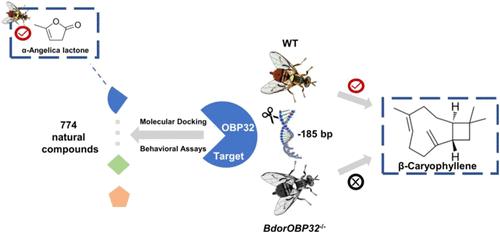
Bactrocera dorsalis is a destructive agricultural pest that attacks over 600 plant species. β-Caryophyllene is considered a potential compound for developing novel female attractants due to its attraction to B. dorsalis females. However, the unknown perception mechanism of β-caryophyllene has been the bottleneck of this process. Odorant binding proteins (OBPs) function to bind odorants and transport them to olfactory receptors. Here, behavioral assays revealed that β-caryophyllene strongly attracted mated, instead of virgin females. RT-qPCR confirmed BdorOBP32 up-regulation out of five OBPs in mated females compared to virgin females. Microscale thermophoresis (MST) results showed BdorOBP32 bind β-caryophyllene with relatively high affinity. Subsequently, CRISPR/Cas9 knockout of BdorOBP32 reduced electroantennograms responses and behavioral preferences to β-caryophyllene in mutants. Moreover, molecular docking and behavioral analysis identified a novel female attractant (α-angelica lactone) targeting BdorOBP32. These findings highlight BdorOBP32 plays critical roles in β-caryophyllene perception and offer new insights for developing novel olfactory behavior modulators.
期刊介绍:
The Journal of Agricultural and Food Chemistry publishes high-quality, cutting edge original research representing complete studies and research advances dealing with the chemistry and biochemistry of agriculture and food. The Journal also encourages papers with chemistry and/or biochemistry as a major component combined with biological/sensory/nutritional/toxicological evaluation related to agriculture and/or food.




 京公网安备 11010802042870号
京ICP备2023020795号-1
京公网安备 11010802042870号
京ICP备2023020795号-1

 分享
分享
 求助内容:
求助内容: 应助结果提醒方式:
 扫码关注我们
