{"title":"昆虫口腔分泌蛋白及其相关核心肽诱导寄主植物内源性脱落酸增强抗虫能力","authors":"Mengjun Yun, Yu Xiong, Zhuobing Wang, Lianjie Xie, Hanwen Ye, Xiaofang Yuan, Weiyi He, Binqing Chen, Zhanjun Lu, Wei Chen","doi":"10.1021/acs.jafc.4c12912","DOIUrl":null,"url":null,"abstract":"Plants perceive proteins from insect-derived oral secretion (OS) and regulate the classical endogenous hormone jasmonic acid to resist insects, but the role of abscisic acid (ABA) in this process is poorly understood. In this study, we used the specialist herbivorous caterpillar <i>Plutella xylostella</i> and cruciferous plants as a model to investigate how the ABA hormone responds to the OS and its core peptide from the insect. Through proteomics and Western blotting analysis, glucosinolate sulfatase 1 (GSS1) was identified in OS. Yeast library screening revealed that GSS1 and its 28-amino-acid core peptide (GSS1-P1) interact with ABA biosynthetic enzyme ABA1. <i>Arabidopsis</i> overexpressing GSS1 and plants treated with synthetic GSS1-P1 showed elevated ABA levels. Transcriptome analysis and RT-qPCR confirmed that GSS1-P1 upregulates <i>WRKY18</i> and <i>ABA1</i> expression, modulating ABA production. Both GSS1-P1 application and optimal ABA concentrations enhanced plant resistance to herbivory. Our study shows that GSS1 and its peptide stimulate ABA production, boosting plant–insect resistance and highlighting ABA’s potential role in pest-stress response.","PeriodicalId":41,"journal":{"name":"Journal of Agricultural and Food Chemistry","volume":"70 1","pages":""},"PeriodicalIF":6.7000,"publicationDate":"2025-04-24","publicationTypes":"Journal Article","fieldsOfStudy":null,"isOpenAccess":false,"openAccessPdf":"","citationCount":"0","resultStr":"{\"title\":\"Insect Oral Secretion Protein and Its Related Core Peptide Induce the Host Plant’s Endogenous Abscisic Acid to Enhance Resistance against Insect\",\"authors\":\"Mengjun Yun, Yu Xiong, Zhuobing Wang, Lianjie Xie, Hanwen Ye, Xiaofang Yuan, Weiyi He, Binqing Chen, Zhanjun Lu, Wei Chen\",\"doi\":\"10.1021/acs.jafc.4c12912\",\"DOIUrl\":null,\"url\":null,\"abstract\":\"Plants perceive proteins from insect-derived oral secretion (OS) and regulate the classical endogenous hormone jasmonic acid to resist insects, but the role of abscisic acid (ABA) in this process is poorly understood. In this study, we used the specialist herbivorous caterpillar <i>Plutella xylostella</i> and cruciferous plants as a model to investigate how the ABA hormone responds to the OS and its core peptide from the insect. Through proteomics and Western blotting analysis, glucosinolate sulfatase 1 (GSS1) was identified in OS. Yeast library screening revealed that GSS1 and its 28-amino-acid core peptide (GSS1-P1) interact with ABA biosynthetic enzyme ABA1. <i>Arabidopsis</i> overexpressing GSS1 and plants treated with synthetic GSS1-P1 showed elevated ABA levels. Transcriptome analysis and RT-qPCR confirmed that GSS1-P1 upregulates <i>WRKY18</i> and <i>ABA1</i> expression, modulating ABA production. Both GSS1-P1 application and optimal ABA concentrations enhanced plant resistance to herbivory. Our study shows that GSS1 and its peptide stimulate ABA production, boosting plant–insect resistance and highlighting ABA’s potential role in pest-stress response.\",\"PeriodicalId\":41,\"journal\":{\"name\":\"Journal of Agricultural and Food Chemistry\",\"volume\":\"70 1\",\"pages\":\"\"},\"PeriodicalIF\":6.7000,\"publicationDate\":\"2025-04-24\",\"publicationTypes\":\"Journal Article\",\"fieldsOfStudy\":null,\"isOpenAccess\":false,\"openAccessPdf\":\"\",\"citationCount\":\"0\",\"resultStr\":null,\"platform\":\"Semanticscholar\",\"paperid\":null,\"PeriodicalName\":\"Journal of Agricultural and Food Chemistry\",\"FirstCategoryId\":\"97\",\"ListUrlMain\":\"https://doi.org/10.1021/acs.jafc.4c12912\",\"RegionNum\":1,\"RegionCategory\":\"农林科学\",\"ArticlePicture\":[],\"TitleCN\":null,\"AbstractTextCN\":null,\"PMCID\":null,\"EPubDate\":\"\",\"PubModel\":\"\",\"JCR\":\"Q1\",\"JCRName\":\"AGRICULTURE, MULTIDISCIPLINARY\",\"Score\":null,\"Total\":0}","platform":"Semanticscholar","paperid":null,"PeriodicalName":"Journal of Agricultural and Food Chemistry","FirstCategoryId":"97","ListUrlMain":"https://doi.org/10.1021/acs.jafc.4c12912","RegionNum":1,"RegionCategory":"农林科学","ArticlePicture":[],"TitleCN":null,"AbstractTextCN":null,"PMCID":null,"EPubDate":"","PubModel":"","JCR":"Q1","JCRName":"AGRICULTURE, MULTIDISCIPLINARY","Score":null,"Total":0}
引用次数: 0
摘要
植物能感知来自昆虫口腔分泌物(OS)的蛋白质,并调节经典的内源激素茉莉酸来抵抗昆虫,但人们对脱落酸(ABA)在这一过程中的作用却知之甚少。在这项研究中,我们以专食草本的毛毛虫灰飞虱和十字花科植物为模型,研究ABA激素如何对来自昆虫的OS及其核心肽做出反应。通过蛋白质组学和Western印迹分析,在OS中发现了葡萄糖苷酸硫酸化酶1(GSS1)。酵母文库筛选发现,GSS1及其28氨基酸核心肽(GSS1-P1)与ABA生物合成酶ABA1相互作用。过表达 GSS1 的拟南芥和用合成 GSS1-P1 处理的植株显示 ABA 水平升高。转录组分析和 RT-qPCR 证实,GSS1-P1 能上调 WRKY18 和 ABA1 的表达,从而调节 ABA 的产生。施用 GSS1-P1 和最佳 ABA 浓度都能增强植物对食草动物的抵抗力。我们的研究表明,GSS1及其多肽能刺激ABA的产生,增强植物对昆虫的抵抗力,并突出了ABA在害虫胁迫响应中的潜在作用。
Insect Oral Secretion Protein and Its Related Core Peptide Induce the Host Plant’s Endogenous Abscisic Acid to Enhance Resistance against Insect
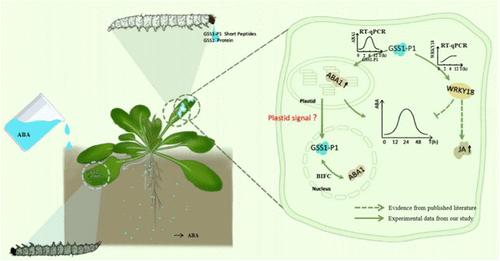
Plants perceive proteins from insect-derived oral secretion (OS) and regulate the classical endogenous hormone jasmonic acid to resist insects, but the role of abscisic acid (ABA) in this process is poorly understood. In this study, we used the specialist herbivorous caterpillar Plutella xylostella and cruciferous plants as a model to investigate how the ABA hormone responds to the OS and its core peptide from the insect. Through proteomics and Western blotting analysis, glucosinolate sulfatase 1 (GSS1) was identified in OS. Yeast library screening revealed that GSS1 and its 28-amino-acid core peptide (GSS1-P1) interact with ABA biosynthetic enzyme ABA1. Arabidopsis overexpressing GSS1 and plants treated with synthetic GSS1-P1 showed elevated ABA levels. Transcriptome analysis and RT-qPCR confirmed that GSS1-P1 upregulates WRKY18 and ABA1 expression, modulating ABA production. Both GSS1-P1 application and optimal ABA concentrations enhanced plant resistance to herbivory. Our study shows that GSS1 and its peptide stimulate ABA production, boosting plant–insect resistance and highlighting ABA’s potential role in pest-stress response.
期刊介绍:
The Journal of Agricultural and Food Chemistry publishes high-quality, cutting edge original research representing complete studies and research advances dealing with the chemistry and biochemistry of agriculture and food. The Journal also encourages papers with chemistry and/or biochemistry as a major component combined with biological/sensory/nutritional/toxicological evaluation related to agriculture and/or food.




 京公网安备 11010802042870号
京ICP备2023020795号-1
京公网安备 11010802042870号
京ICP备2023020795号-1

 分享
分享
 求助内容:
求助内容: 应助结果提醒方式:
 扫码关注我们
