{"title":"具有树枝状结构的无配体多尺度CuAgSe微纳米颗粒在室温热电材料中的应用","authors":"Xinxing Zhou, Kerui Li, Chengyi Hou, Qinghong Zhang, Yaogang Li, Hongzhi Wang","doi":"10.1002/adfm.202505741","DOIUrl":null,"url":null,"abstract":"<p>Exploring non-BiSbTe thermoelectric (TE) materials operable in the near room temperature range has emerged as a vibrant research frontier. However, the current synthesis of such materials heavily relies on energy-intensive techniques, with harsh conditions and the use of toxic reagents. In this work, a scalable, safe, simple, and cost-effective solution-based method is reported for synthesizing <i>β</i>-CuAgSe materials with a topologically dendritic structure. Notably, the synthesized material's surface is free from the complex organic ligands typically left by conventional synthesis methods, which mitigates the electrical performance degradation due to the intricate structure. Meanwhile, the multi-scale phonon scattering induced by the complex structure leads to a reduction in thermal conductivity. As a result, the material achieves a maximum ZT<sub>max</sub> of 0.48 at 298K and ZT<sub>ave</sub> of 0.42 in the 298–348K range, surpassing other doped CuAgSe materials and ranking among the top in various materials synthesized via solvothermal methods. The successful fabrication of thermoelectric devices (TED) enhanced with integrated radiative cooling and TE pastes formulated from these materials demonstrates their potential for applications in flexible TE.</p>","PeriodicalId":112,"journal":{"name":"Advanced Functional Materials","volume":"35 40","pages":""},"PeriodicalIF":19.0000,"publicationDate":"2025-04-24","publicationTypes":"Journal Article","fieldsOfStudy":null,"isOpenAccess":false,"openAccessPdf":"","citationCount":"0","resultStr":"{\"title\":\"Ligand-Free Multi-Scale CuAgSe Micro-Nanoparticles with a Dendritic Structure for Application as a Room Temperature Thermoelectric Material\",\"authors\":\"Xinxing Zhou, Kerui Li, Chengyi Hou, Qinghong Zhang, Yaogang Li, Hongzhi Wang\",\"doi\":\"10.1002/adfm.202505741\",\"DOIUrl\":null,\"url\":null,\"abstract\":\"<p>Exploring non-BiSbTe thermoelectric (TE) materials operable in the near room temperature range has emerged as a vibrant research frontier. However, the current synthesis of such materials heavily relies on energy-intensive techniques, with harsh conditions and the use of toxic reagents. In this work, a scalable, safe, simple, and cost-effective solution-based method is reported for synthesizing <i>β</i>-CuAgSe materials with a topologically dendritic structure. Notably, the synthesized material's surface is free from the complex organic ligands typically left by conventional synthesis methods, which mitigates the electrical performance degradation due to the intricate structure. Meanwhile, the multi-scale phonon scattering induced by the complex structure leads to a reduction in thermal conductivity. As a result, the material achieves a maximum ZT<sub>max</sub> of 0.48 at 298K and ZT<sub>ave</sub> of 0.42 in the 298–348K range, surpassing other doped CuAgSe materials and ranking among the top in various materials synthesized via solvothermal methods. The successful fabrication of thermoelectric devices (TED) enhanced with integrated radiative cooling and TE pastes formulated from these materials demonstrates their potential for applications in flexible TE.</p>\",\"PeriodicalId\":112,\"journal\":{\"name\":\"Advanced Functional Materials\",\"volume\":\"35 40\",\"pages\":\"\"},\"PeriodicalIF\":19.0000,\"publicationDate\":\"2025-04-24\",\"publicationTypes\":\"Journal Article\",\"fieldsOfStudy\":null,\"isOpenAccess\":false,\"openAccessPdf\":\"\",\"citationCount\":\"0\",\"resultStr\":null,\"platform\":\"Semanticscholar\",\"paperid\":null,\"PeriodicalName\":\"Advanced Functional Materials\",\"FirstCategoryId\":\"88\",\"ListUrlMain\":\"https://advanced.onlinelibrary.wiley.com/doi/10.1002/adfm.202505741\",\"RegionNum\":1,\"RegionCategory\":\"材料科学\",\"ArticlePicture\":[],\"TitleCN\":null,\"AbstractTextCN\":null,\"PMCID\":null,\"EPubDate\":\"\",\"PubModel\":\"\",\"JCR\":\"Q1\",\"JCRName\":\"CHEMISTRY, MULTIDISCIPLINARY\",\"Score\":null,\"Total\":0}","platform":"Semanticscholar","paperid":null,"PeriodicalName":"Advanced Functional Materials","FirstCategoryId":"88","ListUrlMain":"https://advanced.onlinelibrary.wiley.com/doi/10.1002/adfm.202505741","RegionNum":1,"RegionCategory":"材料科学","ArticlePicture":[],"TitleCN":null,"AbstractTextCN":null,"PMCID":null,"EPubDate":"","PubModel":"","JCR":"Q1","JCRName":"CHEMISTRY, MULTIDISCIPLINARY","Score":null,"Total":0}
Ligand-Free Multi-Scale CuAgSe Micro-Nanoparticles with a Dendritic Structure for Application as a Room Temperature Thermoelectric Material
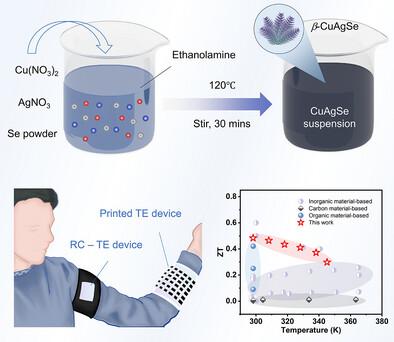
Exploring non-BiSbTe thermoelectric (TE) materials operable in the near room temperature range has emerged as a vibrant research frontier. However, the current synthesis of such materials heavily relies on energy-intensive techniques, with harsh conditions and the use of toxic reagents. In this work, a scalable, safe, simple, and cost-effective solution-based method is reported for synthesizing β-CuAgSe materials with a topologically dendritic structure. Notably, the synthesized material's surface is free from the complex organic ligands typically left by conventional synthesis methods, which mitigates the electrical performance degradation due to the intricate structure. Meanwhile, the multi-scale phonon scattering induced by the complex structure leads to a reduction in thermal conductivity. As a result, the material achieves a maximum ZTmax of 0.48 at 298K and ZTave of 0.42 in the 298–348K range, surpassing other doped CuAgSe materials and ranking among the top in various materials synthesized via solvothermal methods. The successful fabrication of thermoelectric devices (TED) enhanced with integrated radiative cooling and TE pastes formulated from these materials demonstrates their potential for applications in flexible TE.
期刊介绍:
Firmly established as a top-tier materials science journal, Advanced Functional Materials reports breakthrough research in all aspects of materials science, including nanotechnology, chemistry, physics, and biology every week.
Advanced Functional Materials is known for its rapid and fair peer review, quality content, and high impact, making it the first choice of the international materials science community.





 京公网安备 11010802042870号
京ICP备2023020795号-1
京公网安备 11010802042870号
京ICP备2023020795号-1

 分享
分享
 求助内容:
求助内容: 应助结果提醒方式:
 扫码关注我们
