Imane El Fartassi , Alice E. Milne , Bader Oulaid , Youssef Bezrhoud , Helen Metcalfe , Vasthi Alonso Chavez , Kevin Coleman , Alhousseine Diarra , Rafiq El Alami , Jonah Prout , Toby Waine , Joanna Zawadzka , Ron Corstanje
{"title":"与摩洛哥半干旱地区种植模式变化相关的权衡","authors":"Imane El Fartassi , Alice E. Milne , Bader Oulaid , Youssef Bezrhoud , Helen Metcalfe , Vasthi Alonso Chavez , Kevin Coleman , Alhousseine Diarra , Rafiq El Alami , Jonah Prout , Toby Waine , Joanna Zawadzka , Ron Corstanje","doi":"10.1016/j.scitotenv.2025.179492","DOIUrl":null,"url":null,"abstract":"<div><div>We developed a model-based framework to support land-use and management decision-making. This framework integrates data and models to support an assessment of scenarios related to crop choices and irrigation management. The framework includes the IPCC models to describe nutrient losses, the Rothamsted carbon model to predict soil organic carbon and Cornel's Environmental Impact Quotient model to predict impacts from pesticides (fungicides, herbicides and insecticides). We used Monte Carlo simulations to quantify model uncertainties. Shaded arrays were used to communicate the uncertainties to end users of the framework. We parameterised our framework to explore outcomes for an irrigated agricultural area in a semi-arid region of Morocco. We used the framework to explore scenarios that were codesigned with farming stakeholders. The scenarios related to crop diversification, and to recent policies on the expansion of olive cultivation and the adoption of efficient irrigation technologies. For the outcomes considered (production, profitability, soil carbon, nutrient losses, pesticide impacts), there were clear trade-offs associated with the cropping system choice. Compared to the baseline scenario of rotated crops, olive production led to greater carbon sequestration (average 4 % increase by doubling olive production), reduced water use (average 3 % reduction by doubling olive production), and reduced emissions (average 42 % reduction by doubling olive production) but was less profitable and provided fewer edible calories. Additionally, olive cultivation was associated with higher environmental impacts from pesticides. Diversified systems, while less profitable, were associated with less harmful pesticide use. Drip irrigation was associated with positive outcomes for profit (average 23 % increase), water use (average 13 % reduction in water use), and reduced nitrogen leaching (average 40 % reduction) with negligible changes in other metrics. However, we did not account for factors associated with increased groundwater depletion. We conclude that such frameworks are a useful means for policy-stakeholders to explore the outcomes of their decisions, thereby, helping to minimise unintended consequences.</div></div>","PeriodicalId":422,"journal":{"name":"Science of the Total Environment","volume":"979 ","pages":"Article 179492"},"PeriodicalIF":8.0000,"publicationDate":"2025-06-01","publicationTypes":"Journal Article","fieldsOfStudy":null,"isOpenAccess":false,"openAccessPdf":"","citationCount":"0","resultStr":"{\"title\":\"Trade-offs associated with changing cropping patterns in semi-arid areas of Morocco\",\"authors\":\"Imane El Fartassi , Alice E. Milne , Bader Oulaid , Youssef Bezrhoud , Helen Metcalfe , Vasthi Alonso Chavez , Kevin Coleman , Alhousseine Diarra , Rafiq El Alami , Jonah Prout , Toby Waine , Joanna Zawadzka , Ron Corstanje\",\"doi\":\"10.1016/j.scitotenv.2025.179492\",\"DOIUrl\":null,\"url\":null,\"abstract\":\"<div><div>We developed a model-based framework to support land-use and management decision-making. This framework integrates data and models to support an assessment of scenarios related to crop choices and irrigation management. The framework includes the IPCC models to describe nutrient losses, the Rothamsted carbon model to predict soil organic carbon and Cornel's Environmental Impact Quotient model to predict impacts from pesticides (fungicides, herbicides and insecticides). We used Monte Carlo simulations to quantify model uncertainties. Shaded arrays were used to communicate the uncertainties to end users of the framework. We parameterised our framework to explore outcomes for an irrigated agricultural area in a semi-arid region of Morocco. We used the framework to explore scenarios that were codesigned with farming stakeholders. The scenarios related to crop diversification, and to recent policies on the expansion of olive cultivation and the adoption of efficient irrigation technologies. For the outcomes considered (production, profitability, soil carbon, nutrient losses, pesticide impacts), there were clear trade-offs associated with the cropping system choice. Compared to the baseline scenario of rotated crops, olive production led to greater carbon sequestration (average 4 % increase by doubling olive production), reduced water use (average 3 % reduction by doubling olive production), and reduced emissions (average 42 % reduction by doubling olive production) but was less profitable and provided fewer edible calories. Additionally, olive cultivation was associated with higher environmental impacts from pesticides. Diversified systems, while less profitable, were associated with less harmful pesticide use. Drip irrigation was associated with positive outcomes for profit (average 23 % increase), water use (average 13 % reduction in water use), and reduced nitrogen leaching (average 40 % reduction) with negligible changes in other metrics. However, we did not account for factors associated with increased groundwater depletion. We conclude that such frameworks are a useful means for policy-stakeholders to explore the outcomes of their decisions, thereby, helping to minimise unintended consequences.</div></div>\",\"PeriodicalId\":422,\"journal\":{\"name\":\"Science of the Total Environment\",\"volume\":\"979 \",\"pages\":\"Article 179492\"},\"PeriodicalIF\":8.0000,\"publicationDate\":\"2025-06-01\",\"publicationTypes\":\"Journal Article\",\"fieldsOfStudy\":null,\"isOpenAccess\":false,\"openAccessPdf\":\"\",\"citationCount\":\"0\",\"resultStr\":null,\"platform\":\"Semanticscholar\",\"paperid\":null,\"PeriodicalName\":\"Science of the Total Environment\",\"FirstCategoryId\":\"93\",\"ListUrlMain\":\"https://www.sciencedirect.com/science/article/pii/S0048969725011295\",\"RegionNum\":1,\"RegionCategory\":\"环境科学与生态学\",\"ArticlePicture\":[],\"TitleCN\":null,\"AbstractTextCN\":null,\"PMCID\":null,\"EPubDate\":\"2025/4/24 0:00:00\",\"PubModel\":\"Epub\",\"JCR\":\"Q1\",\"JCRName\":\"ENVIRONMENTAL SCIENCES\",\"Score\":null,\"Total\":0}","platform":"Semanticscholar","paperid":null,"PeriodicalName":"Science of the Total Environment","FirstCategoryId":"93","ListUrlMain":"https://www.sciencedirect.com/science/article/pii/S0048969725011295","RegionNum":1,"RegionCategory":"环境科学与生态学","ArticlePicture":[],"TitleCN":null,"AbstractTextCN":null,"PMCID":null,"EPubDate":"2025/4/24 0:00:00","PubModel":"Epub","JCR":"Q1","JCRName":"ENVIRONMENTAL SCIENCES","Score":null,"Total":0}
Trade-offs associated with changing cropping patterns in semi-arid areas of Morocco
We developed a model-based framework to support land-use and management decision-making. This framework integrates data and models to support an assessment of scenarios related to crop choices and irrigation management. The framework includes the IPCC models to describe nutrient losses, the Rothamsted carbon model to predict soil organic carbon and Cornel's Environmental Impact Quotient model to predict impacts from pesticides (fungicides, herbicides and insecticides). We used Monte Carlo simulations to quantify model uncertainties. Shaded arrays were used to communicate the uncertainties to end users of the framework. We parameterised our framework to explore outcomes for an irrigated agricultural area in a semi-arid region of Morocco. We used the framework to explore scenarios that were codesigned with farming stakeholders. The scenarios related to crop diversification, and to recent policies on the expansion of olive cultivation and the adoption of efficient irrigation technologies. For the outcomes considered (production, profitability, soil carbon, nutrient losses, pesticide impacts), there were clear trade-offs associated with the cropping system choice. Compared to the baseline scenario of rotated crops, olive production led to greater carbon sequestration (average 4 % increase by doubling olive production), reduced water use (average 3 % reduction by doubling olive production), and reduced emissions (average 42 % reduction by doubling olive production) but was less profitable and provided fewer edible calories. Additionally, olive cultivation was associated with higher environmental impacts from pesticides. Diversified systems, while less profitable, were associated with less harmful pesticide use. Drip irrigation was associated with positive outcomes for profit (average 23 % increase), water use (average 13 % reduction in water use), and reduced nitrogen leaching (average 40 % reduction) with negligible changes in other metrics. However, we did not account for factors associated with increased groundwater depletion. We conclude that such frameworks are a useful means for policy-stakeholders to explore the outcomes of their decisions, thereby, helping to minimise unintended consequences.
期刊介绍:
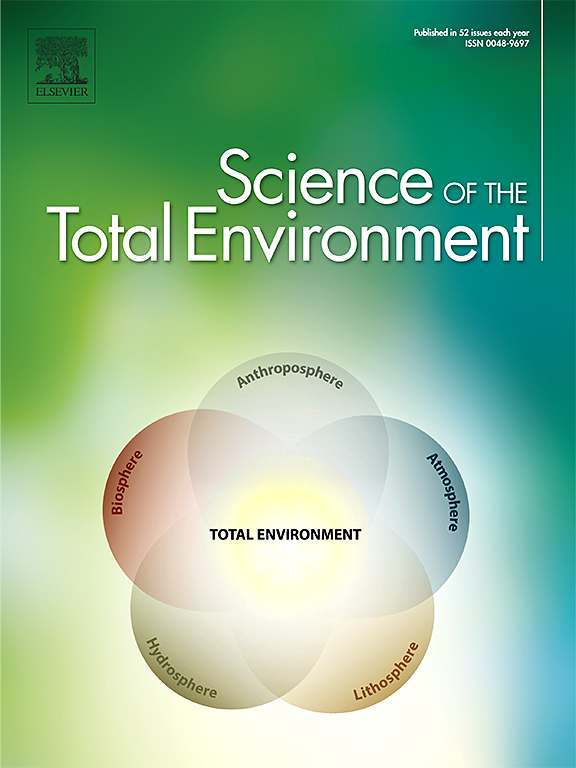
The Science of the Total Environment is an international journal dedicated to scientific research on the environment and its interaction with humanity. It covers a wide range of disciplines and seeks to publish innovative, hypothesis-driven, and impactful research that explores the entire environment, including the atmosphere, lithosphere, hydrosphere, biosphere, and anthroposphere.
The journal's updated Aims & Scope emphasizes the importance of interdisciplinary environmental research with broad impact. Priority is given to studies that advance fundamental understanding and explore the interconnectedness of multiple environmental spheres. Field studies are preferred, while laboratory experiments must demonstrate significant methodological advancements or mechanistic insights with direct relevance to the environment.





 京公网安备 11010802042870号
京ICP备2023020795号-1
京公网安备 11010802042870号
京ICP备2023020795号-1

 分享
分享
 求助内容:
求助内容: 应助结果提醒方式:
 扫码关注我们
