{"title":"集成先进的化学计量学和机器学习技术:用未修饰的碳糊电极进行苯胺检测的堆叠模型和XGBoost动态校正","authors":"Meryem NINI, Mohamed NOHAIR","doi":"10.1016/j.ijleo.2025.172369","DOIUrl":null,"url":null,"abstract":"<div><div>This study proposes a novel Chemometric approach for the precise and reliable quantification of aniline using an unmodified carbon paste electrode (CPE), even in the presence of interfering species such as phenol. The proposed methodology integrates partial least squares (PLS), random forest (RF) and ridge regression in a stacked model framework, combined with particle swarm optimization (PSO) for potential selection. To enhance the prediction accuracy, a dynamic correction based on XGBoost was applied, which effectively minimized residual errors and improved model robustness. The model developed demonstrated high performance on the training (R<sup>2</sup> = 0.9993, RMSE = 0.6260 and MAE = 0.4773), test (R<sup>2</sup> = 0.9979, RMSE = 0.7616 and MAE = 0.6839) and cross-validation datasets (R<sup>2</sup> = 0.9988, RMSE = 0.8312 and MAE = 0.5467), thus confirming its stability and reliability. The high coefficient of determination (R2), as well as the low root mean square error (RMSE) and mean absolute deviation (MAE) values, underscore the model's robust predictive capabilities and its capacity to accommodate intricate electrochemical interactions. Moreover, the calculated recovery rates and tolerance limits signify high precision and consistency across varying concentration levels. Utilizing an unmodified EPC, this approach proffers a cost-effective, sensitive, and selective strategy for aniline quantification, rendering it especially well-suited for environmental and industrial monitoring. The model's strong predictive capabilities underscore its potential for real-world contaminant detection, offering a reliable solution for complex analytical environments.</div></div>","PeriodicalId":19513,"journal":{"name":"Optik","volume":"330 ","pages":"Article 172369"},"PeriodicalIF":3.1000,"publicationDate":"2025-07-01","publicationTypes":"Journal Article","fieldsOfStudy":null,"isOpenAccess":false,"openAccessPdf":"","citationCount":"0","resultStr":"{\"title\":\"Integration of advanced chemometric and machine learning techniques: Stacking model and XGBoost dynamic correction for aniline detection with an unmodified carbon paste electrode\",\"authors\":\"Meryem NINI, Mohamed NOHAIR\",\"doi\":\"10.1016/j.ijleo.2025.172369\",\"DOIUrl\":null,\"url\":null,\"abstract\":\"<div><div>This study proposes a novel Chemometric approach for the precise and reliable quantification of aniline using an unmodified carbon paste electrode (CPE), even in the presence of interfering species such as phenol. The proposed methodology integrates partial least squares (PLS), random forest (RF) and ridge regression in a stacked model framework, combined with particle swarm optimization (PSO) for potential selection. To enhance the prediction accuracy, a dynamic correction based on XGBoost was applied, which effectively minimized residual errors and improved model robustness. The model developed demonstrated high performance on the training (R<sup>2</sup> = 0.9993, RMSE = 0.6260 and MAE = 0.4773), test (R<sup>2</sup> = 0.9979, RMSE = 0.7616 and MAE = 0.6839) and cross-validation datasets (R<sup>2</sup> = 0.9988, RMSE = 0.8312 and MAE = 0.5467), thus confirming its stability and reliability. The high coefficient of determination (R2), as well as the low root mean square error (RMSE) and mean absolute deviation (MAE) values, underscore the model's robust predictive capabilities and its capacity to accommodate intricate electrochemical interactions. Moreover, the calculated recovery rates and tolerance limits signify high precision and consistency across varying concentration levels. Utilizing an unmodified EPC, this approach proffers a cost-effective, sensitive, and selective strategy for aniline quantification, rendering it especially well-suited for environmental and industrial monitoring. The model's strong predictive capabilities underscore its potential for real-world contaminant detection, offering a reliable solution for complex analytical environments.</div></div>\",\"PeriodicalId\":19513,\"journal\":{\"name\":\"Optik\",\"volume\":\"330 \",\"pages\":\"Article 172369\"},\"PeriodicalIF\":3.1000,\"publicationDate\":\"2025-07-01\",\"publicationTypes\":\"Journal Article\",\"fieldsOfStudy\":null,\"isOpenAccess\":false,\"openAccessPdf\":\"\",\"citationCount\":\"0\",\"resultStr\":null,\"platform\":\"Semanticscholar\",\"paperid\":null,\"PeriodicalName\":\"Optik\",\"FirstCategoryId\":\"101\",\"ListUrlMain\":\"https://www.sciencedirect.com/science/article/pii/S0030402625001573\",\"RegionNum\":3,\"RegionCategory\":\"物理与天体物理\",\"ArticlePicture\":[],\"TitleCN\":null,\"AbstractTextCN\":null,\"PMCID\":null,\"EPubDate\":\"2025/4/22 0:00:00\",\"PubModel\":\"Epub\",\"JCR\":\"Q2\",\"JCRName\":\"Engineering\",\"Score\":null,\"Total\":0}","platform":"Semanticscholar","paperid":null,"PeriodicalName":"Optik","FirstCategoryId":"101","ListUrlMain":"https://www.sciencedirect.com/science/article/pii/S0030402625001573","RegionNum":3,"RegionCategory":"物理与天体物理","ArticlePicture":[],"TitleCN":null,"AbstractTextCN":null,"PMCID":null,"EPubDate":"2025/4/22 0:00:00","PubModel":"Epub","JCR":"Q2","JCRName":"Engineering","Score":null,"Total":0}
引用次数: 0
摘要
本研究提出了一种新的化学计量学方法,用于使用未修饰的碳糊电极(CPE)精确可靠地定量苯胺,即使在存在干扰物质(如苯酚)的情况下。该方法将偏最小二乘(PLS)、随机森林(RF)和脊回归(ridge regression)集成在一个堆叠模型框架中,并结合粒子群优化(PSO)进行潜在选择。为了提高预测精度,采用了基于XGBoost的动态校正,有效地减小了残差,提高了模型的鲁棒性。该模型在训练数据集(R2 = 0.9993, RMSE = 0.6260, MAE = 0.4773)、检验数据集(R2 = 0.9979, RMSE = 0.7616, MAE = 0.6839)和交叉验证数据集(R2 = 0.9988, RMSE = 0.8312, MAE = 0.5467)上均表现出良好的性能,验证了模型的稳定性和可靠性。高决定系数(R2),以及低均方根误差(RMSE)和平均绝对偏差(MAE)值,强调了该模型的强大预测能力及其适应复杂电化学相互作用的能力。此外,计算的回收率和公差限制表明在不同浓度水平下具有高精度和一致性。利用未经修改的EPC,这种方法为苯胺定量提供了一种经济、敏感和选择性的策略,使其特别适合环境和工业监测。该模型强大的预测能力强调了其在现实世界污染物检测中的潜力,为复杂的分析环境提供了可靠的解决方案。
Integration of advanced chemometric and machine learning techniques: Stacking model and XGBoost dynamic correction for aniline detection with an unmodified carbon paste electrode
This study proposes a novel Chemometric approach for the precise and reliable quantification of aniline using an unmodified carbon paste electrode (CPE), even in the presence of interfering species such as phenol. The proposed methodology integrates partial least squares (PLS), random forest (RF) and ridge regression in a stacked model framework, combined with particle swarm optimization (PSO) for potential selection. To enhance the prediction accuracy, a dynamic correction based on XGBoost was applied, which effectively minimized residual errors and improved model robustness. The model developed demonstrated high performance on the training (R2 = 0.9993, RMSE = 0.6260 and MAE = 0.4773), test (R2 = 0.9979, RMSE = 0.7616 and MAE = 0.6839) and cross-validation datasets (R2 = 0.9988, RMSE = 0.8312 and MAE = 0.5467), thus confirming its stability and reliability. The high coefficient of determination (R2), as well as the low root mean square error (RMSE) and mean absolute deviation (MAE) values, underscore the model's robust predictive capabilities and its capacity to accommodate intricate electrochemical interactions. Moreover, the calculated recovery rates and tolerance limits signify high precision and consistency across varying concentration levels. Utilizing an unmodified EPC, this approach proffers a cost-effective, sensitive, and selective strategy for aniline quantification, rendering it especially well-suited for environmental and industrial monitoring. The model's strong predictive capabilities underscore its potential for real-world contaminant detection, offering a reliable solution for complex analytical environments.
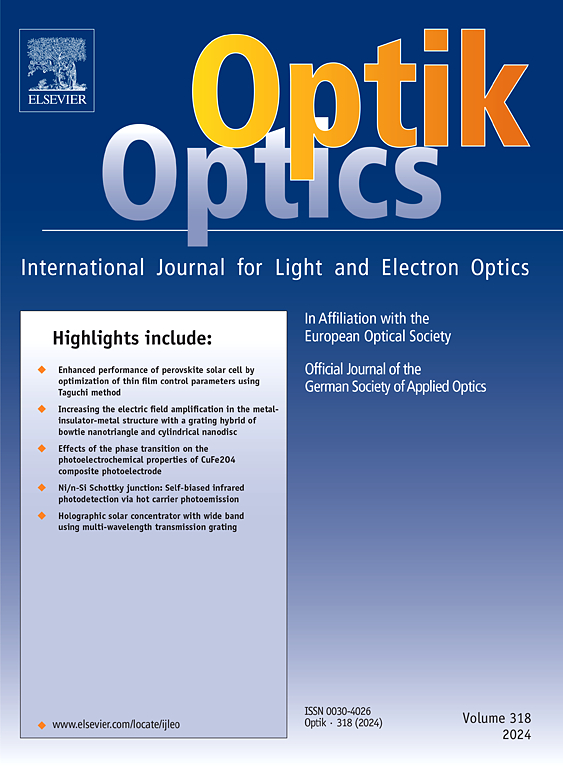
期刊介绍:
Optik publishes articles on all subjects related to light and electron optics and offers a survey on the state of research and technical development within the following fields:
Optics:
-Optics design, geometrical and beam optics, wave optics-
Optical and micro-optical components, diffractive optics, devices and systems-
Photoelectric and optoelectronic devices-
Optical properties of materials, nonlinear optics, wave propagation and transmission in homogeneous and inhomogeneous materials-
Information optics, image formation and processing, holographic techniques, microscopes and spectrometer techniques, and image analysis-
Optical testing and measuring techniques-
Optical communication and computing-
Physiological optics-
As well as other related topics.




 京公网安备 11010802042870号
京ICP备2023020795号-1
京公网安备 11010802042870号
京ICP备2023020795号-1

 分享
分享
 求助内容:
求助内容: 应助结果提醒方式:
 扫码关注我们
