{"title":"电沉积Ni-C非晶合金:一种提高析氢和尿素电氧化催化活性的新方法","authors":"Dawid Kutyła","doi":"10.1016/j.ijhydene.2025.04.290","DOIUrl":null,"url":null,"abstract":"<div><div>This study presents the electrodeposition of nickel–carbon (Ni–C) amorphous alloys using arginine as a carbon precursor in a modified Watts bath. Increasing carbon content leads to structural amorphization, reduced crystallite size (down to 8 nm), and enhanced electrochemically active surface area (ECSA). Electrochemical tests reveal improved catalytic performance for both hydrogen evolution (HER) and urea electrooxidation. The overpotential at −10 mA/cm<sup>2</sup> for HER is significantly reduced (−0.243 V vs. RHE), and Ni–C electrodes exhibit 10-time higher current densities for urea oxidation at +1.55 V in 1 M NaOH +0.33 M urea compared to pure nickel. The presence of carbon promotes the formation of the Ni(OH)<sub>2</sub>/NiOOH redox couple by increasing the electrochemically active surface area and enhancing oxidation efficiency. These results highlight Ni–C alloys as promising electrode materials for energy conversion and waste valorization applications.</div></div>","PeriodicalId":337,"journal":{"name":"International Journal of Hydrogen Energy","volume":"129 ","pages":"Pages 184-192"},"PeriodicalIF":8.3000,"publicationDate":"2025-05-19","publicationTypes":"Journal Article","fieldsOfStudy":null,"isOpenAccess":false,"openAccessPdf":"","citationCount":"0","resultStr":"{\"title\":\"Electrodeposited Ni–C amorphous alloys: A novel approach to enhancing catalytic activity for hydrogen evolution and urea electrooxidation\",\"authors\":\"Dawid Kutyła\",\"doi\":\"10.1016/j.ijhydene.2025.04.290\",\"DOIUrl\":null,\"url\":null,\"abstract\":\"<div><div>This study presents the electrodeposition of nickel–carbon (Ni–C) amorphous alloys using arginine as a carbon precursor in a modified Watts bath. Increasing carbon content leads to structural amorphization, reduced crystallite size (down to 8 nm), and enhanced electrochemically active surface area (ECSA). Electrochemical tests reveal improved catalytic performance for both hydrogen evolution (HER) and urea electrooxidation. The overpotential at −10 mA/cm<sup>2</sup> for HER is significantly reduced (−0.243 V vs. RHE), and Ni–C electrodes exhibit 10-time higher current densities for urea oxidation at +1.55 V in 1 M NaOH +0.33 M urea compared to pure nickel. The presence of carbon promotes the formation of the Ni(OH)<sub>2</sub>/NiOOH redox couple by increasing the electrochemically active surface area and enhancing oxidation efficiency. These results highlight Ni–C alloys as promising electrode materials for energy conversion and waste valorization applications.</div></div>\",\"PeriodicalId\":337,\"journal\":{\"name\":\"International Journal of Hydrogen Energy\",\"volume\":\"129 \",\"pages\":\"Pages 184-192\"},\"PeriodicalIF\":8.3000,\"publicationDate\":\"2025-05-19\",\"publicationTypes\":\"Journal Article\",\"fieldsOfStudy\":null,\"isOpenAccess\":false,\"openAccessPdf\":\"\",\"citationCount\":\"0\",\"resultStr\":null,\"platform\":\"Semanticscholar\",\"paperid\":null,\"PeriodicalName\":\"International Journal of Hydrogen Energy\",\"FirstCategoryId\":\"5\",\"ListUrlMain\":\"https://www.sciencedirect.com/science/article/pii/S0360319925019755\",\"RegionNum\":2,\"RegionCategory\":\"工程技术\",\"ArticlePicture\":[],\"TitleCN\":null,\"AbstractTextCN\":null,\"PMCID\":null,\"EPubDate\":\"2025/4/24 0:00:00\",\"PubModel\":\"Epub\",\"JCR\":\"Q1\",\"JCRName\":\"CHEMISTRY, PHYSICAL\",\"Score\":null,\"Total\":0}","platform":"Semanticscholar","paperid":null,"PeriodicalName":"International Journal of Hydrogen Energy","FirstCategoryId":"5","ListUrlMain":"https://www.sciencedirect.com/science/article/pii/S0360319925019755","RegionNum":2,"RegionCategory":"工程技术","ArticlePicture":[],"TitleCN":null,"AbstractTextCN":null,"PMCID":null,"EPubDate":"2025/4/24 0:00:00","PubModel":"Epub","JCR":"Q1","JCRName":"CHEMISTRY, PHYSICAL","Score":null,"Total":0}
Electrodeposited Ni–C amorphous alloys: A novel approach to enhancing catalytic activity for hydrogen evolution and urea electrooxidation
This study presents the electrodeposition of nickel–carbon (Ni–C) amorphous alloys using arginine as a carbon precursor in a modified Watts bath. Increasing carbon content leads to structural amorphization, reduced crystallite size (down to 8 nm), and enhanced electrochemically active surface area (ECSA). Electrochemical tests reveal improved catalytic performance for both hydrogen evolution (HER) and urea electrooxidation. The overpotential at −10 mA/cm2 for HER is significantly reduced (−0.243 V vs. RHE), and Ni–C electrodes exhibit 10-time higher current densities for urea oxidation at +1.55 V in 1 M NaOH +0.33 M urea compared to pure nickel. The presence of carbon promotes the formation of the Ni(OH)2/NiOOH redox couple by increasing the electrochemically active surface area and enhancing oxidation efficiency. These results highlight Ni–C alloys as promising electrode materials for energy conversion and waste valorization applications.
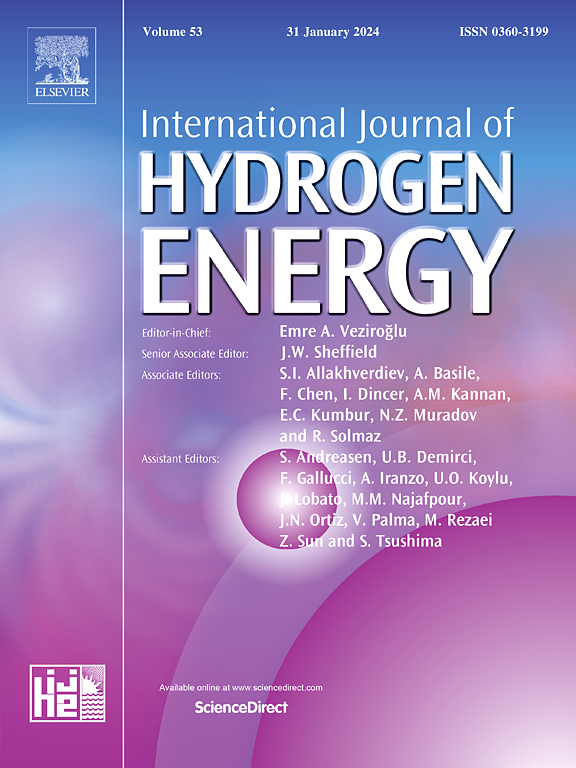
期刊介绍:
The objective of the International Journal of Hydrogen Energy is to facilitate the exchange of new ideas, technological advancements, and research findings in the field of Hydrogen Energy among scientists and engineers worldwide. This journal showcases original research, both analytical and experimental, covering various aspects of Hydrogen Energy. These include production, storage, transmission, utilization, enabling technologies, environmental impact, economic considerations, and global perspectives on hydrogen and its carriers such as NH3, CH4, alcohols, etc.
The utilization aspect encompasses various methods such as thermochemical (combustion), photochemical, electrochemical (fuel cells), and nuclear conversion of hydrogen, hydrogen isotopes, and hydrogen carriers into thermal, mechanical, and electrical energies. The applications of these energies can be found in transportation (including aerospace), industrial, commercial, and residential sectors.




 京公网安备 11010802042870号
京ICP备2023020795号-1
京公网安备 11010802042870号
京ICP备2023020795号-1

 分享
分享
 求助内容:
求助内容: 应助结果提醒方式:
 扫码关注我们
