Woojin Lim, Bhavana Joshi, Edmund Samuel, Jung Woo Huh, Ali Aldalbahi, Govindasami Periyasami, Hae-Seok Lee, Bin Ding, Sam S. Yoon
{"title":"用超音速喷射Sr2SnO4纳米棒增强大功率纳米发电机用PVDF的电活性相","authors":"Woojin Lim, Bhavana Joshi, Edmund Samuel, Jung Woo Huh, Ali Aldalbahi, Govindasami Periyasami, Hae-Seok Lee, Bin Ding, Sam S. Yoon","doi":"10.1016/j.jmst.2025.03.040","DOIUrl":null,"url":null,"abstract":"Supersonic spraying is a scalable, non-vacuum, rapid coating technique that uses a supersonic gas stream from a de Laval nozzle to deposit precursors under atmospheric conditions. In this study, the supersonic spraying of Sr<sub>2</sub>SnO<sub>4</sub> nanorods (SSO-NRs) was found to increase the content of electroactive <em>β</em>- and <em>γ</em>-phases in poly (vinylidene fluoride) (PVDF) by more than twofold. Specifically, shear stress between the PVDF and SSO-NRs, induced by supersonic blowing, amplified the <em>β</em>- and <em>γ</em>-phases, which enhanced the energy-harvesting performance of a flexible piezoelectric nanogenerator (PENG). The swirling of the high-aspect-ratio SSO-NRs intensified the turbulence, thereby magnifying the influence of the shear stress. The supersonically driven shear stress caused multidirectional stretching, elongation, and twisting of PVDF and transformed a large amount of the <em>α</em>-phase into electroactive <em>β</em>- and <em>γ</em>-phases, as evidenced by X-ray diffractometry and infrared spectroscopy. The composite film with a minimal filler content of 2.5 wt.% exhibited a piezopotential of 41 V without additional poling. The optimal SSO/PVDF-based PENG delivered a high power density of 90 µW cm<sup>−2</sup> when subjected to a tapping force. Furthermore, the practical applicability of the PENG was demonstrated using air pressure, vibration, and human body movement. The fabricated PENG device was integrated with a supercapacitor electrode to exhibit a wide application range in wearable and portable electronics.","PeriodicalId":16154,"journal":{"name":"Journal of Materials Science & Technology","volume":"69 1","pages":""},"PeriodicalIF":14.3000,"publicationDate":"2025-04-24","publicationTypes":"Journal Article","fieldsOfStudy":null,"isOpenAccess":false,"openAccessPdf":"","citationCount":"0","resultStr":"{\"title\":\"Shear stress-induced augmentation of electroactive phases of PVDF for high-power nanogenerator using supersonically sprayed Sr2SnO4 nanorods\",\"authors\":\"Woojin Lim, Bhavana Joshi, Edmund Samuel, Jung Woo Huh, Ali Aldalbahi, Govindasami Periyasami, Hae-Seok Lee, Bin Ding, Sam S. Yoon\",\"doi\":\"10.1016/j.jmst.2025.03.040\",\"DOIUrl\":null,\"url\":null,\"abstract\":\"Supersonic spraying is a scalable, non-vacuum, rapid coating technique that uses a supersonic gas stream from a de Laval nozzle to deposit precursors under atmospheric conditions. In this study, the supersonic spraying of Sr<sub>2</sub>SnO<sub>4</sub> nanorods (SSO-NRs) was found to increase the content of electroactive <em>β</em>- and <em>γ</em>-phases in poly (vinylidene fluoride) (PVDF) by more than twofold. Specifically, shear stress between the PVDF and SSO-NRs, induced by supersonic blowing, amplified the <em>β</em>- and <em>γ</em>-phases, which enhanced the energy-harvesting performance of a flexible piezoelectric nanogenerator (PENG). The swirling of the high-aspect-ratio SSO-NRs intensified the turbulence, thereby magnifying the influence of the shear stress. The supersonically driven shear stress caused multidirectional stretching, elongation, and twisting of PVDF and transformed a large amount of the <em>α</em>-phase into electroactive <em>β</em>- and <em>γ</em>-phases, as evidenced by X-ray diffractometry and infrared spectroscopy. The composite film with a minimal filler content of 2.5 wt.% exhibited a piezopotential of 41 V without additional poling. The optimal SSO/PVDF-based PENG delivered a high power density of 90 µW cm<sup>−2</sup> when subjected to a tapping force. Furthermore, the practical applicability of the PENG was demonstrated using air pressure, vibration, and human body movement. The fabricated PENG device was integrated with a supercapacitor electrode to exhibit a wide application range in wearable and portable electronics.\",\"PeriodicalId\":16154,\"journal\":{\"name\":\"Journal of Materials Science & Technology\",\"volume\":\"69 1\",\"pages\":\"\"},\"PeriodicalIF\":14.3000,\"publicationDate\":\"2025-04-24\",\"publicationTypes\":\"Journal Article\",\"fieldsOfStudy\":null,\"isOpenAccess\":false,\"openAccessPdf\":\"\",\"citationCount\":\"0\",\"resultStr\":null,\"platform\":\"Semanticscholar\",\"paperid\":null,\"PeriodicalName\":\"Journal of Materials Science & Technology\",\"FirstCategoryId\":\"88\",\"ListUrlMain\":\"https://doi.org/10.1016/j.jmst.2025.03.040\",\"RegionNum\":1,\"RegionCategory\":\"材料科学\",\"ArticlePicture\":[],\"TitleCN\":null,\"AbstractTextCN\":null,\"PMCID\":null,\"EPubDate\":\"\",\"PubModel\":\"\",\"JCR\":\"Q1\",\"JCRName\":\"MATERIALS SCIENCE, MULTIDISCIPLINARY\",\"Score\":null,\"Total\":0}","platform":"Semanticscholar","paperid":null,"PeriodicalName":"Journal of Materials Science & Technology","FirstCategoryId":"88","ListUrlMain":"https://doi.org/10.1016/j.jmst.2025.03.040","RegionNum":1,"RegionCategory":"材料科学","ArticlePicture":[],"TitleCN":null,"AbstractTextCN":null,"PMCID":null,"EPubDate":"","PubModel":"","JCR":"Q1","JCRName":"MATERIALS SCIENCE, MULTIDISCIPLINARY","Score":null,"Total":0}
引用次数: 0
摘要
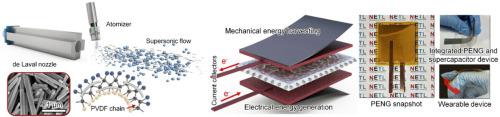
超音速喷涂是一种可扩展的、非真空的快速涂层技术,它使用来自de Laval喷嘴的超音速气流在大气条件下沉积前驱体。在本研究中,发现Sr2SnO4纳米棒(SSO-NRs)的超音速喷涂使聚偏氟乙烯(PVDF)中电活性β-相和γ-相的含量增加了两倍以上。具体而言,PVDF和SSO-NRs之间的剪切应力在超音速吹风作用下放大了β-相和γ-相,从而提高了柔性压电纳米发电机(PENG)的能量收集性能。高展弦比sso - nr的旋流加剧了湍流,从而放大了剪应力的影响。x射线衍射和红外光谱分析表明,在超音速剪切应力作用下,PVDF发生多向拉伸、伸长和扭转,α-相大量转化为电活性β-相和γ-相。填料含量为2.5 wt.%的复合薄膜在没有额外极化的情况下具有41 V的压势。当受到攻丝力时,基于SSO/ pvdf的最佳PENG提供了90 μ W cm−2的高功率密度。此外,还通过空气压力、振动和人体运动证明了PENG的实际适用性。制造的PENG器件与超级电容器电极集成在一起,在可穿戴和便携式电子产品中具有广泛的应用范围。
Shear stress-induced augmentation of electroactive phases of PVDF for high-power nanogenerator using supersonically sprayed Sr2SnO4 nanorods
Supersonic spraying is a scalable, non-vacuum, rapid coating technique that uses a supersonic gas stream from a de Laval nozzle to deposit precursors under atmospheric conditions. In this study, the supersonic spraying of Sr2SnO4 nanorods (SSO-NRs) was found to increase the content of electroactive β- and γ-phases in poly (vinylidene fluoride) (PVDF) by more than twofold. Specifically, shear stress between the PVDF and SSO-NRs, induced by supersonic blowing, amplified the β- and γ-phases, which enhanced the energy-harvesting performance of a flexible piezoelectric nanogenerator (PENG). The swirling of the high-aspect-ratio SSO-NRs intensified the turbulence, thereby magnifying the influence of the shear stress. The supersonically driven shear stress caused multidirectional stretching, elongation, and twisting of PVDF and transformed a large amount of the α-phase into electroactive β- and γ-phases, as evidenced by X-ray diffractometry and infrared spectroscopy. The composite film with a minimal filler content of 2.5 wt.% exhibited a piezopotential of 41 V without additional poling. The optimal SSO/PVDF-based PENG delivered a high power density of 90 µW cm−2 when subjected to a tapping force. Furthermore, the practical applicability of the PENG was demonstrated using air pressure, vibration, and human body movement. The fabricated PENG device was integrated with a supercapacitor electrode to exhibit a wide application range in wearable and portable electronics.
期刊介绍:
Journal of Materials Science & Technology strives to promote global collaboration in the field of materials science and technology. It primarily publishes original research papers, invited review articles, letters, research notes, and summaries of scientific achievements. The journal covers a wide range of materials science and technology topics, including metallic materials, inorganic nonmetallic materials, and composite materials.




 京公网安备 11010802042870号
京ICP备2023020795号-1
京公网安备 11010802042870号
京ICP备2023020795号-1

 分享
分享
 求助内容:
求助内容: 应助结果提醒方式:
 扫码关注我们
