{"title":"评估药房工作人员和注册前学生对电子烟使用的了解和看法:系统回顾。","authors":"Ravina Barrett, Hajar Aldamkhi","doi":"10.1177/1179173X211016867","DOIUrl":null,"url":null,"abstract":"<p><strong>Introduction: </strong>Pharmacy staff are a trusted source of advice on the safe and appropriate use of medicines and devices. Retail pharmacies deliver smoking cessation services and sell e-cigarettes in the UK. This review asks 'what knowledge, experience and ability do staff have to support e-cigarette users to quit smoking'.</p><p><strong>Methods: </strong>A systematic literature search was undertaken drawn on predefined eligibility criteria and a comprehensive search strategy following the PRISMA guideline. Eligible papers reported survey-research published in English from 2015 to 2020. PubMed, Google Scholar, OVID, EMBASE and MEDLINE Databases were searched. No restrictions on study design or language were applied. Two reviewers independently screened for inclusion/exclusion and then extracted the relevant information from the articles for synthesis.</p><p><strong>Results: </strong>Of 12 potentially eligible full-text studies, 1 was a duplicate, 7 were excluded as per eligibility criteria. Four papers were finally included in this literature review. Two studies indicated that pharmacy staff are less confident in giving advice on e-cigarette use. Knowledge on the adverse effects of e-cigarettes compared to traditional smoking cessation aids remain unclear. In one study, 42% of community pharmacists did not believe that e-cigarettes could be used for smoking cessation. Three studies identified need for specific regulations and professional support. The overall certainty of the evidence is 'low' or 'very low', with moderate levels of bias.</p><p><strong>Conclusion: </strong>Pharmacists may be well placed to implement e-cigarette smoking cessation interventions, but most practitioners lacked knowledge and ability to support these customers citing unclear risk of harm. Pharmacists felt secure in recommending traditional cessation tools. Further regulation, guidelines and training is needed. Findings may be less generalizable in countries where e-cigarettes are banned. Their extent of knowledge, experience and ability to support users of e-cigarettes within their community to quit smoking is lacking.</p>","PeriodicalId":2,"journal":{"name":"ACS Applied Bio Materials","volume":" ","pages":"1179173X211016867"},"PeriodicalIF":4.7000,"publicationDate":"2021-06-14","publicationTypes":"Journal Article","fieldsOfStudy":null,"isOpenAccess":false,"openAccessPdf":"https://www.ncbi.nlm.nih.gov/pmc/articles/PMC8209790/pdf/","citationCount":"0","resultStr":"{\"title\":\"An Evaluation of the Knowledge and Perceptions of Pharmacy Staff and Pre-Registration Students of E-Cigarettes Use: A Systematic Review.\",\"authors\":\"Ravina Barrett, Hajar Aldamkhi\",\"doi\":\"10.1177/1179173X211016867\",\"DOIUrl\":null,\"url\":null,\"abstract\":\"<p><strong>Introduction: </strong>Pharmacy staff are a trusted source of advice on the safe and appropriate use of medicines and devices. Retail pharmacies deliver smoking cessation services and sell e-cigarettes in the UK. This review asks 'what knowledge, experience and ability do staff have to support e-cigarette users to quit smoking'.</p><p><strong>Methods: </strong>A systematic literature search was undertaken drawn on predefined eligibility criteria and a comprehensive search strategy following the PRISMA guideline. Eligible papers reported survey-research published in English from 2015 to 2020. PubMed, Google Scholar, OVID, EMBASE and MEDLINE Databases were searched. No restrictions on study design or language were applied. Two reviewers independently screened for inclusion/exclusion and then extracted the relevant information from the articles for synthesis.</p><p><strong>Results: </strong>Of 12 potentially eligible full-text studies, 1 was a duplicate, 7 were excluded as per eligibility criteria. Four papers were finally included in this literature review. Two studies indicated that pharmacy staff are less confident in giving advice on e-cigarette use. Knowledge on the adverse effects of e-cigarettes compared to traditional smoking cessation aids remain unclear. In one study, 42% of community pharmacists did not believe that e-cigarettes could be used for smoking cessation. Three studies identified need for specific regulations and professional support. The overall certainty of the evidence is 'low' or 'very low', with moderate levels of bias.</p><p><strong>Conclusion: </strong>Pharmacists may be well placed to implement e-cigarette smoking cessation interventions, but most practitioners lacked knowledge and ability to support these customers citing unclear risk of harm. Pharmacists felt secure in recommending traditional cessation tools. Further regulation, guidelines and training is needed. Findings may be less generalizable in countries where e-cigarettes are banned. Their extent of knowledge, experience and ability to support users of e-cigarettes within their community to quit smoking is lacking.</p>\",\"PeriodicalId\":2,\"journal\":{\"name\":\"ACS Applied Bio Materials\",\"volume\":\" \",\"pages\":\"1179173X211016867\"},\"PeriodicalIF\":4.7000,\"publicationDate\":\"2021-06-14\",\"publicationTypes\":\"Journal Article\",\"fieldsOfStudy\":null,\"isOpenAccess\":false,\"openAccessPdf\":\"https://www.ncbi.nlm.nih.gov/pmc/articles/PMC8209790/pdf/\",\"citationCount\":\"0\",\"resultStr\":null,\"platform\":\"Semanticscholar\",\"paperid\":null,\"PeriodicalName\":\"ACS Applied Bio Materials\",\"FirstCategoryId\":\"1085\",\"ListUrlMain\":\"https://doi.org/10.1177/1179173X211016867\",\"RegionNum\":0,\"RegionCategory\":null,\"ArticlePicture\":[],\"TitleCN\":null,\"AbstractTextCN\":null,\"PMCID\":null,\"EPubDate\":\"2021/1/1 0:00:00\",\"PubModel\":\"eCollection\",\"JCR\":\"Q2\",\"JCRName\":\"MATERIALS SCIENCE, BIOMATERIALS\",\"Score\":null,\"Total\":0}","platform":"Semanticscholar","paperid":null,"PeriodicalName":"ACS Applied Bio Materials","FirstCategoryId":"1085","ListUrlMain":"https://doi.org/10.1177/1179173X211016867","RegionNum":0,"RegionCategory":null,"ArticlePicture":[],"TitleCN":null,"AbstractTextCN":null,"PMCID":null,"EPubDate":"2021/1/1 0:00:00","PubModel":"eCollection","JCR":"Q2","JCRName":"MATERIALS SCIENCE, BIOMATERIALS","Score":null,"Total":0}
An Evaluation of the Knowledge and Perceptions of Pharmacy Staff and Pre-Registration Students of E-Cigarettes Use: A Systematic Review.
Introduction: Pharmacy staff are a trusted source of advice on the safe and appropriate use of medicines and devices. Retail pharmacies deliver smoking cessation services and sell e-cigarettes in the UK. This review asks 'what knowledge, experience and ability do staff have to support e-cigarette users to quit smoking'.
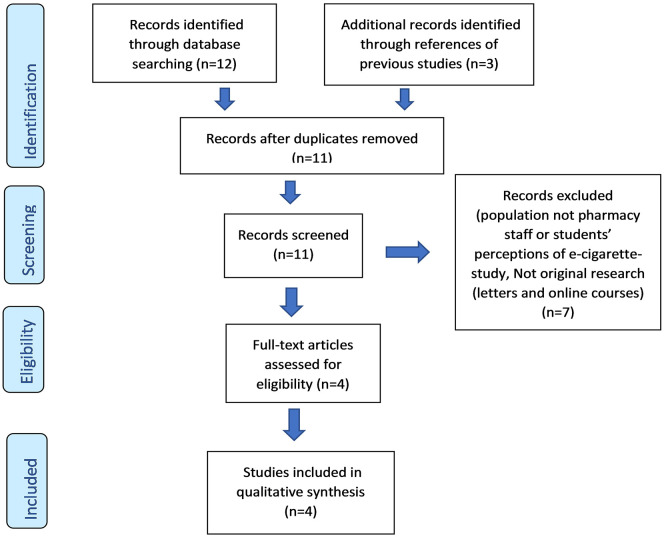
Methods: A systematic literature search was undertaken drawn on predefined eligibility criteria and a comprehensive search strategy following the PRISMA guideline. Eligible papers reported survey-research published in English from 2015 to 2020. PubMed, Google Scholar, OVID, EMBASE and MEDLINE Databases were searched. No restrictions on study design or language were applied. Two reviewers independently screened for inclusion/exclusion and then extracted the relevant information from the articles for synthesis.
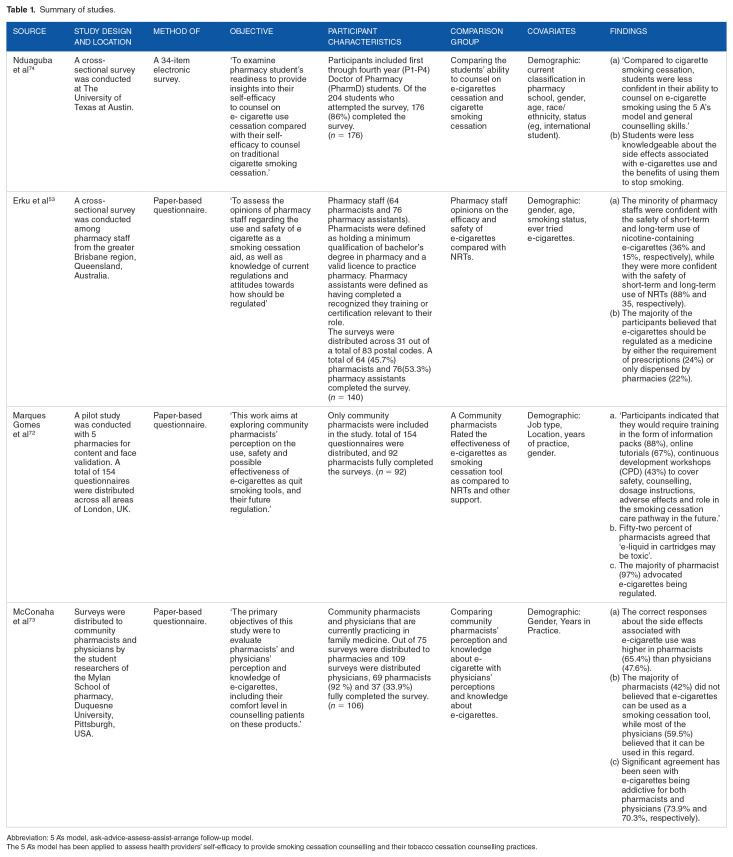
Results: Of 12 potentially eligible full-text studies, 1 was a duplicate, 7 were excluded as per eligibility criteria. Four papers were finally included in this literature review. Two studies indicated that pharmacy staff are less confident in giving advice on e-cigarette use. Knowledge on the adverse effects of e-cigarettes compared to traditional smoking cessation aids remain unclear. In one study, 42% of community pharmacists did not believe that e-cigarettes could be used for smoking cessation. Three studies identified need for specific regulations and professional support. The overall certainty of the evidence is 'low' or 'very low', with moderate levels of bias.
Conclusion: Pharmacists may be well placed to implement e-cigarette smoking cessation interventions, but most practitioners lacked knowledge and ability to support these customers citing unclear risk of harm. Pharmacists felt secure in recommending traditional cessation tools. Further regulation, guidelines and training is needed. Findings may be less generalizable in countries where e-cigarettes are banned. Their extent of knowledge, experience and ability to support users of e-cigarettes within their community to quit smoking is lacking.
期刊介绍:
ACS Applied Bio Materials is an interdisciplinary journal publishing original research covering all aspects of biomaterials and biointerfaces including and beyond the traditional biosensing, biomedical and therapeutic applications.
The journal is devoted to reports of new and original experimental and theoretical research of an applied nature that integrates knowledge in the areas of materials, engineering, physics, bioscience, and chemistry into important bio applications. The journal is specifically interested in work that addresses the relationship between structure and function and assesses the stability and degradation of materials under relevant environmental and biological conditions.






 京公网安备 11010802042870号
京ICP备2023020795号-1
京公网安备 11010802042870号
京ICP备2023020795号-1

 分享
分享
 求助内容:
求助内容: 应助结果提醒方式:
 扫码关注我们
