Andrius Ramonas, Paul B. Laursen, Micalla Williden, Andrew E. Kilding
{"title":"急性控制碳水化合物有效性对高强度跑步成绩、跑步经济性、临界速度和基质代谢的影响。","authors":"Andrius Ramonas, Paul B. Laursen, Micalla Williden, Andrew E. Kilding","doi":"10.1080/17461391.2022.2130097","DOIUrl":null,"url":null,"abstract":"<div>\n \n <p>Completing selected training sessions with reduced glycogen availability is associated with greater signalling and improved muscle oxidative capacity, although it may impact the overall quality of the session. We examined the effects of low carbohydrate availability on high intensity exercise performance, running economy, critical speed, and substrate metabolism. On two occasions, nine male runners (V̇O<sub>2peak</sub> 60.3 ± 3.3 mL.kg<sup>−1</sup>.min<sup>−1</sup>) completed a glycogen depletion protocol involving 90-min at 75%vV̇O<sub>2peak</sub> followed by 10 × 1-min at 110% vV̇O<sub>2peak</sub>. This was followed either by high (HIGH) or low (LOW) carbohydrate intake (>6 g.kg<sup>−1</sup>.day<sup>−1</sup> and <50 g.day<sup>−1</sup>, respectively) until completion of a performance protocol on day 2 consisting of a series of time-trials (TT) (50m to 3000m) and physiological assessments. There were no differences between LOW and HIGH for any TT distance (mean TT performance times for LOW and HIGH were: 3000m TT 651.7 ± 52.8s and 646.4 ± 52.5s, 1500 m TT 304.0 ± 20.2s and 304.2 ± 22.1s, 400 m TT 67.64 ± 4.2s and 67.3 ± 3.8s, 50 m TT 7.27 ± 0.44s and 7.25 ± 0.45s, respectively, <i>P </i>> 0.05), though some athletes performed better in LOW (n = 5). While fat oxidation in LOW was significantly greater than HIGH (Δ0.32 ± 0.14 g.min<sup>−1</sup>; <i>P </i>< 0.001 at 14 km.h<sup>−1</sup> and Δ0.34 ± 0.12 g.min<sup>−1</sup> at 16 km.h<sup>−1</sup>; <i>P </i>< 0.01), running economy did not differ between trials (<i>P </i>> 0.05). Acute manipulation of carbohydrate availability showed immediate effects on substrate metabolism evidenced by greater fat oxidation without changes in RE. Acute low carbohydrate availability did not affect high intensity running performance across a range of distances.</p>\n </div>","PeriodicalId":93999,"journal":{"name":"European journal of sport science","volume":"23 9","pages":"1961-1971"},"PeriodicalIF":3.0000,"publicationDate":"2022-10-16","publicationTypes":"Journal Article","fieldsOfStudy":null,"isOpenAccess":false,"openAccessPdf":"https://onlinelibrary.wiley.com/doi/epdf/10.1080/17461391.2022.2130097","citationCount":"0","resultStr":"{\"title\":\"The effect of acute manipulation of carbohydrate availability on high intensity running performance, running economy, critical speed, and substrate metabolism in trained Male runners\",\"authors\":\"Andrius Ramonas, Paul B. Laursen, Micalla Williden, Andrew E. Kilding\",\"doi\":\"10.1080/17461391.2022.2130097\",\"DOIUrl\":null,\"url\":null,\"abstract\":\"<div>\\n \\n <p>Completing selected training sessions with reduced glycogen availability is associated with greater signalling and improved muscle oxidative capacity, although it may impact the overall quality of the session. We examined the effects of low carbohydrate availability on high intensity exercise performance, running economy, critical speed, and substrate metabolism. On two occasions, nine male runners (V̇O<sub>2peak</sub> 60.3 ± 3.3 mL.kg<sup>−1</sup>.min<sup>−1</sup>) completed a glycogen depletion protocol involving 90-min at 75%vV̇O<sub>2peak</sub> followed by 10 × 1-min at 110% vV̇O<sub>2peak</sub>. This was followed either by high (HIGH) or low (LOW) carbohydrate intake (>6 g.kg<sup>−1</sup>.day<sup>−1</sup> and <50 g.day<sup>−1</sup>, respectively) until completion of a performance protocol on day 2 consisting of a series of time-trials (TT) (50m to 3000m) and physiological assessments. There were no differences between LOW and HIGH for any TT distance (mean TT performance times for LOW and HIGH were: 3000m TT 651.7 ± 52.8s and 646.4 ± 52.5s, 1500 m TT 304.0 ± 20.2s and 304.2 ± 22.1s, 400 m TT 67.64 ± 4.2s and 67.3 ± 3.8s, 50 m TT 7.27 ± 0.44s and 7.25 ± 0.45s, respectively, <i>P </i>> 0.05), though some athletes performed better in LOW (n = 5). While fat oxidation in LOW was significantly greater than HIGH (Δ0.32 ± 0.14 g.min<sup>−1</sup>; <i>P </i>< 0.001 at 14 km.h<sup>−1</sup> and Δ0.34 ± 0.12 g.min<sup>−1</sup> at 16 km.h<sup>−1</sup>; <i>P </i>< 0.01), running economy did not differ between trials (<i>P </i>> 0.05). Acute manipulation of carbohydrate availability showed immediate effects on substrate metabolism evidenced by greater fat oxidation without changes in RE. Acute low carbohydrate availability did not affect high intensity running performance across a range of distances.</p>\\n </div>\",\"PeriodicalId\":93999,\"journal\":{\"name\":\"European journal of sport science\",\"volume\":\"23 9\",\"pages\":\"1961-1971\"},\"PeriodicalIF\":3.0000,\"publicationDate\":\"2022-10-16\",\"publicationTypes\":\"Journal Article\",\"fieldsOfStudy\":null,\"isOpenAccess\":false,\"openAccessPdf\":\"https://onlinelibrary.wiley.com/doi/epdf/10.1080/17461391.2022.2130097\",\"citationCount\":\"0\",\"resultStr\":null,\"platform\":\"Semanticscholar\",\"paperid\":null,\"PeriodicalName\":\"European journal of sport science\",\"FirstCategoryId\":\"1085\",\"ListUrlMain\":\"https://onlinelibrary.wiley.com/doi/10.1080/17461391.2022.2130097\",\"RegionNum\":0,\"RegionCategory\":null,\"ArticlePicture\":[],\"TitleCN\":null,\"AbstractTextCN\":null,\"PMCID\":null,\"EPubDate\":\"\",\"PubModel\":\"\",\"JCR\":\"\",\"JCRName\":\"\",\"Score\":null,\"Total\":0}","platform":"Semanticscholar","paperid":null,"PeriodicalName":"European journal of sport science","FirstCategoryId":"1085","ListUrlMain":"https://onlinelibrary.wiley.com/doi/10.1080/17461391.2022.2130097","RegionNum":0,"RegionCategory":null,"ArticlePicture":[],"TitleCN":null,"AbstractTextCN":null,"PMCID":null,"EPubDate":"","PubModel":"","JCR":"","JCRName":"","Score":null,"Total":0}
The effect of acute manipulation of carbohydrate availability on high intensity running performance, running economy, critical speed, and substrate metabolism in trained Male runners
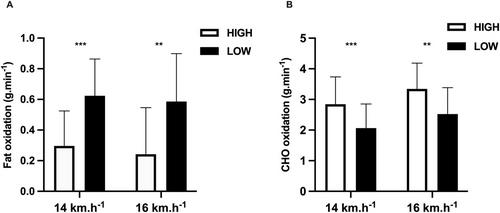
Completing selected training sessions with reduced glycogen availability is associated with greater signalling and improved muscle oxidative capacity, although it may impact the overall quality of the session. We examined the effects of low carbohydrate availability on high intensity exercise performance, running economy, critical speed, and substrate metabolism. On two occasions, nine male runners (V̇O2peak 60.3 ± 3.3 mL.kg−1.min−1) completed a glycogen depletion protocol involving 90-min at 75%vV̇O2peak followed by 10 × 1-min at 110% vV̇O2peak. This was followed either by high (HIGH) or low (LOW) carbohydrate intake (>6 g.kg−1.day−1 and <50 g.day−1, respectively) until completion of a performance protocol on day 2 consisting of a series of time-trials (TT) (50m to 3000m) and physiological assessments. There were no differences between LOW and HIGH for any TT distance (mean TT performance times for LOW and HIGH were: 3000m TT 651.7 ± 52.8s and 646.4 ± 52.5s, 1500 m TT 304.0 ± 20.2s and 304.2 ± 22.1s, 400 m TT 67.64 ± 4.2s and 67.3 ± 3.8s, 50 m TT 7.27 ± 0.44s and 7.25 ± 0.45s, respectively, P > 0.05), though some athletes performed better in LOW (n = 5). While fat oxidation in LOW was significantly greater than HIGH (Δ0.32 ± 0.14 g.min−1; P < 0.001 at 14 km.h−1 and Δ0.34 ± 0.12 g.min−1 at 16 km.h−1; P < 0.01), running economy did not differ between trials (P > 0.05). Acute manipulation of carbohydrate availability showed immediate effects on substrate metabolism evidenced by greater fat oxidation without changes in RE. Acute low carbohydrate availability did not affect high intensity running performance across a range of distances.



 京公网安备 11010802042870号
京ICP备2023020795号-1
京公网安备 11010802042870号
京ICP备2023020795号-1

 分享
分享

 求助内容:
求助内容: 应助结果提醒方式:
 扫码关注我们
