{"title":"全固态锂离子电池硅基阳极的合理设计综述","authors":"Minho Kim, Hwichan Ahn, Junil Choi, Won Bae Kim","doi":"10.1002/ente.202201321","DOIUrl":null,"url":null,"abstract":"<div>\n \n <section>\n \n <p>Silicon is a promising alternative to the conventional graphite anode for lithium-ion batteries (LIBs). However, pulverization of Si particles caused by volume expansion and formation of unstable solid electrolyte interphase can lead to several failure behaviors of LIBs. In contrast to LIBs employing liquid electrolytes, all-solid-state batteries (ASSBs) could exhibit totally different interfacial environments over Si anode materials, in terms of wetting properties of the Si surface by electrolyte. This characteristic interface of Si anode with solid-state electrolyte (SSE) can change the electrochemical stability and long-term life cycle performance of Si. In respect of commercialization, the incorporation of Si anode into ASSB could be the strongest approach to overcome the intrinsic limitations of anode materials. However, large contact losses between Si and SSE have to be handled in order to provide good electrochemical performance and stability. In this review, failure behaviors of Si anode within the SSE with proper characterization method is addressed and several design strategies for incorporation of Si anode into ASSB based on the following classifications are introduced: composite type and diffusion-dependent type Si anodes. From this review, the possibility of Si anode for practical application to next-generation ASSB by regulating its chemical and mechanical properties is suggested.</p>\n </section>\n </div>","PeriodicalId":11573,"journal":{"name":"Energy technology","volume":"11 6","pages":""},"PeriodicalIF":3.6000,"publicationDate":"2023-02-14","publicationTypes":"Journal Article","fieldsOfStudy":null,"isOpenAccess":false,"openAccessPdf":"","citationCount":"1","resultStr":"{\"title\":\"A Rational Design of Silicon-Based Anode for All-Solid-State Lithium-Ion Batteries: A Review\",\"authors\":\"Minho Kim, Hwichan Ahn, Junil Choi, Won Bae Kim\",\"doi\":\"10.1002/ente.202201321\",\"DOIUrl\":null,\"url\":null,\"abstract\":\"<div>\\n \\n <section>\\n \\n <p>Silicon is a promising alternative to the conventional graphite anode for lithium-ion batteries (LIBs). However, pulverization of Si particles caused by volume expansion and formation of unstable solid electrolyte interphase can lead to several failure behaviors of LIBs. In contrast to LIBs employing liquid electrolytes, all-solid-state batteries (ASSBs) could exhibit totally different interfacial environments over Si anode materials, in terms of wetting properties of the Si surface by electrolyte. This characteristic interface of Si anode with solid-state electrolyte (SSE) can change the electrochemical stability and long-term life cycle performance of Si. In respect of commercialization, the incorporation of Si anode into ASSB could be the strongest approach to overcome the intrinsic limitations of anode materials. However, large contact losses between Si and SSE have to be handled in order to provide good electrochemical performance and stability. In this review, failure behaviors of Si anode within the SSE with proper characterization method is addressed and several design strategies for incorporation of Si anode into ASSB based on the following classifications are introduced: composite type and diffusion-dependent type Si anodes. From this review, the possibility of Si anode for practical application to next-generation ASSB by regulating its chemical and mechanical properties is suggested.</p>\\n </section>\\n </div>\",\"PeriodicalId\":11573,\"journal\":{\"name\":\"Energy technology\",\"volume\":\"11 6\",\"pages\":\"\"},\"PeriodicalIF\":3.6000,\"publicationDate\":\"2023-02-14\",\"publicationTypes\":\"Journal Article\",\"fieldsOfStudy\":null,\"isOpenAccess\":false,\"openAccessPdf\":\"\",\"citationCount\":\"1\",\"resultStr\":null,\"platform\":\"Semanticscholar\",\"paperid\":null,\"PeriodicalName\":\"Energy technology\",\"FirstCategoryId\":\"5\",\"ListUrlMain\":\"https://onlinelibrary.wiley.com/doi/10.1002/ente.202201321\",\"RegionNum\":4,\"RegionCategory\":\"工程技术\",\"ArticlePicture\":[],\"TitleCN\":null,\"AbstractTextCN\":null,\"PMCID\":null,\"EPubDate\":\"\",\"PubModel\":\"\",\"JCR\":\"Q3\",\"JCRName\":\"ENERGY & FUELS\",\"Score\":null,\"Total\":0}","platform":"Semanticscholar","paperid":null,"PeriodicalName":"Energy technology","FirstCategoryId":"5","ListUrlMain":"https://onlinelibrary.wiley.com/doi/10.1002/ente.202201321","RegionNum":4,"RegionCategory":"工程技术","ArticlePicture":[],"TitleCN":null,"AbstractTextCN":null,"PMCID":null,"EPubDate":"","PubModel":"","JCR":"Q3","JCRName":"ENERGY & FUELS","Score":null,"Total":0}
A Rational Design of Silicon-Based Anode for All-Solid-State Lithium-Ion Batteries: A Review
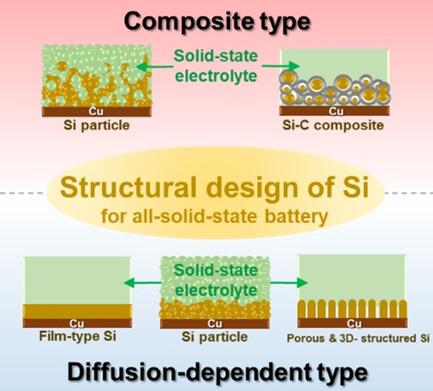
Silicon is a promising alternative to the conventional graphite anode for lithium-ion batteries (LIBs). However, pulverization of Si particles caused by volume expansion and formation of unstable solid electrolyte interphase can lead to several failure behaviors of LIBs. In contrast to LIBs employing liquid electrolytes, all-solid-state batteries (ASSBs) could exhibit totally different interfacial environments over Si anode materials, in terms of wetting properties of the Si surface by electrolyte. This characteristic interface of Si anode with solid-state electrolyte (SSE) can change the electrochemical stability and long-term life cycle performance of Si. In respect of commercialization, the incorporation of Si anode into ASSB could be the strongest approach to overcome the intrinsic limitations of anode materials. However, large contact losses between Si and SSE have to be handled in order to provide good electrochemical performance and stability. In this review, failure behaviors of Si anode within the SSE with proper characterization method is addressed and several design strategies for incorporation of Si anode into ASSB based on the following classifications are introduced: composite type and diffusion-dependent type Si anodes. From this review, the possibility of Si anode for practical application to next-generation ASSB by regulating its chemical and mechanical properties is suggested.
期刊介绍:
Energy Technology provides a forum for researchers and engineers from all relevant disciplines concerned with the generation, conversion, storage, and distribution of energy.
This new journal shall publish articles covering all technical aspects of energy process engineering from different perspectives, e.g.,
new concepts of energy generation and conversion;
design, operation, control, and optimization of processes for energy generation (e.g., carbon capture) and conversion of energy carriers;
improvement of existing processes;
combination of single components to systems for energy generation;
design of systems for energy storage;
production processes of fuels, e.g., hydrogen, electricity, petroleum, biobased fuels;
concepts and design of devices for energy distribution.




 京公网安备 11010802042870号
京ICP备2023020795号-1
京公网安备 11010802042870号
京ICP备2023020795号-1

 分享
分享
 求助内容:
求助内容: 应助结果提醒方式:
 扫码关注我们
