Yangjia Lu, Jie Ren, Shaoyang Cui, Junqi Chen, Yong Huang, Chunzhi Tang, Baoci Shan, Bingbing Nie, Lai Xinsheng
{"title":"阿尔茨海默病大鼠模型的脑葡萄糖代谢评估:18F-FDG-PET 研究。","authors":"Yangjia Lu, Jie Ren, Shaoyang Cui, Junqi Chen, Yong Huang, Chunzhi Tang, Baoci Shan, Bingbing Nie, Lai Xinsheng","doi":"10.1177/1533317515617725","DOIUrl":null,"url":null,"abstract":"<p><strong>Objective: </strong>This study was designed to detect the brain glucose metabolism in rat models of Alzheimer's disease (AD) by the application of (18)F-2-fluoro-deoxy-d-glucose positron emission tomography ((18)F-FDG-PET) and to provide new insights for the early detection of AD.</p><p><strong>Methods: </strong>Forty Wistar rats were randomly divided into 2 groups. Fifteen sham-operated rats were used as a control group. The remaining rats as a premodel group were intracerebroventricularly injected with ibotenic acid and were intraperitoneally injected with d-galactose, of which 15 rats were included as the experimental group. The above-mentioned 2 groups were assigned to Y-maze test and underwent (18)F-FDG-PET scanning. Positron emission tomography images were processed with SPM 2.0.</p><p><strong>Results: </strong>The learning and memory skills were weakened in AD rats. Besides, the glucose metabolic activity of AD rats decreased in hippolampus, hypothalamus, insular cortex, piriform cortex, striatum, cingulate gyrus, stria terminalis, and parietal lobe and increased in olfactory bulb, cerebellum, midbrain, pontine, and retrosplenial cortex compared with the control group. Dorsal thalamus had shown both enhanced and reduced glucose metabolic activity.</p><p><strong>Conclusion: </strong>Our data indicate that the changed glucose metabolism in cerebral regions in (18)F-FDG-PET imaging could be an important predictor for early AD.</p>","PeriodicalId":19511,"journal":{"name":"Optics and Laser Technology","volume":"45 1","pages":"333-40"},"PeriodicalIF":5.0000,"publicationDate":"2016-06-01","publicationTypes":"Journal Article","fieldsOfStudy":null,"isOpenAccess":false,"openAccessPdf":"https://www.ncbi.nlm.nih.gov/pmc/articles/PMC10852943/pdf/","citationCount":"0","resultStr":"{\"title\":\"Cerebral Glucose Metabolism Assessment in Rat Models of Alzheimer's Disease: An 18F-FDG-PET Study.\",\"authors\":\"Yangjia Lu, Jie Ren, Shaoyang Cui, Junqi Chen, Yong Huang, Chunzhi Tang, Baoci Shan, Bingbing Nie, Lai Xinsheng\",\"doi\":\"10.1177/1533317515617725\",\"DOIUrl\":null,\"url\":null,\"abstract\":\"<p><strong>Objective: </strong>This study was designed to detect the brain glucose metabolism in rat models of Alzheimer's disease (AD) by the application of (18)F-2-fluoro-deoxy-d-glucose positron emission tomography ((18)F-FDG-PET) and to provide new insights for the early detection of AD.</p><p><strong>Methods: </strong>Forty Wistar rats were randomly divided into 2 groups. Fifteen sham-operated rats were used as a control group. The remaining rats as a premodel group were intracerebroventricularly injected with ibotenic acid and were intraperitoneally injected with d-galactose, of which 15 rats were included as the experimental group. The above-mentioned 2 groups were assigned to Y-maze test and underwent (18)F-FDG-PET scanning. Positron emission tomography images were processed with SPM 2.0.</p><p><strong>Results: </strong>The learning and memory skills were weakened in AD rats. Besides, the glucose metabolic activity of AD rats decreased in hippolampus, hypothalamus, insular cortex, piriform cortex, striatum, cingulate gyrus, stria terminalis, and parietal lobe and increased in olfactory bulb, cerebellum, midbrain, pontine, and retrosplenial cortex compared with the control group. Dorsal thalamus had shown both enhanced and reduced glucose metabolic activity.</p><p><strong>Conclusion: </strong>Our data indicate that the changed glucose metabolism in cerebral regions in (18)F-FDG-PET imaging could be an important predictor for early AD.</p>\",\"PeriodicalId\":19511,\"journal\":{\"name\":\"Optics and Laser Technology\",\"volume\":\"45 1\",\"pages\":\"333-40\"},\"PeriodicalIF\":5.0000,\"publicationDate\":\"2016-06-01\",\"publicationTypes\":\"Journal Article\",\"fieldsOfStudy\":null,\"isOpenAccess\":false,\"openAccessPdf\":\"https://www.ncbi.nlm.nih.gov/pmc/articles/PMC10852943/pdf/\",\"citationCount\":\"0\",\"resultStr\":null,\"platform\":\"Semanticscholar\",\"paperid\":null,\"PeriodicalName\":\"Optics and Laser Technology\",\"FirstCategoryId\":\"1085\",\"ListUrlMain\":\"https://doi.org/10.1177/1533317515617725\",\"RegionNum\":2,\"RegionCategory\":\"物理与天体物理\",\"ArticlePicture\":[],\"TitleCN\":null,\"AbstractTextCN\":null,\"PMCID\":null,\"EPubDate\":\"2015/12/1 0:00:00\",\"PubModel\":\"Epub\",\"JCR\":\"Q1\",\"JCRName\":\"OPTICS\",\"Score\":null,\"Total\":0}","platform":"Semanticscholar","paperid":null,"PeriodicalName":"Optics and Laser Technology","FirstCategoryId":"1085","ListUrlMain":"https://doi.org/10.1177/1533317515617725","RegionNum":2,"RegionCategory":"物理与天体物理","ArticlePicture":[],"TitleCN":null,"AbstractTextCN":null,"PMCID":null,"EPubDate":"2015/12/1 0:00:00","PubModel":"Epub","JCR":"Q1","JCRName":"OPTICS","Score":null,"Total":0}
Cerebral Glucose Metabolism Assessment in Rat Models of Alzheimer's Disease: An 18F-FDG-PET Study.
Objective: This study was designed to detect the brain glucose metabolism in rat models of Alzheimer's disease (AD) by the application of (18)F-2-fluoro-deoxy-d-glucose positron emission tomography ((18)F-FDG-PET) and to provide new insights for the early detection of AD.
Methods: Forty Wistar rats were randomly divided into 2 groups. Fifteen sham-operated rats were used as a control group. The remaining rats as a premodel group were intracerebroventricularly injected with ibotenic acid and were intraperitoneally injected with d-galactose, of which 15 rats were included as the experimental group. The above-mentioned 2 groups were assigned to Y-maze test and underwent (18)F-FDG-PET scanning. Positron emission tomography images were processed with SPM 2.0.
Results: The learning and memory skills were weakened in AD rats. Besides, the glucose metabolic activity of AD rats decreased in hippolampus, hypothalamus, insular cortex, piriform cortex, striatum, cingulate gyrus, stria terminalis, and parietal lobe and increased in olfactory bulb, cerebellum, midbrain, pontine, and retrosplenial cortex compared with the control group. Dorsal thalamus had shown both enhanced and reduced glucose metabolic activity.
Conclusion: Our data indicate that the changed glucose metabolism in cerebral regions in (18)F-FDG-PET imaging could be an important predictor for early AD.
期刊介绍:
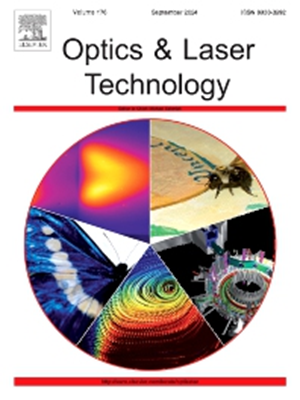
Optics & Laser Technology aims to provide a vehicle for the publication of a broad range of high quality research and review papers in those fields of scientific and engineering research appertaining to the development and application of the technology of optics and lasers. Papers describing original work in these areas are submitted to rigorous refereeing prior to acceptance for publication.
The scope of Optics & Laser Technology encompasses, but is not restricted to, the following areas:
•development in all types of lasers
•developments in optoelectronic devices and photonics
•developments in new photonics and optical concepts
•developments in conventional optics, optical instruments and components
•techniques of optical metrology, including interferometry and optical fibre sensors
•LIDAR and other non-contact optical measurement techniques, including optical methods in heat and fluid flow
•applications of lasers to materials processing, optical NDT display (including holography) and optical communication
•research and development in the field of laser safety including studies of hazards resulting from the applications of lasers (laser safety, hazards of laser fume)
•developments in optical computing and optical information processing
•developments in new optical materials
•developments in new optical characterization methods and techniques
•developments in quantum optics
•developments in light assisted micro and nanofabrication methods and techniques
•developments in nanophotonics and biophotonics
•developments in imaging processing and systems




 京公网安备 11010802042870号
京ICP备2023020795号-1
京公网安备 11010802042870号
京ICP备2023020795号-1

 分享
分享
 求助内容:
求助内容: 应助结果提醒方式:
 扫码关注我们
