{"title":"磷酸R2P-OH及其衍生物的磷酸-曼尼希反应","authors":"Dmitry V. Moiseev","doi":"10.1080/10426507.2023.2235054","DOIUrl":null,"url":null,"abstract":"<div><div>Secondary phosphine oxides R<sub>2</sub>P(O)H are a relatively stable tautomeric form of secondary phosphinous acids R<sub>2</sub>P–OH that with imine/iminium species, or their donors, form compounds with a P(O)–C<em></em><sub>sp3</sub><em></em>–N linkage (the phospha-Mannich reaction). These can be referred to as (α-aminoalkyl)phosphine oxides, (α-phosphinoylalkyl)amines, or P(O),N-acetals. Compared to P–C<em></em><sub>sp3</sub><em></em>–N linkages of P,N-acetals, products of phospha-Mannich reactions involving secondary phosphines R<sub>2</sub>PH, the P(O)–C<em></em><sub>sp3</sub><em></em>–N linkage is significantly more stable that allows for many examples of α-functionalized P(O),N-acetals and α-phosphinoylated N-heterocycles, whereas such examples for P,N-acetals are rare. Trivalent derivatives of phosphinous acids such as halides R<sub>2</sub>P–Hal, esters R<sub>2</sub>P–OR’ (phosphinites), amides R<sub>2</sub>P–NR’<sub>2</sub> (aminophosphines), and phosphides R<sub>2</sub>P–PR’<sub>2</sub> (biphosphines) also participate in Mannich-type reactions with mechanisms depending on the reactants. The phosphinous halides and esters react with (α-alkoxyalkyl)amines (N,O-acetals) and (α-haloalkyl)amines (N,Hal-acetals), respectively, <em>via</em> Arbuzov-type intermediates that are rearranged into P(O),N-acetals and alkyl halides (Arbuzov rearrangement). Furthermore, unlike phospha-Mannich reactions involving phosphines, secondary phosphine oxides and P(O),N-acetals are less sensitive to oxidation, and imines/iminium species can be generated not only under conventional Mannich conditions, <em>i.e.</em>, from N,E-acetals (E = OH, O, N, halogen, <em>etc</em>.), but also, for example, by oxidation of α-C-atom of amines, or by oxidation of alcohols to aldehydes that than form imines/iminium species with amines.</div></div>","PeriodicalId":20056,"journal":{"name":"Phosphorus, Sulfur, and Silicon and the Related Elements","volume":"198 11","pages":"Pages 867-923"},"PeriodicalIF":1.6000,"publicationDate":"2023-11-02","publicationTypes":"Journal Article","fieldsOfStudy":null,"isOpenAccess":false,"openAccessPdf":"","citationCount":"0","resultStr":"{\"title\":\"Phospha-Mannich reactions of phosphinous acids R2P–OH and their derivatives\",\"authors\":\"Dmitry V. Moiseev\",\"doi\":\"10.1080/10426507.2023.2235054\",\"DOIUrl\":null,\"url\":null,\"abstract\":\"<div><div>Secondary phosphine oxides R<sub>2</sub>P(O)H are a relatively stable tautomeric form of secondary phosphinous acids R<sub>2</sub>P–OH that with imine/iminium species, or their donors, form compounds with a P(O)–C<em></em><sub>sp3</sub><em></em>–N linkage (the phospha-Mannich reaction). These can be referred to as (α-aminoalkyl)phosphine oxides, (α-phosphinoylalkyl)amines, or P(O),N-acetals. Compared to P–C<em></em><sub>sp3</sub><em></em>–N linkages of P,N-acetals, products of phospha-Mannich reactions involving secondary phosphines R<sub>2</sub>PH, the P(O)–C<em></em><sub>sp3</sub><em></em>–N linkage is significantly more stable that allows for many examples of α-functionalized P(O),N-acetals and α-phosphinoylated N-heterocycles, whereas such examples for P,N-acetals are rare. Trivalent derivatives of phosphinous acids such as halides R<sub>2</sub>P–Hal, esters R<sub>2</sub>P–OR’ (phosphinites), amides R<sub>2</sub>P–NR’<sub>2</sub> (aminophosphines), and phosphides R<sub>2</sub>P–PR’<sub>2</sub> (biphosphines) also participate in Mannich-type reactions with mechanisms depending on the reactants. The phosphinous halides and esters react with (α-alkoxyalkyl)amines (N,O-acetals) and (α-haloalkyl)amines (N,Hal-acetals), respectively, <em>via</em> Arbuzov-type intermediates that are rearranged into P(O),N-acetals and alkyl halides (Arbuzov rearrangement). Furthermore, unlike phospha-Mannich reactions involving phosphines, secondary phosphine oxides and P(O),N-acetals are less sensitive to oxidation, and imines/iminium species can be generated not only under conventional Mannich conditions, <em>i.e.</em>, from N,E-acetals (E = OH, O, N, halogen, <em>etc</em>.), but also, for example, by oxidation of α-C-atom of amines, or by oxidation of alcohols to aldehydes that than form imines/iminium species with amines.</div></div>\",\"PeriodicalId\":20056,\"journal\":{\"name\":\"Phosphorus, Sulfur, and Silicon and the Related Elements\",\"volume\":\"198 11\",\"pages\":\"Pages 867-923\"},\"PeriodicalIF\":1.6000,\"publicationDate\":\"2023-11-02\",\"publicationTypes\":\"Journal Article\",\"fieldsOfStudy\":null,\"isOpenAccess\":false,\"openAccessPdf\":\"\",\"citationCount\":\"0\",\"resultStr\":null,\"platform\":\"Semanticscholar\",\"paperid\":null,\"PeriodicalName\":\"Phosphorus, Sulfur, and Silicon and the Related Elements\",\"FirstCategoryId\":\"92\",\"ListUrlMain\":\"https://www.sciencedirect.com/org/science/article/pii/S1042650723001739\",\"RegionNum\":4,\"RegionCategory\":\"化学\",\"ArticlePicture\":[],\"TitleCN\":null,\"AbstractTextCN\":null,\"PMCID\":null,\"EPubDate\":\"2023/8/29 0:00:00\",\"PubModel\":\"Epub\",\"JCR\":\"Q4\",\"JCRName\":\"CHEMISTRY, INORGANIC & NUCLEAR\",\"Score\":null,\"Total\":0}","platform":"Semanticscholar","paperid":null,"PeriodicalName":"Phosphorus, Sulfur, and Silicon and the Related Elements","FirstCategoryId":"92","ListUrlMain":"https://www.sciencedirect.com/org/science/article/pii/S1042650723001739","RegionNum":4,"RegionCategory":"化学","ArticlePicture":[],"TitleCN":null,"AbstractTextCN":null,"PMCID":null,"EPubDate":"2023/8/29 0:00:00","PubModel":"Epub","JCR":"Q4","JCRName":"CHEMISTRY, INORGANIC & NUCLEAR","Score":null,"Total":0}
引用次数: 0
摘要
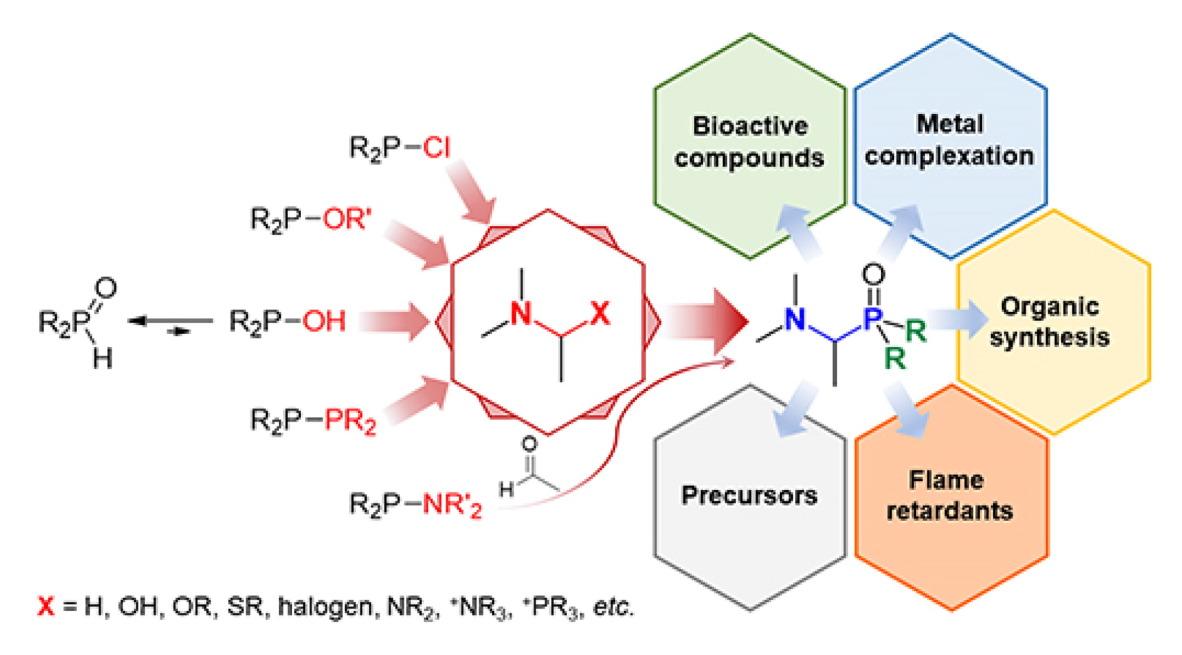
二次膦氧化物R2P(O)H是一种相对稳定的二次膦酸R2P - oh的互变异构形式,它与亚胺/亚胺物种或它们的供体形成具有P(O) -Csp3-N键的化合物(磷酸-曼尼希反应)。这些可以被称为(α-氨基烷基)磷化氢氧化物,(α-膦酰烷基)胺,或P(O), n -缩醛。与P, n -缩醛的P -Csp3-N键相比,P(O) -Csp3-N键更稳定,这使得α-功能化的P(O), n -缩醛和α-磷酸化的n -杂环的例子很多,而P, n -缩醛的例子很少。磷酸的三价衍生物,如卤化物R2P-Hal、酯类R2P-OR ‘(亚膦酸盐)、酰胺类R2P-NR ’ 2(氨基膦酸盐)和磷化物R2P-PR ' 2(二膦酸盐)也参与曼尼奇型反应,其机制取决于反应物。磷卤化物和酯分别与(α-烷氧烷基)胺(N,O-缩醛)和(α-卤代烷基)胺(N,O-缩醛)通过Arbuzov型中间体重排成P(O),N-缩醛和烷基卤化物(Arbuzov重排)反应。此外,不同于磷-曼尼希反应涉及磷化氢、二次磷化氢氧化物和磷(O),N-缩醛对氧化的敏感性较低,并且亚胺/亚胺不仅可以在常规曼尼希条件下生成,即从N、E-缩醛(E = OH、O、N、卤素等)生成,还可以通过例如胺的α- c原子氧化或醇氧化生成醛,而不是与胺形成亚胺/亚胺。
Phospha-Mannich reactions of phosphinous acids R2P–OH and their derivatives
Secondary phosphine oxides R2P(O)H are a relatively stable tautomeric form of secondary phosphinous acids R2P–OH that with imine/iminium species, or their donors, form compounds with a P(O)–Csp3–N linkage (the phospha-Mannich reaction). These can be referred to as (α-aminoalkyl)phosphine oxides, (α-phosphinoylalkyl)amines, or P(O),N-acetals. Compared to P–Csp3–N linkages of P,N-acetals, products of phospha-Mannich reactions involving secondary phosphines R2PH, the P(O)–Csp3–N linkage is significantly more stable that allows for many examples of α-functionalized P(O),N-acetals and α-phosphinoylated N-heterocycles, whereas such examples for P,N-acetals are rare. Trivalent derivatives of phosphinous acids such as halides R2P–Hal, esters R2P–OR’ (phosphinites), amides R2P–NR’2 (aminophosphines), and phosphides R2P–PR’2 (biphosphines) also participate in Mannich-type reactions with mechanisms depending on the reactants. The phosphinous halides and esters react with (α-alkoxyalkyl)amines (N,O-acetals) and (α-haloalkyl)amines (N,Hal-acetals), respectively, via Arbuzov-type intermediates that are rearranged into P(O),N-acetals and alkyl halides (Arbuzov rearrangement). Furthermore, unlike phospha-Mannich reactions involving phosphines, secondary phosphine oxides and P(O),N-acetals are less sensitive to oxidation, and imines/iminium species can be generated not only under conventional Mannich conditions, i.e., from N,E-acetals (E = OH, O, N, halogen, etc.), but also, for example, by oxidation of α-C-atom of amines, or by oxidation of alcohols to aldehydes that than form imines/iminium species with amines.
期刊介绍:
Phosphorus, Sulfur, and Silicon and the Related Elements is a monthly publication intended to disseminate current trends and novel methods to those working in the broad and interdisciplinary field of heteroatom chemistry.




 京公网安备 11010802042870号
京ICP备2023020795号-1
京公网安备 11010802042870号
京ICP备2023020795号-1

 分享
分享
 求助内容:
求助内容: 应助结果提醒方式:
 扫码关注我们
