L Bixo, G Sandblom, J Österberg, O Stackelberg, K Bewö, A Olsson
{"title":"直肠间距离与产后腹肌松弛妇女腹部核心功能受损之间的关系","authors":"L Bixo, G Sandblom, J Österberg, O Stackelberg, K Bewö, A Olsson","doi":"10.3389/jaws.2022.10909","DOIUrl":null,"url":null,"abstract":"<p><p><b>Background and Aim:</b> The definition and management of Diastasis Recti Abdominis (DRA) is under debate. This study aimed to understand the correlation between the post-partum inter-recti distance (IRD) and functional impairments associated with core instability, with the hypothesis that IRD could serve as a proxy for core instability symptoms and constitute a tool in decision-making for DRA treatment. <b>Material and Methods:</b> A cohort of post-partum women with abdominal core instability symptoms combined with DRA were studied. The size of IRD was measured with ultrasonography and cross-sectionally analysed against functional impairments registered with the self-report Disability Rating Index (DRI), which grades the ability to perform 12 different daily activities. <b>Results:</b> A total of 224 women were included in the study. In univariable analysis, IRD was associated with impairment of the activities running (<i>p</i> = 0.007), heavy work (<i>p</i> = 0.036) and exercise/sports (<i>p</i> = 0.047), but not with dressing, walking, sitting for long periods, standing bent over a sink, carrying a suitcase, making a bed, light manual labour or heavy lifting. No significant correlations were seen in the multivariable analysis when adjustments were made for BMI and parity. <b>Conclusion:</b> IRD and post-partum functional impairments had no significant correlation in multivariable analysis. The post-partum core instability condition is complex and probably associated with more factors than solely the IRD. The IRD alone does not seem to be a sufficient proxy for decision-making regarding optimal treatment. A more complete instrument to assess the post-partum abdominal core is warranted.</p>","PeriodicalId":49708,"journal":{"name":"Perception","volume":"34 1","pages":"10909"},"PeriodicalIF":1.5000,"publicationDate":"2022-12-01","publicationTypes":"Journal Article","fieldsOfStudy":null,"isOpenAccess":false,"openAccessPdf":"https://www.ncbi.nlm.nih.gov/pmc/articles/PMC10831648/pdf/","citationCount":"0","resultStr":"{\"title\":\"Association Between Inter-Recti Distance and Impaired Abdominal Core Function in Post-Partum Women With Diastasis Recti Abdominis.\",\"authors\":\"L Bixo, G Sandblom, J Österberg, O Stackelberg, K Bewö, A Olsson\",\"doi\":\"10.3389/jaws.2022.10909\",\"DOIUrl\":null,\"url\":null,\"abstract\":\"<p><p><b>Background and Aim:</b> The definition and management of Diastasis Recti Abdominis (DRA) is under debate. This study aimed to understand the correlation between the post-partum inter-recti distance (IRD) and functional impairments associated with core instability, with the hypothesis that IRD could serve as a proxy for core instability symptoms and constitute a tool in decision-making for DRA treatment. <b>Material and Methods:</b> A cohort of post-partum women with abdominal core instability symptoms combined with DRA were studied. The size of IRD was measured with ultrasonography and cross-sectionally analysed against functional impairments registered with the self-report Disability Rating Index (DRI), which grades the ability to perform 12 different daily activities. <b>Results:</b> A total of 224 women were included in the study. In univariable analysis, IRD was associated with impairment of the activities running (<i>p</i> = 0.007), heavy work (<i>p</i> = 0.036) and exercise/sports (<i>p</i> = 0.047), but not with dressing, walking, sitting for long periods, standing bent over a sink, carrying a suitcase, making a bed, light manual labour or heavy lifting. No significant correlations were seen in the multivariable analysis when adjustments were made for BMI and parity. <b>Conclusion:</b> IRD and post-partum functional impairments had no significant correlation in multivariable analysis. The post-partum core instability condition is complex and probably associated with more factors than solely the IRD. The IRD alone does not seem to be a sufficient proxy for decision-making regarding optimal treatment. A more complete instrument to assess the post-partum abdominal core is warranted.</p>\",\"PeriodicalId\":49708,\"journal\":{\"name\":\"Perception\",\"volume\":\"34 1\",\"pages\":\"10909\"},\"PeriodicalIF\":1.5000,\"publicationDate\":\"2022-12-01\",\"publicationTypes\":\"Journal Article\",\"fieldsOfStudy\":null,\"isOpenAccess\":false,\"openAccessPdf\":\"https://www.ncbi.nlm.nih.gov/pmc/articles/PMC10831648/pdf/\",\"citationCount\":\"0\",\"resultStr\":null,\"platform\":\"Semanticscholar\",\"paperid\":null,\"PeriodicalName\":\"Perception\",\"FirstCategoryId\":\"1085\",\"ListUrlMain\":\"https://doi.org/10.3389/jaws.2022.10909\",\"RegionNum\":4,\"RegionCategory\":\"心理学\",\"ArticlePicture\":[],\"TitleCN\":null,\"AbstractTextCN\":null,\"PMCID\":null,\"EPubDate\":\"2022/1/1 0:00:00\",\"PubModel\":\"eCollection\",\"JCR\":\"Q3\",\"JCRName\":\"OPHTHALMOLOGY\",\"Score\":null,\"Total\":0}","platform":"Semanticscholar","paperid":null,"PeriodicalName":"Perception","FirstCategoryId":"1085","ListUrlMain":"https://doi.org/10.3389/jaws.2022.10909","RegionNum":4,"RegionCategory":"心理学","ArticlePicture":[],"TitleCN":null,"AbstractTextCN":null,"PMCID":null,"EPubDate":"2022/1/1 0:00:00","PubModel":"eCollection","JCR":"Q3","JCRName":"OPHTHALMOLOGY","Score":null,"Total":0}
Association Between Inter-Recti Distance and Impaired Abdominal Core Function in Post-Partum Women With Diastasis Recti Abdominis.
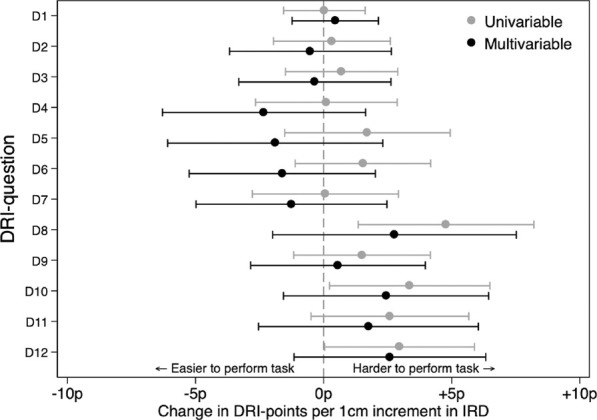
Background and Aim: The definition and management of Diastasis Recti Abdominis (DRA) is under debate. This study aimed to understand the correlation between the post-partum inter-recti distance (IRD) and functional impairments associated with core instability, with the hypothesis that IRD could serve as a proxy for core instability symptoms and constitute a tool in decision-making for DRA treatment. Material and Methods: A cohort of post-partum women with abdominal core instability symptoms combined with DRA were studied. The size of IRD was measured with ultrasonography and cross-sectionally analysed against functional impairments registered with the self-report Disability Rating Index (DRI), which grades the ability to perform 12 different daily activities. Results: A total of 224 women were included in the study. In univariable analysis, IRD was associated with impairment of the activities running (p = 0.007), heavy work (p = 0.036) and exercise/sports (p = 0.047), but not with dressing, walking, sitting for long periods, standing bent over a sink, carrying a suitcase, making a bed, light manual labour or heavy lifting. No significant correlations were seen in the multivariable analysis when adjustments were made for BMI and parity. Conclusion: IRD and post-partum functional impairments had no significant correlation in multivariable analysis. The post-partum core instability condition is complex and probably associated with more factors than solely the IRD. The IRD alone does not seem to be a sufficient proxy for decision-making regarding optimal treatment. A more complete instrument to assess the post-partum abdominal core is warranted.
期刊介绍:
Perception is a traditional print journal covering all areas of the perceptual sciences, but with a strong historical emphasis on perceptual illusions. Perception is a subscription journal, free for authors to publish their research as a Standard Article, Short Report or Short & Sweet. The journal also publishes Editorials and Book Reviews.





 京公网安备 11010802042870号
京ICP备2023020795号-1
京公网安备 11010802042870号
京ICP备2023020795号-1

 分享
分享
 求助内容:
求助内容: 应助结果提醒方式:
 扫码关注我们
