Stephen Stanio, Jan Henric T. Bacurio, Haozhe Yang, Marc M. Greenberg and Ashis K. Basu*,
{"title":"8-Oxo-2 ' -脱氧鸟苷在人细胞p53基因突变热点序列中的复制比相应的甲脒嘧啶的复制具有更小的致突变性","authors":"Stephen Stanio, Jan Henric T. Bacurio, Haozhe Yang, Marc M. Greenberg and Ashis K. Basu*, ","doi":"10.1021/acs.chemrestox.3c00069","DOIUrl":null,"url":null,"abstract":"<p >7,8-Dihydro-8-oxo-2′-deoxyguanosine (8-OxodGuo) is a ubiquitous DNA damage formed by oxidation of 2′-deoxyguanosine. In this study, plasmid DNA containing 8-OxodGuo located in three mutational hot spots of human cancers, codons 248, 249, and 273 of the <i>Tp53</i> tumor suppressor gene, was replicated in HEK 293T cells. 8-OxodGuo was only a weak block of replication, and the bypass was largely error-free. The mutations (1–5%) were primarily G → T transversions, and the mutation frequency was generally lower than that of the chemically related Fapy·dG. A unique 8-OxodGuo mutation spectrum was observed at each site, as reflected by replication in translesion synthesis (TLS) polymerase- or hPol λ-deficient cells. In codon 248 (CG*G) and 249 (AG*G), where G* denotes 8-OxodGuo, hPol η and hPol ζ carried out largely error-free bypass of the lesion, whereas hPol κ and hPol ι were involved mostly in error-prone TLS, resulting in G → T mutations. 8-OxodGuo bypass in codon 273 (CG*T) was unlike the other two sites, as hPol κ participated in the mostly error-free bypass of the lesion. Yet, in all three sites, including codon 273, simultaneous deficiency of hpol κ and hPol ι resulted in reduction of G → T transversions. This indicates a convincing role of these two TLS polymerases in error-prone bypass of 8-OxodGuo. Although the dominant mutation was G → T in each site, in codon 249, and to a lesser extent in codon 248, significant semi-targeted single-base deletions also occurred, which suggests that 8-OxodGuo can initiate slippage of a base near the lesion site. This study underscores the importance of sequence context in 8-OxodGuo mutagenesis in human cells. It also provides a more comprehensive comparison between 8-OxodGuo and the sister lesion, Fapy·dG. The greater mutagenicity of the latter in the same sequence contexts indicates that Fapy·dG is a biologically significant lesion and biomarker on par with 8-OxodGuo.</p>","PeriodicalId":31,"journal":{"name":"Chemical Research in Toxicology","volume":"36 5","pages":"782–789"},"PeriodicalIF":4.1000,"publicationDate":"2023-04-24","publicationTypes":"Journal Article","fieldsOfStudy":null,"isOpenAccess":false,"openAccessPdf":"","citationCount":"1","resultStr":"{\"title\":\"8-Oxo-2′-deoxyguanosine Replication in Mutational Hot Spot Sequences of the p53 Gene in Human Cells Is Less Mutagenic than That of the Corresponding Formamidopyrimidine\",\"authors\":\"Stephen Stanio, Jan Henric T. Bacurio, Haozhe Yang, Marc M. Greenberg and Ashis K. Basu*, \",\"doi\":\"10.1021/acs.chemrestox.3c00069\",\"DOIUrl\":null,\"url\":null,\"abstract\":\"<p >7,8-Dihydro-8-oxo-2′-deoxyguanosine (8-OxodGuo) is a ubiquitous DNA damage formed by oxidation of 2′-deoxyguanosine. In this study, plasmid DNA containing 8-OxodGuo located in three mutational hot spots of human cancers, codons 248, 249, and 273 of the <i>Tp53</i> tumor suppressor gene, was replicated in HEK 293T cells. 8-OxodGuo was only a weak block of replication, and the bypass was largely error-free. The mutations (1–5%) were primarily G → T transversions, and the mutation frequency was generally lower than that of the chemically related Fapy·dG. A unique 8-OxodGuo mutation spectrum was observed at each site, as reflected by replication in translesion synthesis (TLS) polymerase- or hPol λ-deficient cells. In codon 248 (CG*G) and 249 (AG*G), where G* denotes 8-OxodGuo, hPol η and hPol ζ carried out largely error-free bypass of the lesion, whereas hPol κ and hPol ι were involved mostly in error-prone TLS, resulting in G → T mutations. 8-OxodGuo bypass in codon 273 (CG*T) was unlike the other two sites, as hPol κ participated in the mostly error-free bypass of the lesion. Yet, in all three sites, including codon 273, simultaneous deficiency of hpol κ and hPol ι resulted in reduction of G → T transversions. This indicates a convincing role of these two TLS polymerases in error-prone bypass of 8-OxodGuo. Although the dominant mutation was G → T in each site, in codon 249, and to a lesser extent in codon 248, significant semi-targeted single-base deletions also occurred, which suggests that 8-OxodGuo can initiate slippage of a base near the lesion site. This study underscores the importance of sequence context in 8-OxodGuo mutagenesis in human cells. It also provides a more comprehensive comparison between 8-OxodGuo and the sister lesion, Fapy·dG. The greater mutagenicity of the latter in the same sequence contexts indicates that Fapy·dG is a biologically significant lesion and biomarker on par with 8-OxodGuo.</p>\",\"PeriodicalId\":31,\"journal\":{\"name\":\"Chemical Research in Toxicology\",\"volume\":\"36 5\",\"pages\":\"782–789\"},\"PeriodicalIF\":4.1000,\"publicationDate\":\"2023-04-24\",\"publicationTypes\":\"Journal Article\",\"fieldsOfStudy\":null,\"isOpenAccess\":false,\"openAccessPdf\":\"\",\"citationCount\":\"1\",\"resultStr\":null,\"platform\":\"Semanticscholar\",\"paperid\":null,\"PeriodicalName\":\"Chemical Research in Toxicology\",\"FirstCategoryId\":\"3\",\"ListUrlMain\":\"https://pubs.acs.org/doi/10.1021/acs.chemrestox.3c00069\",\"RegionNum\":3,\"RegionCategory\":\"医学\",\"ArticlePicture\":[],\"TitleCN\":null,\"AbstractTextCN\":null,\"PMCID\":null,\"EPubDate\":\"\",\"PubModel\":\"\",\"JCR\":\"Q2\",\"JCRName\":\"CHEMISTRY, MEDICINAL\",\"Score\":null,\"Total\":0}","platform":"Semanticscholar","paperid":null,"PeriodicalName":"Chemical Research in Toxicology","FirstCategoryId":"3","ListUrlMain":"https://pubs.acs.org/doi/10.1021/acs.chemrestox.3c00069","RegionNum":3,"RegionCategory":"医学","ArticlePicture":[],"TitleCN":null,"AbstractTextCN":null,"PMCID":null,"EPubDate":"","PubModel":"","JCR":"Q2","JCRName":"CHEMISTRY, MEDICINAL","Score":null,"Total":0}
8-Oxo-2′-deoxyguanosine Replication in Mutational Hot Spot Sequences of the p53 Gene in Human Cells Is Less Mutagenic than That of the Corresponding Formamidopyrimidine
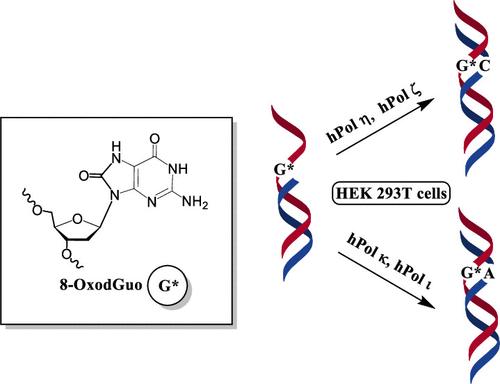
7,8-Dihydro-8-oxo-2′-deoxyguanosine (8-OxodGuo) is a ubiquitous DNA damage formed by oxidation of 2′-deoxyguanosine. In this study, plasmid DNA containing 8-OxodGuo located in three mutational hot spots of human cancers, codons 248, 249, and 273 of the Tp53 tumor suppressor gene, was replicated in HEK 293T cells. 8-OxodGuo was only a weak block of replication, and the bypass was largely error-free. The mutations (1–5%) were primarily G → T transversions, and the mutation frequency was generally lower than that of the chemically related Fapy·dG. A unique 8-OxodGuo mutation spectrum was observed at each site, as reflected by replication in translesion synthesis (TLS) polymerase- or hPol λ-deficient cells. In codon 248 (CG*G) and 249 (AG*G), where G* denotes 8-OxodGuo, hPol η and hPol ζ carried out largely error-free bypass of the lesion, whereas hPol κ and hPol ι were involved mostly in error-prone TLS, resulting in G → T mutations. 8-OxodGuo bypass in codon 273 (CG*T) was unlike the other two sites, as hPol κ participated in the mostly error-free bypass of the lesion. Yet, in all three sites, including codon 273, simultaneous deficiency of hpol κ and hPol ι resulted in reduction of G → T transversions. This indicates a convincing role of these two TLS polymerases in error-prone bypass of 8-OxodGuo. Although the dominant mutation was G → T in each site, in codon 249, and to a lesser extent in codon 248, significant semi-targeted single-base deletions also occurred, which suggests that 8-OxodGuo can initiate slippage of a base near the lesion site. This study underscores the importance of sequence context in 8-OxodGuo mutagenesis in human cells. It also provides a more comprehensive comparison between 8-OxodGuo and the sister lesion, Fapy·dG. The greater mutagenicity of the latter in the same sequence contexts indicates that Fapy·dG is a biologically significant lesion and biomarker on par with 8-OxodGuo.
期刊介绍:
Chemical Research in Toxicology publishes Articles, Rapid Reports, Chemical Profiles, Reviews, Perspectives, Letters to the Editor, and ToxWatch on a wide range of topics in Toxicology that inform a chemical and molecular understanding and capacity to predict biological outcomes on the basis of structures and processes. The overarching goal of activities reported in the Journal are to provide knowledge and innovative approaches needed to promote intelligent solutions for human safety and ecosystem preservation. The journal emphasizes insight concerning mechanisms of toxicity over phenomenological observations. It upholds rigorous chemical, physical and mathematical standards for characterization and application of modern techniques.




 京公网安备 11010802042870号
京ICP备2023020795号-1
京公网安备 11010802042870号
京ICP备2023020795号-1

 分享
分享
 求助内容:
求助内容: 应助结果提醒方式:
 扫码关注我们
