{"title":"生物电网络:实现从生理到心智进化的认知粘合剂。","authors":"Michael Levin","doi":"10.1007/s10071-023-01780-3","DOIUrl":null,"url":null,"abstract":"<div><p>Each of us made the remarkable journey from mere matter to mind: starting life as a quiescent oocyte (“just chemistry and physics”), and slowly, gradually, becoming an adult human with complex metacognitive processes, hopes, and dreams. In addition, even though we feel ourselves to be a unified, single Self, distinct from the emergent dynamics of termite mounds and other swarms, the reality is that all intelligence is collective intelligence: each of us consists of a huge number of cells working together to generate a coherent cognitive being with goals, preferences, and memories that belong to the whole and not to its parts. Basal cognition is the quest to understand how Mind scales—how large numbers of competent subunits can work together to become intelligences that expand the scale of their possible goals. Crucially, the remarkable trick of turning homeostatic, cell-level physiological competencies into large-scale behavioral intelligences is not limited to the electrical dynamics of the brain. Evolution was using bioelectric signaling long before neurons and muscles appeared, to solve the problem of creating and repairing complex bodies. In this Perspective, I review the deep symmetry between the intelligence of developmental morphogenesis and that of classical behavior. I describe the highly conserved mechanisms that enable the collective intelligence of cells to implement regulative embryogenesis, regeneration, and cancer suppression. I sketch the story of an evolutionary pivot that repurposed the algorithms and cellular machinery that enable navigation of morphospace into the behavioral navigation of the 3D world which we so readily recognize as intelligence. Understanding the bioelectric dynamics that underlie construction of complex bodies and brains provides an essential path to understanding the natural evolution, and bioengineered design, of diverse intelligences within and beyond the phylogenetic history of Earth.</p></div>","PeriodicalId":7879,"journal":{"name":"Animal Cognition","volume":"26 6","pages":"1865 - 1891"},"PeriodicalIF":2.1000,"publicationDate":"2023-05-19","publicationTypes":"Journal Article","fieldsOfStudy":null,"isOpenAccess":false,"openAccessPdf":"https://www.ncbi.nlm.nih.gov/pmc/articles/PMC10770221/pdf/","citationCount":"0","resultStr":"{\"title\":\"Bioelectric networks: the cognitive glue enabling evolutionary scaling from physiology to mind\",\"authors\":\"Michael Levin\",\"doi\":\"10.1007/s10071-023-01780-3\",\"DOIUrl\":null,\"url\":null,\"abstract\":\"<div><p>Each of us made the remarkable journey from mere matter to mind: starting life as a quiescent oocyte (“just chemistry and physics”), and slowly, gradually, becoming an adult human with complex metacognitive processes, hopes, and dreams. In addition, even though we feel ourselves to be a unified, single Self, distinct from the emergent dynamics of termite mounds and other swarms, the reality is that all intelligence is collective intelligence: each of us consists of a huge number of cells working together to generate a coherent cognitive being with goals, preferences, and memories that belong to the whole and not to its parts. Basal cognition is the quest to understand how Mind scales—how large numbers of competent subunits can work together to become intelligences that expand the scale of their possible goals. Crucially, the remarkable trick of turning homeostatic, cell-level physiological competencies into large-scale behavioral intelligences is not limited to the electrical dynamics of the brain. Evolution was using bioelectric signaling long before neurons and muscles appeared, to solve the problem of creating and repairing complex bodies. In this Perspective, I review the deep symmetry between the intelligence of developmental morphogenesis and that of classical behavior. I describe the highly conserved mechanisms that enable the collective intelligence of cells to implement regulative embryogenesis, regeneration, and cancer suppression. I sketch the story of an evolutionary pivot that repurposed the algorithms and cellular machinery that enable navigation of morphospace into the behavioral navigation of the 3D world which we so readily recognize as intelligence. Understanding the bioelectric dynamics that underlie construction of complex bodies and brains provides an essential path to understanding the natural evolution, and bioengineered design, of diverse intelligences within and beyond the phylogenetic history of Earth.</p></div>\",\"PeriodicalId\":7879,\"journal\":{\"name\":\"Animal Cognition\",\"volume\":\"26 6\",\"pages\":\"1865 - 1891\"},\"PeriodicalIF\":2.1000,\"publicationDate\":\"2023-05-19\",\"publicationTypes\":\"Journal Article\",\"fieldsOfStudy\":null,\"isOpenAccess\":false,\"openAccessPdf\":\"https://www.ncbi.nlm.nih.gov/pmc/articles/PMC10770221/pdf/\",\"citationCount\":\"0\",\"resultStr\":null,\"platform\":\"Semanticscholar\",\"paperid\":null,\"PeriodicalName\":\"Animal Cognition\",\"FirstCategoryId\":\"99\",\"ListUrlMain\":\"https://link.springer.com/article/10.1007/s10071-023-01780-3\",\"RegionNum\":2,\"RegionCategory\":\"生物学\",\"ArticlePicture\":[],\"TitleCN\":null,\"AbstractTextCN\":null,\"PMCID\":null,\"EPubDate\":\"\",\"PubModel\":\"\",\"JCR\":\"Q3\",\"JCRName\":\"BEHAVIORAL SCIENCES\",\"Score\":null,\"Total\":0}","platform":"Semanticscholar","paperid":null,"PeriodicalName":"Animal Cognition","FirstCategoryId":"99","ListUrlMain":"https://link.springer.com/article/10.1007/s10071-023-01780-3","RegionNum":2,"RegionCategory":"生物学","ArticlePicture":[],"TitleCN":null,"AbstractTextCN":null,"PMCID":null,"EPubDate":"","PubModel":"","JCR":"Q3","JCRName":"BEHAVIORAL SCIENCES","Score":null,"Total":0}
Bioelectric networks: the cognitive glue enabling evolutionary scaling from physiology to mind
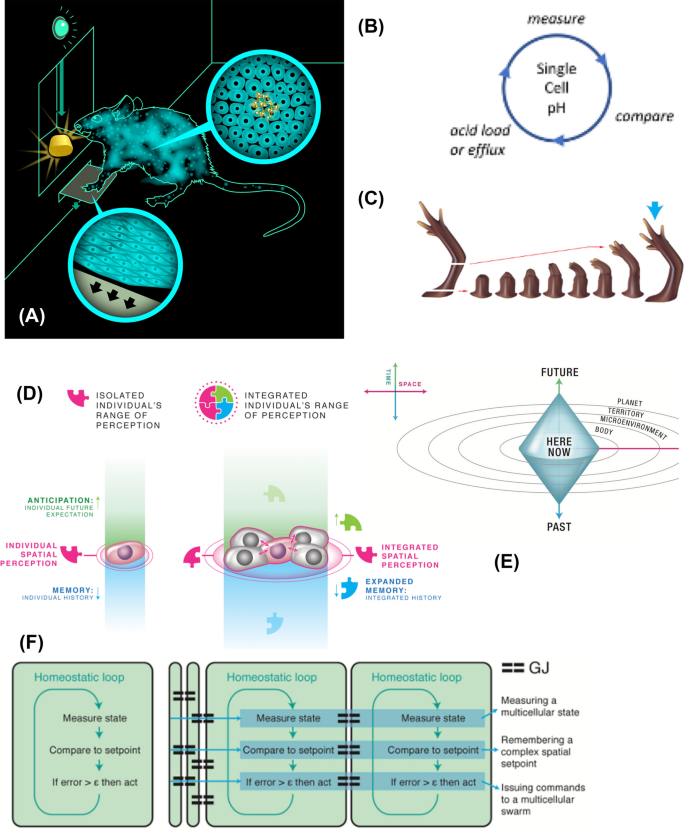
Each of us made the remarkable journey from mere matter to mind: starting life as a quiescent oocyte (“just chemistry and physics”), and slowly, gradually, becoming an adult human with complex metacognitive processes, hopes, and dreams. In addition, even though we feel ourselves to be a unified, single Self, distinct from the emergent dynamics of termite mounds and other swarms, the reality is that all intelligence is collective intelligence: each of us consists of a huge number of cells working together to generate a coherent cognitive being with goals, preferences, and memories that belong to the whole and not to its parts. Basal cognition is the quest to understand how Mind scales—how large numbers of competent subunits can work together to become intelligences that expand the scale of their possible goals. Crucially, the remarkable trick of turning homeostatic, cell-level physiological competencies into large-scale behavioral intelligences is not limited to the electrical dynamics of the brain. Evolution was using bioelectric signaling long before neurons and muscles appeared, to solve the problem of creating and repairing complex bodies. In this Perspective, I review the deep symmetry between the intelligence of developmental morphogenesis and that of classical behavior. I describe the highly conserved mechanisms that enable the collective intelligence of cells to implement regulative embryogenesis, regeneration, and cancer suppression. I sketch the story of an evolutionary pivot that repurposed the algorithms and cellular machinery that enable navigation of morphospace into the behavioral navigation of the 3D world which we so readily recognize as intelligence. Understanding the bioelectric dynamics that underlie construction of complex bodies and brains provides an essential path to understanding the natural evolution, and bioengineered design, of diverse intelligences within and beyond the phylogenetic history of Earth.
期刊介绍:
Animal Cognition is an interdisciplinary journal offering current research from many disciplines (ethology, behavioral ecology, animal behavior and learning, cognitive sciences, comparative psychology and evolutionary psychology) on all aspects of animal (and human) cognition in an evolutionary framework.
Animal Cognition publishes original empirical and theoretical work, reviews, methods papers, short communications and correspondence on the mechanisms and evolution of biologically rooted cognitive-intellectual structures.
The journal explores animal time perception and use; causality detection; innate reaction patterns and innate bases of learning; numerical competence and frequency expectancies; symbol use; communication; problem solving, animal thinking and use of tools, and the modularity of the mind.




 京公网安备 11010802042870号
京ICP备2023020795号-1
京公网安备 11010802042870号
京ICP备2023020795号-1

 分享
分享
 求助内容:
求助内容: 应助结果提醒方式:
 扫码关注我们
