Kirsty M. Reynolds, Loris A. Juett, Mark P. Funnell, Joshua B. Schofield, Claire Grundig, George Melidis, Alexander Brown, Will Hubbard, Yuxuan Luo, Ibrahim Almahaireh, Lewis J. James, Stephen A. Mears
{"title":"苹果泥作为一种天然果糖来源,为半程马拉松比赛提供了一种有效的替代碳水化合物来源。","authors":"Kirsty M. Reynolds, Loris A. Juett, Mark P. Funnell, Joshua B. Schofield, Claire Grundig, George Melidis, Alexander Brown, Will Hubbard, Yuxuan Luo, Ibrahim Almahaireh, Lewis J. James, Stephen A. Mears","doi":"10.1080/17461391.2023.2207074","DOIUrl":null,"url":null,"abstract":"<div>\n \n <p>Carbohydrate supplementation during endurance exercise is known to improve performance, but the effects of food-based approaches in running exercise are understudied. Therefore, this study investigated the performance and gastrointestinal (GI) effects of a carbohydrate supplement containing a natural fructose source compared with a highly processed fructose source in a combined glucose-fructose supplement, during a half-marathon. Eleven trained runners (9 males, 2 females; age 32 ± 8 y, 89:53 ± 13:28 min half-marathon personal record) completed a familiarisation (8 miles) and two experimental trials (13.1 miles) on an outdoor running course, with blood and urine samples collected before and after the run. Subjective GI measures were made throughout the run. Carbohydrate was provided as a natural fructose source in the form of apple puree (AP) or highly processed crystalline fructose (GF) in a 2:1 glucose-to-fructose ratio (additional required glucose was provided through maltodextrin). Half-marathon performance was not different between carbohydrate sources (AP 89:52 ± 09:33 min, GF 88:44 ± 10:09 min; <i>P = </i>0.684). There were no interaction effects for GI comfort (<i>P </i>= 0.305) or other GI symptoms (<i>P </i>≥ 0.211). There were no differences between carbohydrate sources in <i>ad libitum</i> fluid intake (AP 409 ± 206 mL; GF 294 ± 149 mL; <i>P </i>= 0.094) or any other urinary (<i>P </i>≥ 0.724), blood-based (<i>P </i>≥ 0.215) or subjective (<i>P </i>≥ 0.421) measures. Apple puree as a natural fructose source was equivalent to crystalline fructose in supporting half-marathon running performance without increasing GI symptoms.</p>\n </div>","PeriodicalId":93999,"journal":{"name":"European journal of sport science","volume":"23 10","pages":"2011-2020"},"PeriodicalIF":3.0000,"publicationDate":"2023-05-23","publicationTypes":"Journal Article","fieldsOfStudy":null,"isOpenAccess":false,"openAccessPdf":"https://onlinelibrary.wiley.com/doi/epdf/10.1080/17461391.2023.2207074","citationCount":"0","resultStr":"{\"title\":\"Apple puree as a natural fructose source provides an effective alternative carbohydrate source for fuelling half-marathon running performance\",\"authors\":\"Kirsty M. Reynolds, Loris A. Juett, Mark P. Funnell, Joshua B. Schofield, Claire Grundig, George Melidis, Alexander Brown, Will Hubbard, Yuxuan Luo, Ibrahim Almahaireh, Lewis J. James, Stephen A. Mears\",\"doi\":\"10.1080/17461391.2023.2207074\",\"DOIUrl\":null,\"url\":null,\"abstract\":\"<div>\\n \\n <p>Carbohydrate supplementation during endurance exercise is known to improve performance, but the effects of food-based approaches in running exercise are understudied. Therefore, this study investigated the performance and gastrointestinal (GI) effects of a carbohydrate supplement containing a natural fructose source compared with a highly processed fructose source in a combined glucose-fructose supplement, during a half-marathon. Eleven trained runners (9 males, 2 females; age 32 ± 8 y, 89:53 ± 13:28 min half-marathon personal record) completed a familiarisation (8 miles) and two experimental trials (13.1 miles) on an outdoor running course, with blood and urine samples collected before and after the run. Subjective GI measures were made throughout the run. Carbohydrate was provided as a natural fructose source in the form of apple puree (AP) or highly processed crystalline fructose (GF) in a 2:1 glucose-to-fructose ratio (additional required glucose was provided through maltodextrin). Half-marathon performance was not different between carbohydrate sources (AP 89:52 ± 09:33 min, GF 88:44 ± 10:09 min; <i>P = </i>0.684). There were no interaction effects for GI comfort (<i>P </i>= 0.305) or other GI symptoms (<i>P </i>≥ 0.211). There were no differences between carbohydrate sources in <i>ad libitum</i> fluid intake (AP 409 ± 206 mL; GF 294 ± 149 mL; <i>P </i>= 0.094) or any other urinary (<i>P </i>≥ 0.724), blood-based (<i>P </i>≥ 0.215) or subjective (<i>P </i>≥ 0.421) measures. Apple puree as a natural fructose source was equivalent to crystalline fructose in supporting half-marathon running performance without increasing GI symptoms.</p>\\n </div>\",\"PeriodicalId\":93999,\"journal\":{\"name\":\"European journal of sport science\",\"volume\":\"23 10\",\"pages\":\"2011-2020\"},\"PeriodicalIF\":3.0000,\"publicationDate\":\"2023-05-23\",\"publicationTypes\":\"Journal Article\",\"fieldsOfStudy\":null,\"isOpenAccess\":false,\"openAccessPdf\":\"https://onlinelibrary.wiley.com/doi/epdf/10.1080/17461391.2023.2207074\",\"citationCount\":\"0\",\"resultStr\":null,\"platform\":\"Semanticscholar\",\"paperid\":null,\"PeriodicalName\":\"European journal of sport science\",\"FirstCategoryId\":\"1085\",\"ListUrlMain\":\"https://onlinelibrary.wiley.com/doi/10.1080/17461391.2023.2207074\",\"RegionNum\":0,\"RegionCategory\":null,\"ArticlePicture\":[],\"TitleCN\":null,\"AbstractTextCN\":null,\"PMCID\":null,\"EPubDate\":\"\",\"PubModel\":\"\",\"JCR\":\"\",\"JCRName\":\"\",\"Score\":null,\"Total\":0}","platform":"Semanticscholar","paperid":null,"PeriodicalName":"European journal of sport science","FirstCategoryId":"1085","ListUrlMain":"https://onlinelibrary.wiley.com/doi/10.1080/17461391.2023.2207074","RegionNum":0,"RegionCategory":null,"ArticlePicture":[],"TitleCN":null,"AbstractTextCN":null,"PMCID":null,"EPubDate":"","PubModel":"","JCR":"","JCRName":"","Score":null,"Total":0}
Apple puree as a natural fructose source provides an effective alternative carbohydrate source for fuelling half-marathon running performance
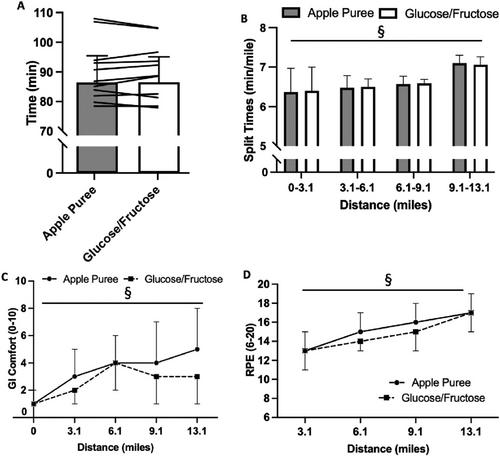
Carbohydrate supplementation during endurance exercise is known to improve performance, but the effects of food-based approaches in running exercise are understudied. Therefore, this study investigated the performance and gastrointestinal (GI) effects of a carbohydrate supplement containing a natural fructose source compared with a highly processed fructose source in a combined glucose-fructose supplement, during a half-marathon. Eleven trained runners (9 males, 2 females; age 32 ± 8 y, 89:53 ± 13:28 min half-marathon personal record) completed a familiarisation (8 miles) and two experimental trials (13.1 miles) on an outdoor running course, with blood and urine samples collected before and after the run. Subjective GI measures were made throughout the run. Carbohydrate was provided as a natural fructose source in the form of apple puree (AP) or highly processed crystalline fructose (GF) in a 2:1 glucose-to-fructose ratio (additional required glucose was provided through maltodextrin). Half-marathon performance was not different between carbohydrate sources (AP 89:52 ± 09:33 min, GF 88:44 ± 10:09 min; P = 0.684). There were no interaction effects for GI comfort (P = 0.305) or other GI symptoms (P ≥ 0.211). There were no differences between carbohydrate sources in ad libitum fluid intake (AP 409 ± 206 mL; GF 294 ± 149 mL; P = 0.094) or any other urinary (P ≥ 0.724), blood-based (P ≥ 0.215) or subjective (P ≥ 0.421) measures. Apple puree as a natural fructose source was equivalent to crystalline fructose in supporting half-marathon running performance without increasing GI symptoms.




 京公网安备 11010802042870号
京ICP备2023020795号-1
京公网安备 11010802042870号
京ICP备2023020795号-1

 分享
分享

 求助内容:
求助内容: 应助结果提醒方式:
 扫码关注我们
