John O. Osborne, Geoffrey M. Minett, Ian B. Stewart, Stewart Trost, Christopher Drovandi, Joseph T. Costello, Toby G. Pavey, David N. Borg
{"title":"热适应训练可能改变睡眠和附带活动的证据","authors":"John O. Osborne, Geoffrey M. Minett, Ian B. Stewart, Stewart Trost, Christopher Drovandi, Joseph T. Costello, Toby G. Pavey, David N. Borg","doi":"10.1080/17461391.2022.2124386","DOIUrl":null,"url":null,"abstract":"<div>\n \n <p>This randomized cross-over study tested the hypothesis that heat acclimation training would detrimentally affect sleep variables and alter incidental physical activity compared to a thermoneutral training control condition. Eight recreationally trained males (V̇O<sub>2peak</sub> 49±4.9 mL<sup>.</sup>kg<sup>-1.</sup>min<sup>-1</sup>) completed two separate interventions separated by at least 31 days: 5 consecutive day training blocks of moderate-intensity cycling (60 min·day<sup>-1</sup> at 50% peak power output) in a hot (34.9±0.7 °C and 53±4 % relative humidity) and a temperate (22.2±2.6 °C; 65±8 % relative humidity) environment. Wrist-mounted accelerometers were worn continuously for the length of the training blocks and recorded physical activity, sleep quality and quantity. Data were analysed in a Bayesian framework, with the results presented as the posterior probability that a coefficient was greater or less than zero. Compared to the temperate training environment, heat acclimation impaired sleep efficiency (Pr <i>β</i><0 = .979) and wake on sleep onset (Pr <i>β</i>>0 = .917). Daily sedentary time was, on average, 35 min longer (Pr <i>β</i>>0 = .973) and light physical activity time 18 min shorter (Pr <i>β</i>>0 = .960) during the heat acclimation period. No differences were observed between conditions in sleep duration, subjective sleep quality, or moderate or vigorous physical activity. These findings may suggest that athletes and coaches need to be cognisant that heat acclimation training may alter sleep quality and increase sedentary behaviour.</p>\n </div>","PeriodicalId":93999,"journal":{"name":"European journal of sport science","volume":"23 8","pages":"1731-1740"},"PeriodicalIF":3.0000,"publicationDate":"2022-10-10","publicationTypes":"Journal Article","fieldsOfStudy":null,"isOpenAccess":false,"openAccessPdf":"https://onlinelibrary.wiley.com/doi/epdf/10.1080/17461391.2022.2124386","citationCount":"0","resultStr":"{\"title\":\"Evidence that heat acclimation training may alter sleep and incidental activity\",\"authors\":\"John O. Osborne, Geoffrey M. Minett, Ian B. Stewart, Stewart Trost, Christopher Drovandi, Joseph T. Costello, Toby G. Pavey, David N. Borg\",\"doi\":\"10.1080/17461391.2022.2124386\",\"DOIUrl\":null,\"url\":null,\"abstract\":\"<div>\\n \\n <p>This randomized cross-over study tested the hypothesis that heat acclimation training would detrimentally affect sleep variables and alter incidental physical activity compared to a thermoneutral training control condition. Eight recreationally trained males (V̇O<sub>2peak</sub> 49±4.9 mL<sup>.</sup>kg<sup>-1.</sup>min<sup>-1</sup>) completed two separate interventions separated by at least 31 days: 5 consecutive day training blocks of moderate-intensity cycling (60 min·day<sup>-1</sup> at 50% peak power output) in a hot (34.9±0.7 °C and 53±4 % relative humidity) and a temperate (22.2±2.6 °C; 65±8 % relative humidity) environment. Wrist-mounted accelerometers were worn continuously for the length of the training blocks and recorded physical activity, sleep quality and quantity. Data were analysed in a Bayesian framework, with the results presented as the posterior probability that a coefficient was greater or less than zero. Compared to the temperate training environment, heat acclimation impaired sleep efficiency (Pr <i>β</i><0 = .979) and wake on sleep onset (Pr <i>β</i>>0 = .917). Daily sedentary time was, on average, 35 min longer (Pr <i>β</i>>0 = .973) and light physical activity time 18 min shorter (Pr <i>β</i>>0 = .960) during the heat acclimation period. No differences were observed between conditions in sleep duration, subjective sleep quality, or moderate or vigorous physical activity. These findings may suggest that athletes and coaches need to be cognisant that heat acclimation training may alter sleep quality and increase sedentary behaviour.</p>\\n </div>\",\"PeriodicalId\":93999,\"journal\":{\"name\":\"European journal of sport science\",\"volume\":\"23 8\",\"pages\":\"1731-1740\"},\"PeriodicalIF\":3.0000,\"publicationDate\":\"2022-10-10\",\"publicationTypes\":\"Journal Article\",\"fieldsOfStudy\":null,\"isOpenAccess\":false,\"openAccessPdf\":\"https://onlinelibrary.wiley.com/doi/epdf/10.1080/17461391.2022.2124386\",\"citationCount\":\"0\",\"resultStr\":null,\"platform\":\"Semanticscholar\",\"paperid\":null,\"PeriodicalName\":\"European journal of sport science\",\"FirstCategoryId\":\"1085\",\"ListUrlMain\":\"https://onlinelibrary.wiley.com/doi/10.1080/17461391.2022.2124386\",\"RegionNum\":0,\"RegionCategory\":null,\"ArticlePicture\":[],\"TitleCN\":null,\"AbstractTextCN\":null,\"PMCID\":null,\"EPubDate\":\"\",\"PubModel\":\"\",\"JCR\":\"\",\"JCRName\":\"\",\"Score\":null,\"Total\":0}","platform":"Semanticscholar","paperid":null,"PeriodicalName":"European journal of sport science","FirstCategoryId":"1085","ListUrlMain":"https://onlinelibrary.wiley.com/doi/10.1080/17461391.2022.2124386","RegionNum":0,"RegionCategory":null,"ArticlePicture":[],"TitleCN":null,"AbstractTextCN":null,"PMCID":null,"EPubDate":"","PubModel":"","JCR":"","JCRName":"","Score":null,"Total":0}
引用次数: 0
摘要
这项随机交叉研究验证了一个假设,即与热中性训练对照条件相比,热适应训练会对睡眠变量产生不利影响,并改变附带的身体活动。8只接受娱乐性训练的雄性小鼠(V²o2峰值为49±4.9 ml .kg-1 min-1)完成了至少间隔31天的两项独立干预:在高温环境(34.9±0.7°C和53±4%相对湿度)和温带环境(22.2±2.6°C;65±8%相对湿度)环境。在训练期间,连续佩戴腕上加速度计,记录身体活动、睡眠质量和睡眠时间。数据在贝叶斯框架中进行分析,结果显示为系数大于或小于零的后验概率。与温带训练环境相比,热驯化降低了睡眠效率(Pr β<0 = .979)和睡眠开始时的清醒(Pr β>0 = .917)。热驯化期平均每天久坐时间增加35 min (Pr β>0 = .973),轻度体力活动时间减少18 min (Pr β>0 = .960)。在睡眠持续时间、主观睡眠质量或中度或剧烈的体育活动方面,没有观察到不同条件之间的差异。这些发现可能表明,运动员和教练需要认识到,热适应训练可能会改变睡眠质量,增加久坐行为。
Evidence that heat acclimation training may alter sleep and incidental activity
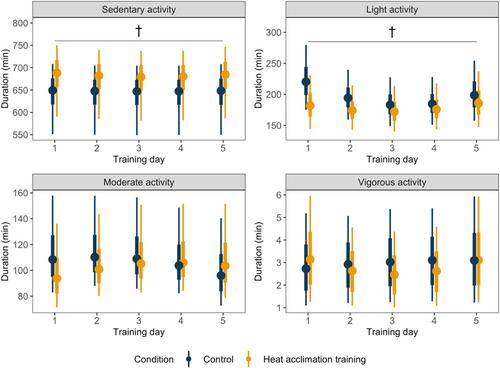
This randomized cross-over study tested the hypothesis that heat acclimation training would detrimentally affect sleep variables and alter incidental physical activity compared to a thermoneutral training control condition. Eight recreationally trained males (V̇O2peak 49±4.9 mL.kg-1.min-1) completed two separate interventions separated by at least 31 days: 5 consecutive day training blocks of moderate-intensity cycling (60 min·day-1 at 50% peak power output) in a hot (34.9±0.7 °C and 53±4 % relative humidity) and a temperate (22.2±2.6 °C; 65±8 % relative humidity) environment. Wrist-mounted accelerometers were worn continuously for the length of the training blocks and recorded physical activity, sleep quality and quantity. Data were analysed in a Bayesian framework, with the results presented as the posterior probability that a coefficient was greater or less than zero. Compared to the temperate training environment, heat acclimation impaired sleep efficiency (Pr β<0 = .979) and wake on sleep onset (Pr β>0 = .917). Daily sedentary time was, on average, 35 min longer (Pr β>0 = .973) and light physical activity time 18 min shorter (Pr β>0 = .960) during the heat acclimation period. No differences were observed between conditions in sleep duration, subjective sleep quality, or moderate or vigorous physical activity. These findings may suggest that athletes and coaches need to be cognisant that heat acclimation training may alter sleep quality and increase sedentary behaviour.




 京公网安备 11010802042870号
京ICP备2023020795号-1
京公网安备 11010802042870号
京ICP备2023020795号-1

 分享
分享

 求助内容:
求助内容: 应助结果提醒方式:
 扫码关注我们
