Lili Hu, Qingli Dong, Zhuosi Li, Yue Ma, Muhammad Zohaib Aslam, Yangtai Liu
{"title":"Modelling the Adhesion and Biofilm Formation Boundary of <i>Listeria monocytogenes</i> ST9.","authors":"Lili Hu, Qingli Dong, Zhuosi Li, Yue Ma, Muhammad Zohaib Aslam, Yangtai Liu","doi":"10.3390/foods11131940","DOIUrl":null,"url":null,"abstract":"<p><p>Listeria monocytogenes is a major foodborne pathogen that can adhere to or form a biofilm on food contact surfaces, depending on the environmental conditions. The purpose of this work is to determine the adhesion and biofilm formation boundaries for L. monocytogenes ST9 under the combination environments of temperature (5, 15, and 25 °C), NaCl concentration (0%, 3%, 6%, and 9% (w/v)) and pH (5.0, 6.0, 7.0, and 8.0). The probability models of adhesion and biofilm formation were built using the logistic regression. For adhesion, only the terms of linear T and NaCl are significant for L. monocytogenes ST9 (p < 0.05), whereas the terms of linear T, NaCl, and pH, and the interaction between T and pH were significant for biofilm formation (p < 0.05). By analyzing contour maps and their surface plots for two different states, we discovered that high temperature promoted adhesion and biofilm formation, whereas excessive NaCl concentration inhibited both of them. With a stringent threshold of 0.1667, the accuracy rate for identifying both adhesion/no-adhesion and biofilm formation/no-biofilm formation events were 0.929, indicating that the probability models are reasonably accurate in predicting the adhesion and biofilm formation boundary of L. monocytogenes ST9. The boundary model may provide a useful way for determining and further controlling L. monocytogenes adhesion and biofilm formation in various food processing environments.</p>","PeriodicalId":12386,"journal":{"name":"Foods","volume":"11 13","pages":""},"PeriodicalIF":5.1000,"publicationDate":"2022-06-29","publicationTypes":"Journal Article","fieldsOfStudy":null,"isOpenAccess":false,"openAccessPdf":"https://www.ncbi.nlm.nih.gov/pmc/articles/PMC9266252/pdf/","citationCount":"3","resultStr":null,"platform":"Semanticscholar","paperid":null,"PeriodicalName":"Foods","FirstCategoryId":"97","ListUrlMain":"https://doi.org/10.3390/foods11131940","RegionNum":2,"RegionCategory":"农林科学","ArticlePicture":[],"TitleCN":null,"AbstractTextCN":null,"PMCID":null,"EPubDate":"","PubModel":"","JCR":"Q1","JCRName":"FOOD SCIENCE & TECHNOLOGY","Score":null,"Total":0}
引用次数: 3
Abstract
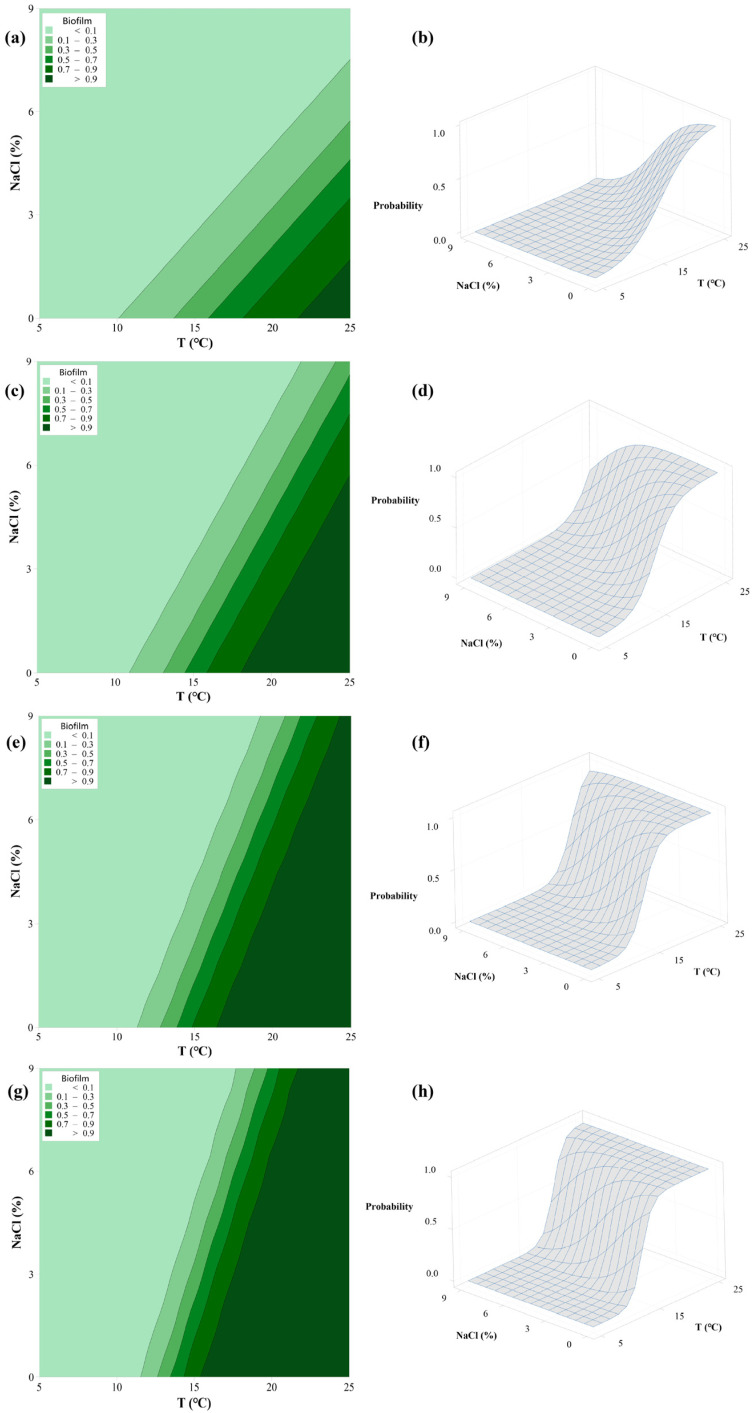
Listeria monocytogenes is a major foodborne pathogen that can adhere to or form a biofilm on food contact surfaces, depending on the environmental conditions. The purpose of this work is to determine the adhesion and biofilm formation boundaries for L. monocytogenes ST9 under the combination environments of temperature (5, 15, and 25 °C), NaCl concentration (0%, 3%, 6%, and 9% (w/v)) and pH (5.0, 6.0, 7.0, and 8.0). The probability models of adhesion and biofilm formation were built using the logistic regression. For adhesion, only the terms of linear T and NaCl are significant for L. monocytogenes ST9 (p < 0.05), whereas the terms of linear T, NaCl, and pH, and the interaction between T and pH were significant for biofilm formation (p < 0.05). By analyzing contour maps and their surface plots for two different states, we discovered that high temperature promoted adhesion and biofilm formation, whereas excessive NaCl concentration inhibited both of them. With a stringent threshold of 0.1667, the accuracy rate for identifying both adhesion/no-adhesion and biofilm formation/no-biofilm formation events were 0.929, indicating that the probability models are reasonably accurate in predicting the adhesion and biofilm formation boundary of L. monocytogenes ST9. The boundary model may provide a useful way for determining and further controlling L. monocytogenes adhesion and biofilm formation in various food processing environments.
期刊介绍:
Foods (ISSN 2304-8158) is an international, peer-reviewed scientific open access journal which provides an advanced forum for studies related to all aspects of food research. It publishes reviews, regular research papers and short communications. Our aim is to encourage scientists, researchers, and other food professionals to publish their experimental and theoretical results in as much detail as possible or share their knowledge with as much readers unlimitedly as possible. There is no restriction on the length of the papers. The full experimental details must be provided so that the results can be reproduced. There are, in addition, unique features of this journal:
manuscripts regarding research proposals and research ideas will be particularly welcomed
electronic files or software regarding the full details of the calculation and experimental procedure, if unable to be published in a normal way, can be deposited as supplementary material
we also accept manuscripts communicating to a broader audience with regard to research projects financed with public funds




 京公网安备 11010802042870号
京ICP备2023020795号-1
京公网安备 11010802042870号
京ICP备2023020795号-1

 分享
分享
 求助内容:
求助内容: 应助结果提醒方式:
 扫码关注我们
