{"title":"On Secondary Recycling of PVDF for 3D Printing of Functional Sensors: Mechanical, Flow, Thermal, and Dielectric Properties","authors":"Minhaz Husain, Rupinder Singh, B. S. Pabla","doi":"10.1007/s40009-023-01364-2","DOIUrl":null,"url":null,"abstract":"<div><p>Virgin polyvinylidene fluoride (PVDF) is widely used in numerous engineering and biomedical applications, hence requiring a scientific recycling solution to achieve the sustainable development goals of the United Nations. However, less has been stated on the effect of secondary (2°) recycling of PVDF to ensure the 3D printing of functional sensors. This study compares virgin and 2° recycled PVDF composite prepared by mechanical reinforcement (by wt.%) of 8% hydroxyapatite (HAp), and 2% chitosan (CS) with a single screw extruder (SSE) for the 3D printing of functional sensors. The 2° recycled PVDF composite was compared with virgin PVDF based on mechanical, flow, thermal, surface characteristics, and dielectric properties. The study outlines that 2° recycled PVDF composite may be used for the 3D printing of functional sensor prototypes with an improvement of Young’s modulus (E) (45%), viscosity (122.6%), and surface roughness (Ra) (6.79%) for the selected composition. However, the modulus of toughness (MOT) was significantly reduced (88.37%). Overall thermal and dielectric properties have shown little variation after 2° recycling.</p></div>","PeriodicalId":717,"journal":{"name":"National Academy Science Letters","volume":"47 4","pages":"385 - 390"},"PeriodicalIF":1.3000,"publicationDate":"2023-11-17","publicationTypes":"Journal Article","fieldsOfStudy":null,"isOpenAccess":false,"openAccessPdf":"","citationCount":"0","resultStr":null,"platform":"Semanticscholar","paperid":null,"PeriodicalName":"National Academy Science Letters","FirstCategoryId":"4","ListUrlMain":"https://link.springer.com/article/10.1007/s40009-023-01364-2","RegionNum":4,"RegionCategory":"综合性期刊","ArticlePicture":[],"TitleCN":null,"AbstractTextCN":null,"PMCID":null,"EPubDate":"","PubModel":"","JCR":"Q3","JCRName":"MULTIDISCIPLINARY SCIENCES","Score":null,"Total":0}
引用次数: 0
Abstract
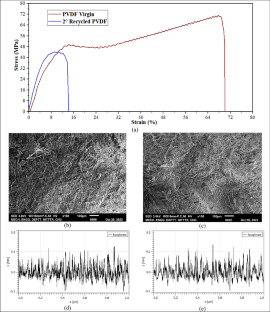
Virgin polyvinylidene fluoride (PVDF) is widely used in numerous engineering and biomedical applications, hence requiring a scientific recycling solution to achieve the sustainable development goals of the United Nations. However, less has been stated on the effect of secondary (2°) recycling of PVDF to ensure the 3D printing of functional sensors. This study compares virgin and 2° recycled PVDF composite prepared by mechanical reinforcement (by wt.%) of 8% hydroxyapatite (HAp), and 2% chitosan (CS) with a single screw extruder (SSE) for the 3D printing of functional sensors. The 2° recycled PVDF composite was compared with virgin PVDF based on mechanical, flow, thermal, surface characteristics, and dielectric properties. The study outlines that 2° recycled PVDF composite may be used for the 3D printing of functional sensor prototypes with an improvement of Young’s modulus (E) (45%), viscosity (122.6%), and surface roughness (Ra) (6.79%) for the selected composition. However, the modulus of toughness (MOT) was significantly reduced (88.37%). Overall thermal and dielectric properties have shown little variation after 2° recycling.
期刊介绍:
The National Academy Science Letters is published by the National Academy of Sciences, India, since 1978. The publication of this unique journal was started with a view to give quick and wide publicity to the innovations in all fields of science




 京公网安备 11010802042870号
京ICP备2023020795号-1
京公网安备 11010802042870号
京ICP备2023020795号-1

 分享
分享
 求助内容:
求助内容: 应助结果提醒方式:
 扫码关注我们
