He Xu , Hao You , Jixing Gong , Ying Zhang , Jianyong Du , Xinyu Wang , Shanshan Gu , Nan Cao , Jia Wang
{"title":"Discovery of Zidovudine as a cardiomyocyte protectant for doxorubicin-induced toxicity through high-throughput phenotypic drug screening","authors":"He Xu , Hao You , Jixing Gong , Ying Zhang , Jianyong Du , Xinyu Wang , Shanshan Gu , Nan Cao , Jia Wang","doi":"10.1016/j.fmre.2023.10.010","DOIUrl":null,"url":null,"abstract":"<div><div>Doxorubicin (DOX) constitutes a cornerstone in cancer chemotherapy, yet its administration is associated with dose-dependent toxicity to the heart, known as doxorubicin-induced cardiotoxicity (DOX-IC). Presently, dexrazoxane stands as the sole approved drug for mitigating DOX-IC; however, its clinical application is restricted due to concerns over severe adversary effects. It is therefore urgent to discover alternative drug candidates to ameliorate DOX-IC. Here, we report the discovery of Zidovudine (ZIDO), a clinically available anti-retroviral medication, as a potent candidate to protect against DOX-IC both <em>in vitro</em> and <em>in vivo</em> by high-throughput phenotypic screening of a library of 1804 Food and Drug Administration (FDA)-approved drugs. Transcriptomic analysis reveals that ZIDO treatment significantly alleviates DOX-induced dysregulation of genes associated with cardiac function and proteotoxic stress. This study sets a paradigm towards discovering novel cardiac protective drugs through repurposing and establishes ZIDO as an agent holding promise for the treatment of DOX-IC patients.</div></div>","PeriodicalId":34602,"journal":{"name":"Fundamental Research","volume":"6 2","pages":"Pages 885-894"},"PeriodicalIF":6.3000,"publicationDate":"2026-03-01","publicationTypes":"Journal Article","fieldsOfStudy":null,"isOpenAccess":false,"openAccessPdf":"","citationCount":"0","resultStr":null,"platform":"Semanticscholar","paperid":null,"PeriodicalName":"Fundamental Research","FirstCategoryId":"1085","ListUrlMain":"https://www.sciencedirect.com/science/article/pii/S2667325823002996","RegionNum":3,"RegionCategory":"综合性期刊","ArticlePicture":[],"TitleCN":null,"AbstractTextCN":null,"PMCID":null,"EPubDate":"2023/11/19 0:00:00","PubModel":"Epub","JCR":"Q1","JCRName":"Multidisciplinary","Score":null,"Total":0}
引用次数: 0
Abstract
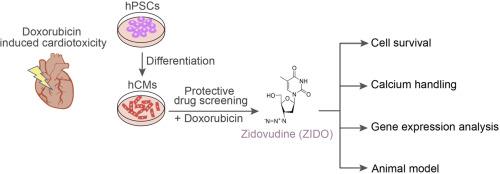
Doxorubicin (DOX) constitutes a cornerstone in cancer chemotherapy, yet its administration is associated with dose-dependent toxicity to the heart, known as doxorubicin-induced cardiotoxicity (DOX-IC). Presently, dexrazoxane stands as the sole approved drug for mitigating DOX-IC; however, its clinical application is restricted due to concerns over severe adversary effects. It is therefore urgent to discover alternative drug candidates to ameliorate DOX-IC. Here, we report the discovery of Zidovudine (ZIDO), a clinically available anti-retroviral medication, as a potent candidate to protect against DOX-IC both in vitro and in vivo by high-throughput phenotypic screening of a library of 1804 Food and Drug Administration (FDA)-approved drugs. Transcriptomic analysis reveals that ZIDO treatment significantly alleviates DOX-induced dysregulation of genes associated with cardiac function and proteotoxic stress. This study sets a paradigm towards discovering novel cardiac protective drugs through repurposing and establishes ZIDO as an agent holding promise for the treatment of DOX-IC patients.




 京公网安备 11010802042870号
京ICP备2023020795号-1
京公网安备 11010802042870号
京ICP备2023020795号-1

 分享
分享
 求助内容:
求助内容: 应助结果提醒方式:
 扫码关注我们
