Distributed scheduling for multi-energy synergy system considering renewable energy generations and plug-in electric vehicles: A level-based coupled optimization method
Linxin Zhang , Zhile Yang , Qinge Xiao , Yuanjun Guo , Zuobin Ying , Tianyu Hu , Xiandong Xu , Sohail Khan , Kang Li
{"title":"Distributed scheduling for multi-energy synergy system considering renewable energy generations and plug-in electric vehicles: A level-based coupled optimization method","authors":"Linxin Zhang , Zhile Yang , Qinge Xiao , Yuanjun Guo , Zuobin Ying , Tianyu Hu , Xiandong Xu , Sohail Khan , Kang Li","doi":"10.1016/j.egyai.2024.100340","DOIUrl":null,"url":null,"abstract":"<div><p>Multi-energy synergy systems integrating high-penetration large-scale plug-in electric vehicles, distributed renewable energy generations, and battery energy storage systems have great potential to reduce the reliance of the grid on traditional fossil fuels. However, the random charging characteristics of plug-in electric vehicles and the uncertainty of photovoltaics may impose an additional burden on the grid and affect the supply–demand equilibrium. To address this issue, judicious scheduling optimization offers an effective solution. In this study, considering charge and discharge management of plug-in electric vehicles and intermittent photovoltaics, a novel Multi-energy synergy systems scheduling framework is developed for solving grid instability and unreliability issues. This formulates a large-scale mixed-integer problem, which calls for a powerful and effective optimizer. The new binary level-based learning optimization algorithm is proposed to address nonlinear large-scale high-coupling unit commitment problems. To investigate the feasibility of the proposed scheme, numerical experiments have been carried out considering multiple scales of unit numbers and various scenarios. Finally, the results confirm that the proposed scheduling framework is reasonable and effective in solving unit commitment problems, can achieve 3.3% cost reduction and demonstrates superior performance in handling large-scale energy optimization problems. The integration of plug-in electric vehicles, distributed renewable energy generations, and battery energy storage systems is verified to reduce the output power of 192.72 MW units during peak periods to improve grid stability. Therefore, optimizing energy utilization and distribution will become an indispensable part of future power systems.</p></div>","PeriodicalId":34138,"journal":{"name":"Energy and AI","volume":"16 ","pages":"Article 100340"},"PeriodicalIF":9.6000,"publicationDate":"2024-05-01","publicationTypes":"Journal Article","fieldsOfStudy":null,"isOpenAccess":false,"openAccessPdf":"https://www.sciencedirect.com/science/article/pii/S2666546824000065/pdfft?md5=cee087e55c3070dc2f888171637184e4&pid=1-s2.0-S2666546824000065-main.pdf","citationCount":"0","resultStr":null,"platform":"Semanticscholar","paperid":null,"PeriodicalName":"Energy and AI","FirstCategoryId":"1085","ListUrlMain":"https://www.sciencedirect.com/science/article/pii/S2666546824000065","RegionNum":0,"RegionCategory":null,"ArticlePicture":[],"TitleCN":null,"AbstractTextCN":null,"PMCID":null,"EPubDate":"2024/1/20 0:00:00","PubModel":"Epub","JCR":"Q1","JCRName":"COMPUTER SCIENCE, ARTIFICIAL INTELLIGENCE","Score":null,"Total":0}
引用次数: 0
Abstract
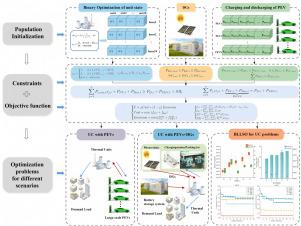
Multi-energy synergy systems integrating high-penetration large-scale plug-in electric vehicles, distributed renewable energy generations, and battery energy storage systems have great potential to reduce the reliance of the grid on traditional fossil fuels. However, the random charging characteristics of plug-in electric vehicles and the uncertainty of photovoltaics may impose an additional burden on the grid and affect the supply–demand equilibrium. To address this issue, judicious scheduling optimization offers an effective solution. In this study, considering charge and discharge management of plug-in electric vehicles and intermittent photovoltaics, a novel Multi-energy synergy systems scheduling framework is developed for solving grid instability and unreliability issues. This formulates a large-scale mixed-integer problem, which calls for a powerful and effective optimizer. The new binary level-based learning optimization algorithm is proposed to address nonlinear large-scale high-coupling unit commitment problems. To investigate the feasibility of the proposed scheme, numerical experiments have been carried out considering multiple scales of unit numbers and various scenarios. Finally, the results confirm that the proposed scheduling framework is reasonable and effective in solving unit commitment problems, can achieve 3.3% cost reduction and demonstrates superior performance in handling large-scale energy optimization problems. The integration of plug-in electric vehicles, distributed renewable energy generations, and battery energy storage systems is verified to reduce the output power of 192.72 MW units during peak periods to improve grid stability. Therefore, optimizing energy utilization and distribution will become an indispensable part of future power systems.




 京公网安备 11010802042870号
京ICP备2023020795号-1
京公网安备 11010802042870号
京ICP备2023020795号-1

 分享
分享
 求助内容:
求助内容: 应助结果提醒方式:
 扫码关注我们
