{"title":"Enhancing non-Newtonian gravity constraint using a levitated pendulum in vacuum","authors":"Fang Xiong , Leilei Guo , Pu Huang , Xiaowen Gao , Zhiming Chen , Xunmin Zhu , Tong Wu , Huizhu Hu","doi":"10.1016/j.fmre.2023.12.008","DOIUrl":null,"url":null,"abstract":"<div><div>The detection of non-Newtonian gravity is crucial for fundamental physics research and our understanding of dark energy. However, conducting an experiment that provides explicit evidence of its existence remains an endeavour. We propose an experiment utilizing a diamagnetically levitated pendulum in vacuum to detect non-Newtonian gravity on a micrometer scale. The pendulum configuration effectively helps to shield electromagnetic force fluctuations in the vacuum levitation system. The structural parameters of the pendulum are intentionally optimized to enhance the constraint on the non-Newtonian gravity strength <span><math><mi>α</mi></math></span>. The designed pendulum can be stably levitated in the diamagnetic trap thanks to its passive levitation mechanism. By conducting resonance force measurements at room temperature for a duration of <span><math><msup><mn>10</mn><mn>4</mn></msup></math></span> s, we anticipate a significant improvement in the constraint on the non-Newtonian gravity strength (<span><math><mrow><mi>α</mi><mo>≥</mo><mn>28</mn></mrow></math></span>) within the force range of <span><math><mrow><mi>λ</mi><mo>=</mo><mn>7.6</mn></mrow></math></span> µm. This represents an enhancement of over three orders of magnitude compared to the current limit. This study presents a promising tool for investigating short-range forces and exploring frontier physics in tabletop laboratory.</div></div>","PeriodicalId":34602,"journal":{"name":"Fundamental Research","volume":"6 1","pages":"Pages 141-148"},"PeriodicalIF":6.3000,"publicationDate":"2026-01-01","publicationTypes":"Journal Article","fieldsOfStudy":null,"isOpenAccess":false,"openAccessPdf":"","citationCount":"0","resultStr":null,"platform":"Semanticscholar","paperid":null,"PeriodicalName":"Fundamental Research","FirstCategoryId":"1085","ListUrlMain":"https://www.sciencedirect.com/science/article/pii/S2667325824000086","RegionNum":3,"RegionCategory":"综合性期刊","ArticlePicture":[],"TitleCN":null,"AbstractTextCN":null,"PMCID":null,"EPubDate":"2024/1/12 0:00:00","PubModel":"Epub","JCR":"Q1","JCRName":"Multidisciplinary","Score":null,"Total":0}
引用次数: 0
Abstract
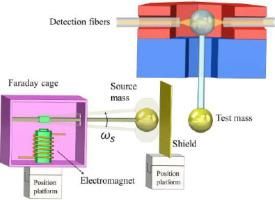
The detection of non-Newtonian gravity is crucial for fundamental physics research and our understanding of dark energy. However, conducting an experiment that provides explicit evidence of its existence remains an endeavour. We propose an experiment utilizing a diamagnetically levitated pendulum in vacuum to detect non-Newtonian gravity on a micrometer scale. The pendulum configuration effectively helps to shield electromagnetic force fluctuations in the vacuum levitation system. The structural parameters of the pendulum are intentionally optimized to enhance the constraint on the non-Newtonian gravity strength . The designed pendulum can be stably levitated in the diamagnetic trap thanks to its passive levitation mechanism. By conducting resonance force measurements at room temperature for a duration of s, we anticipate a significant improvement in the constraint on the non-Newtonian gravity strength () within the force range of µm. This represents an enhancement of over three orders of magnitude compared to the current limit. This study presents a promising tool for investigating short-range forces and exploring frontier physics in tabletop laboratory.





 京公网安备 11010802042870号
京ICP备2023020795号-1
京公网安备 11010802042870号
京ICP备2023020795号-1

 分享
分享
 求助内容:
求助内容: 应助结果提醒方式:
 扫码关注我们
