{"title":"Simultaneous Degradation, Dehalogenation, and Detoxification of Halogenated Antibiotics by Carbon Dioxide Radical Anions","authors":"","doi":"10.1016/j.eng.2024.03.006","DOIUrl":null,"url":null,"abstract":"<div><p>Despite the extensive application of advanced oxidation processes (AOPs) in water treatment, the efficiency of AOPs in eliminating various emerging contaminants such as halogenated antibiotics is constrained by a number of factors. Halogen moieties exhibit strong resistance to oxidative radicals, affecting the dehalogenation and detoxification efficiencies. To address these limitations of AOPs, advanced reduction processes (ARPs) have been proposed. Herein, a novel nucleophilic reductant—namely, the carbon dioxide radical anion (CO<sub>2</sub><sup><img>−</sup>)—is introduced for the simultaneous degradation, dehalogenation, and detoxification of florfenicol (FF), a typical halogenated antibiotic. The results demonstrate that FF is completely eliminated by CO<sub>2</sub><sup><img>−</sup>, with approximately 100% of Cl<sup>−</sup> and 46% of F<sup>−</sup> released after 120 min of treatment. Simultaneous detoxification is observed, which exhibits a linear response to the release of free inorganic halogen ions (<em>R<sup>2</sup></em> = 0.97, <em>p</em> < 0.01). The formation of halogen-free products is the primary reason for the superior detoxification performance of this method, in comparison with conventional hydroxyl-radical-based AOPs. Products identification and density functional theory (DFT) calculations reveal the underlying dehalogenation mechanism, in which the chlorine moiety of FF is more susceptible than other moieties to nucleophilic attack by CO<sub>2</sub><sup><img>−</sup>. Moreover, CO<sub>2</sub><sup><img>−</sup>-based ARPs exhibit superior dehalogenation efficiencies (> 75%) in degrading a series of halogenated antibiotics, including chloramphenicol (CAP), thiamphenicol (THA), diclofenac (DLF), triclosan (TCS), and ciprofloxacin (CIP). The system shows high tolerance to the pH of the solution and the presence of natural water constituents, and demonstrates an excellent degradation performance in actual groundwater, indicating the strong application potential of CO<sub>2</sub><sup><img>−</sup>-based ARPs in real life. Overall, this study elucidates the feasibility of CO<sub>2</sub><sup><img>−</sup> for the simultaneous degradation, dehalogenation, and detoxification of halogenated antibiotics and provides a promising method for their regulation during water or wastewater treatment.</p></div>","PeriodicalId":11783,"journal":{"name":"Engineering","volume":"37 ","pages":"Pages 78-86"},"PeriodicalIF":11.6000,"publicationDate":"2024-06-01","publicationTypes":"Journal Article","fieldsOfStudy":null,"isOpenAccess":false,"openAccessPdf":"https://www.sciencedirect.com/science/article/pii/S2095809924001486/pdfft?md5=424bf764f97198f8faec9cbb620fe2bb&pid=1-s2.0-S2095809924001486-main.pdf","citationCount":"0","resultStr":null,"platform":"Semanticscholar","paperid":null,"PeriodicalName":"Engineering","FirstCategoryId":"5","ListUrlMain":"https://www.sciencedirect.com/science/article/pii/S2095809924001486","RegionNum":1,"RegionCategory":"工程技术","ArticlePicture":[],"TitleCN":null,"AbstractTextCN":null,"PMCID":null,"EPubDate":"2024/3/27 0:00:00","PubModel":"Epub","JCR":"Q1","JCRName":"ENGINEERING, MULTIDISCIPLINARY","Score":null,"Total":0}
引用次数: 0
Abstract
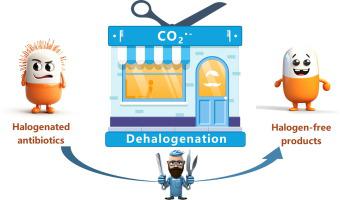
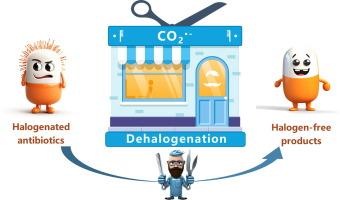
Despite the extensive application of advanced oxidation processes (AOPs) in water treatment, the efficiency of AOPs in eliminating various emerging contaminants such as halogenated antibiotics is constrained by a number of factors. Halogen moieties exhibit strong resistance to oxidative radicals, affecting the dehalogenation and detoxification efficiencies. To address these limitations of AOPs, advanced reduction processes (ARPs) have been proposed. Herein, a novel nucleophilic reductant—namely, the carbon dioxide radical anion (CO2−)—is introduced for the simultaneous degradation, dehalogenation, and detoxification of florfenicol (FF), a typical halogenated antibiotic. The results demonstrate that FF is completely eliminated by CO2−, with approximately 100% of Cl− and 46% of F− released after 120 min of treatment. Simultaneous detoxification is observed, which exhibits a linear response to the release of free inorganic halogen ions (R2 = 0.97, p < 0.01). The formation of halogen-free products is the primary reason for the superior detoxification performance of this method, in comparison with conventional hydroxyl-radical-based AOPs. Products identification and density functional theory (DFT) calculations reveal the underlying dehalogenation mechanism, in which the chlorine moiety of FF is more susceptible than other moieties to nucleophilic attack by CO2−. Moreover, CO2−-based ARPs exhibit superior dehalogenation efficiencies (> 75%) in degrading a series of halogenated antibiotics, including chloramphenicol (CAP), thiamphenicol (THA), diclofenac (DLF), triclosan (TCS), and ciprofloxacin (CIP). The system shows high tolerance to the pH of the solution and the presence of natural water constituents, and demonstrates an excellent degradation performance in actual groundwater, indicating the strong application potential of CO2−-based ARPs in real life. Overall, this study elucidates the feasibility of CO2− for the simultaneous degradation, dehalogenation, and detoxification of halogenated antibiotics and provides a promising method for their regulation during water or wastewater treatment.
期刊介绍:
Engineering, an international open-access journal initiated by the Chinese Academy of Engineering (CAE) in 2015, serves as a distinguished platform for disseminating cutting-edge advancements in engineering R&D, sharing major research outputs, and highlighting key achievements worldwide. The journal's objectives encompass reporting progress in engineering science, fostering discussions on hot topics, addressing areas of interest, challenges, and prospects in engineering development, while considering human and environmental well-being and ethics in engineering. It aims to inspire breakthroughs and innovations with profound economic and social significance, propelling them to advanced international standards and transforming them into a new productive force. Ultimately, this endeavor seeks to bring about positive changes globally, benefit humanity, and shape a new future.



 京公网安备 11010802042870号
京ICP备2023020795号-1
京公网安备 11010802042870号
京ICP备2023020795号-1

 分享
分享
 求助内容:
求助内容: 应助结果提醒方式:
 扫码关注我们
