{"title":"Nanocellulose as a Novel Cryoprotectant to Improve the Quality of Frozen Sour Cherries","authors":"Esra Gençdağ, Ahmet Görgüç, Fatih Mehmet Yılmaz","doi":"10.1007/s11947-024-03404-1","DOIUrl":null,"url":null,"abstract":"<div><p>Recent studies suggest that nanocelluloses may help protect frozen foods’ structure, thereby preserving quality parameters during storage. This study examined the impact of nanocellulose treatment on the frozen quality of sour cherries. Nanocellulose produced from pistachio hull was incorporated into sour cherries using vacuum impregnation, and its cryoprotective role was assessed using three different freezing techniques: static, air-blast, and individual quick frozen (IQF). Multivariate analysis of variance (MANOVA) demonstrated the interactive effects of the parameters. During 6 months of storage, nanocellulose pretreatment resulted in significantly lower drip loss, ion leakage, and color difference while retaining high levels of anthocyanin content and antioxidant capacity compared to the non-treated group. Texture analysis also showed that using nanocellulose could compensate for the disadvantage of slow freezing. Pectin methylesterase (PME) activity values fitted to 2nd order kinetic, and the highest residuals were determined in static freezing. Strong correlations (<i>P</i> < 0.01) were found between drip loss and color difference (<i>r</i> = 0.662), hardness and ion leakage (<i>r</i> = 0.605), and color difference and <i>a</i><sub>w</sub> values (<i>r</i> = 0.628).</p><h3>Graphical Abstract</h3><div><figure><div><div><picture><source><img></source></picture></div></div></figure></div></div>","PeriodicalId":562,"journal":{"name":"Food and Bioprocess Technology","volume":"17 12","pages":"4724 - 4738"},"PeriodicalIF":5.8000,"publicationDate":"2024-04-23","publicationTypes":"Journal Article","fieldsOfStudy":null,"isOpenAccess":false,"openAccessPdf":"https://link.springer.com/content/pdf/10.1007/s11947-024-03404-1.pdf","citationCount":"0","resultStr":null,"platform":"Semanticscholar","paperid":null,"PeriodicalName":"Food and Bioprocess Technology","FirstCategoryId":"97","ListUrlMain":"https://link.springer.com/article/10.1007/s11947-024-03404-1","RegionNum":2,"RegionCategory":"农林科学","ArticlePicture":[],"TitleCN":null,"AbstractTextCN":null,"PMCID":null,"EPubDate":"","PubModel":"","JCR":"Q1","JCRName":"FOOD SCIENCE & TECHNOLOGY","Score":null,"Total":0}
引用次数: 0
Abstract
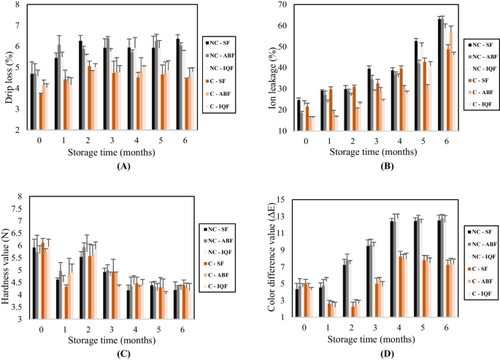
Recent studies suggest that nanocelluloses may help protect frozen foods’ structure, thereby preserving quality parameters during storage. This study examined the impact of nanocellulose treatment on the frozen quality of sour cherries. Nanocellulose produced from pistachio hull was incorporated into sour cherries using vacuum impregnation, and its cryoprotective role was assessed using three different freezing techniques: static, air-blast, and individual quick frozen (IQF). Multivariate analysis of variance (MANOVA) demonstrated the interactive effects of the parameters. During 6 months of storage, nanocellulose pretreatment resulted in significantly lower drip loss, ion leakage, and color difference while retaining high levels of anthocyanin content and antioxidant capacity compared to the non-treated group. Texture analysis also showed that using nanocellulose could compensate for the disadvantage of slow freezing. Pectin methylesterase (PME) activity values fitted to 2nd order kinetic, and the highest residuals were determined in static freezing. Strong correlations (P < 0.01) were found between drip loss and color difference (r = 0.662), hardness and ion leakage (r = 0.605), and color difference and aw values (r = 0.628).
期刊介绍:
Food and Bioprocess Technology provides an effective and timely platform for cutting-edge high quality original papers in the engineering and science of all types of food processing technologies, from the original food supply source to the consumer’s dinner table. It aims to be a leading international journal for the multidisciplinary agri-food research community.
The journal focuses especially on experimental or theoretical research findings that have the potential for helping the agri-food industry to improve process efficiency, enhance product quality and, extend shelf-life of fresh and processed agri-food products. The editors present critical reviews on new perspectives to established processes, innovative and emerging technologies, and trends and future research in food and bioproducts processing. The journal also publishes short communications for rapidly disseminating preliminary results, letters to the Editor on recent developments and controversy, and book reviews.



 京公网安备 11010802042870号
京ICP备2023020795号-1
京公网安备 11010802042870号
京ICP备2023020795号-1

 分享
分享
 求助内容:
求助内容: 应助结果提醒方式:
 扫码关注我们
