{"title":"Conjugation prepared by wet-Maillard reactions improves the stability and properties of lutein and lycopene loaded nanoparticles","authors":"Tugba Dursun Capar, Hasan Yalcin","doi":"10.1007/s13197-024-05976-4","DOIUrl":null,"url":null,"abstract":"<div><p>In this study, lutein and lycopene were encapsulated in plant protein (faba bean protein concentrate, (FPC))-carrageenan (Car) conjugates prepared by Maillard reaction in an aqueous media. The conjugation improved encapsulation yield that reached to 82.69% and 93.07%, for lycopene and lutein, respectively. The mean particle diameters for lutein loaded nanoparticles observed smaller in FPC-Car conjugates (66.60 nm) than FPC (71.49 nm). Scanning electron microscopy images showed that FPC-Car conjugates were more spherical and no fractures or fissures on the surface, revealing that wall materials provided better protection and retention for core materials. The diameter of lycopene nanoparticles coated with FPC remained constant between pH 3–4 and 7–9 but increased to 220 nm at pH 4–6. Even though the diameter of lutein nanoparticles coated with FPC remains steady between pH 5 and 9, increased to 953 nm at pH 3. The bioaccessibility of the lutein or lycopene samples encapsulated by FPC were found as higher than FPC-Car conjugates. These findings suggest that protein-polysaccharide conjugates could be used as a wall material to encapsulate lipophilic lutein and lycopene in order to improve their stability, property and bioaccessibility. As a result, FPC-Car conjugates may be an alternative for the formation of functional beverages as well as other nutraceutical products.</p><h3>Graphical abstract</h3><div><figure><div><div><picture><source><img></source></picture></div></div></figure></div></div>","PeriodicalId":632,"journal":{"name":"Journal of Food Science and Technology","volume":"61 10","pages":"2008 - 2019"},"PeriodicalIF":2.7010,"publicationDate":"2024-04-07","publicationTypes":"Journal Article","fieldsOfStudy":null,"isOpenAccess":false,"openAccessPdf":"https://link.springer.com/content/pdf/10.1007/s13197-024-05976-4.pdf","citationCount":"0","resultStr":null,"platform":"Semanticscholar","paperid":null,"PeriodicalName":"Journal of Food Science and Technology","FirstCategoryId":"1","ListUrlMain":"https://link.springer.com/article/10.1007/s13197-024-05976-4","RegionNum":0,"RegionCategory":null,"ArticlePicture":[],"TitleCN":null,"AbstractTextCN":null,"PMCID":null,"EPubDate":"","PubModel":"","JCR":"","JCRName":"","Score":null,"Total":0}
引用次数: 0
Abstract
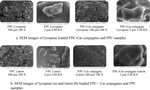
In this study, lutein and lycopene were encapsulated in plant protein (faba bean protein concentrate, (FPC))-carrageenan (Car) conjugates prepared by Maillard reaction in an aqueous media. The conjugation improved encapsulation yield that reached to 82.69% and 93.07%, for lycopene and lutein, respectively. The mean particle diameters for lutein loaded nanoparticles observed smaller in FPC-Car conjugates (66.60 nm) than FPC (71.49 nm). Scanning electron microscopy images showed that FPC-Car conjugates were more spherical and no fractures or fissures on the surface, revealing that wall materials provided better protection and retention for core materials. The diameter of lycopene nanoparticles coated with FPC remained constant between pH 3–4 and 7–9 but increased to 220 nm at pH 4–6. Even though the diameter of lutein nanoparticles coated with FPC remains steady between pH 5 and 9, increased to 953 nm at pH 3. The bioaccessibility of the lutein or lycopene samples encapsulated by FPC were found as higher than FPC-Car conjugates. These findings suggest that protein-polysaccharide conjugates could be used as a wall material to encapsulate lipophilic lutein and lycopene in order to improve their stability, property and bioaccessibility. As a result, FPC-Car conjugates may be an alternative for the formation of functional beverages as well as other nutraceutical products.
期刊介绍:
The Journal of Food Science and Technology (JFST) is the official publication of the Association of Food Scientists and Technologists of India (AFSTI). This monthly publishes peer-reviewed research papers and reviews in all branches of science, technology, packaging and engineering of foods and food products. Special emphasis is given to fundamental and applied research findings that have potential for enhancing product quality, extend shelf life of fresh and processed food products and improve process efficiency. Critical reviews on new perspectives in food handling and processing, innovative and emerging technologies and trends and future research in food products and food industry byproducts are also welcome. The journal also publishes book reviews relevant to all aspects of food science, technology and engineering.



 京公网安备 11010802042870号
京ICP备2023020795号-1
京公网安备 11010802042870号
京ICP备2023020795号-1

 分享
分享
 求助内容:
求助内容: 应助结果提醒方式:
 扫码关注我们
