{"title":"Differential Behavioral Pathways Linking Personality to Leadership Emergence and Effectiveness in Groups.","authors":"Tobias M Härtel, Felix Hoch, Mitja D Back","doi":"10.1177/01461672241246388","DOIUrl":null,"url":null,"abstract":"<p><p>This study integrates leadership process models with process models of personality and behavioral personality science to examine the behavioral-perceptual pathways that explain interpersonal personality traits' divergent relation to group leadership evaluations. We applied data from an online group interaction study (<i>N</i> = 364) alternately assigning participants as leaders conducting brief tasks. We used four variable types to build the pathways in multiple mediator models: (a) Self-reported personality traits, (b) video recordings of expressed interpersonal behaviors coded by 6 trained raters, (c) interpersonal impressions, and (d) mutual evaluations of leadership emergence/effectiveness. We find interpersonal big five traits to differently relate to the two leadership outcomes via the behavioral-perceptual pathways: Extraversion was more important to leadership emergence due to impressions of assertiveness evoked by task-focused behavior being strongly valued. Agreeableness/emotional stability were more important to leadership effectiveness due to impressions of trustworthiness/calmness evoked by member-focused/calm behavior being stronger valued.</p>","PeriodicalId":19834,"journal":{"name":"Personality and Social Psychology Bulletin","volume":" ","pages":"2166-2182"},"PeriodicalIF":2.9000,"publicationDate":"2025-11-01","publicationTypes":"Journal Article","fieldsOfStudy":null,"isOpenAccess":false,"openAccessPdf":"https://www.ncbi.nlm.nih.gov/pmc/articles/PMC12446710/pdf/","citationCount":"0","resultStr":null,"platform":"Semanticscholar","paperid":null,"PeriodicalName":"Personality and Social Psychology Bulletin","FirstCategoryId":"102","ListUrlMain":"https://doi.org/10.1177/01461672241246388","RegionNum":2,"RegionCategory":"心理学","ArticlePicture":[],"TitleCN":null,"AbstractTextCN":null,"PMCID":null,"EPubDate":"2024/4/24 0:00:00","PubModel":"Epub","JCR":"Q1","JCRName":"PSYCHOLOGY, SOCIAL","Score":null,"Total":0}
引用次数: 0
Abstract
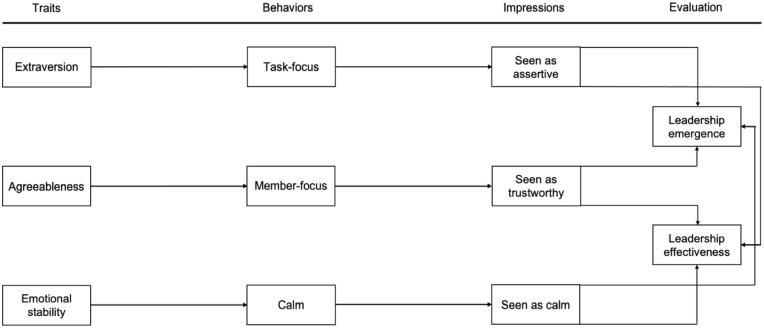
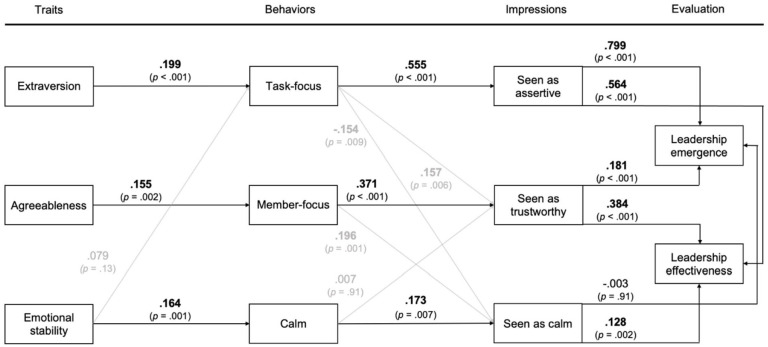
This study integrates leadership process models with process models of personality and behavioral personality science to examine the behavioral-perceptual pathways that explain interpersonal personality traits' divergent relation to group leadership evaluations. We applied data from an online group interaction study (N = 364) alternately assigning participants as leaders conducting brief tasks. We used four variable types to build the pathways in multiple mediator models: (a) Self-reported personality traits, (b) video recordings of expressed interpersonal behaviors coded by 6 trained raters, (c) interpersonal impressions, and (d) mutual evaluations of leadership emergence/effectiveness. We find interpersonal big five traits to differently relate to the two leadership outcomes via the behavioral-perceptual pathways: Extraversion was more important to leadership emergence due to impressions of assertiveness evoked by task-focused behavior being strongly valued. Agreeableness/emotional stability were more important to leadership effectiveness due to impressions of trustworthiness/calmness evoked by member-focused/calm behavior being stronger valued.
期刊介绍:
The Personality and Social Psychology Bulletin is the official journal for the Society of Personality and Social Psychology. The journal is an international outlet for original empirical papers in all areas of personality and social psychology.






 京公网安备 11010802042870号
京ICP备2023020795号-1
京公网安备 11010802042870号
京ICP备2023020795号-1

 分享
分享
 求助内容:
求助内容: 应助结果提醒方式:
 扫码关注我们
